 IC Markets

 3:09
 2:39
 2:10
 2:18
 3:43
 8:42
























 WriterAbir KhanWriterWrites the guides · checks every figure against primary sources View profileAbout Abir →

 Market analysisTanbir Habib RiyadForex & Crypto AnalystForex and crypto analyst · technical and fundamental analysis View profileAbout Tanbir →

 Fact-checking & riskJannatul FerdaushFact-Checker & Risk AnalystFact-checks every figure · risk analysis · Applied Statistics, University of Dhaka View profileAbout Jannatul →

 Trading reviewJowel RanaForex TraderForex trader · reviews guides from a trader's view View profileAbout Jowel →

 Final approvalRanjan N. MondolForex TraderForex trader · signs off every guide View profileAbout Ranjan →


Exness
XM

IC Markets

LiteFinance

FP Markets

AvaTrade

Octa

RoboForex
Disclosure: "Visit Broker" links are partner (affiliate) links. FX Recap may earn a commission at no cost to you. Trading involves significant risk of loss. T&Cs apply.
Top-tier copy trading platforms in 2026 feature advanced software that automatically mirrors, allocating capital proportionally to a chosen strategy provider who executes trades on your behalf. Copy trading links your account to a leader and replicates their positions without you having to manage every trade manually.
Financial markets are dynamic and they demand discipline. Many traders struggle with emotion, timing, or analysis. A structured copy trading environment bridges educational gaps, eliminates execution latency, and grants direct access to. That said, this tool still needs to be used with discipline, not blind faith.
This guide outlines the mechanics of copy trading, how the leading platforms compare, the fundamental parameters to analyze prior to deploying capital, and the risk-management habits of successful disciplined users from those who lose money.
Understanding Copy Trading Mechanics
Copy trading represents a highly technical social trading infrastructure. Structurally, you select a verified strategy manager, assign funds, and your account automatically replicates that trader’s activity in real time. Replicated trading activities encompass opening, modifying, scaling, or liquidating market exposures, usually with risk controls such as stop losses adjusted proportionately to your account size. This setup acts as a guided execution system linked directly to a seasoned strategist.
Copy trading imitates real-time human decisions or certified strategy rules. It does not guarantee profitable returns. For most traders, copy trading operates most effectively as an execution shortcut paired with education, and the real benefit comes from combining it with careful risk evaluation and diversified allocation decisions. You retain full ownership of your account and can pause or stop copied trades at any point.
How It Differs from Related Products
Traders frequently conflate three distinct industry products but they describe different products. Trade signals deliver market alerts, leaving the manual execution and timing decisions entirely to you whether to act. Mirror trading copies algorithmic strategies with no live human decision-making involved. Copy trading imitates real-time human decisions or certified strategy rules, with proportional replication based on your allocated capital.
The distinction matters when you assess drawdowns or review provider track records. Live strategists can adjust their risk parameters from their stated approach as market conditions shift; an algorithm cannot.
Watch this on video
Copy Trading Explained, in 2:08
Copy trading explained: every trade is copied, including losses. What to check before you copy anyone.
Why Copy Trading Has Grown in 2026?
Market data shows that traders are placing more emphasis on collective wisdom rather than personal expertise. Global social trading networks like eToro support millions of active participants, with copy systems acting as the primary driver users stay engaged.
One factor is accessibility. Aspiring market participants can engage with financial markets without first mastering technical analysis to participate in markets. Another is diversification: instead of following a single signal, many users now allocate across multiple strategies and spread their risk. At the same time, professional traders occasionally use copy trading to explore new markets or experiment in a structured setting, duplicating an equity strategy, for example, while focusing their own attention on Forex execution.
The evolution of platform technology is also a factor. Modern social platforms utilize proprietary machine-learning risk scores, sentiment analytics, and user reviews into their provider ranking systems, tools that simply were not available at the retail level a few years ago. Copy trading has become part of diversified retail trading portfolios, not simply a novelty.
What Makes a Platform Worth Using?
Copy trading platforms differ significantly in their performance tracking and risk management environments with the same experience or level of protection. prior to funding an account, there are five areas worth considering closely.
Liability and Reliability
Operating via tier-one regulated brokerages minimizes counterparty risk and guarantees carry lower risk of fraud and mismanagement. Select platforms authorized by the FCA (UK), ASIC (Australia), CySEC (Cyprus), CBI (Ireland), or comparable tier-one bodies. Regulatory standing does not guarantee profit, but it substantially reduces counterparty risk and creates a proper mechanism for dispute resolution.
Provider History Transparency
Reliable copy networks provide transparent, historical performance parameters, drawdowns, trade history, and risk metrics rather than headline returns alone. Short-term gains lacking long-term tracking are insufficient metrics for selecting a provider.
Control Over Allocations
The ability to dynamically adjust your capital allocation, pause mid-copy, or set stop limits is important. Platforms that lock you into copying without clear exit options create unnecessary exposure.
Community and Analytics
Robust community feeds and analytical filters filter out volatile or unverified strategies experienced providers from noise. The quality of these tools varies considerably across platforms, so check what is actually available before registering.
Costs and Fee Structures
Copy trading cost structures can include monthly subscription charges, performance-based profit shares, or widened spreads. Prior understanding of these costs shields you from discovering real costs only after capital is committed. Read the full fee schedule before allocating.
Best Copy Trading Platforms for 2026: Comparison Table
The table below covers the platforms FX Recap has assessed based on verified regulatory standing, asset coverage, provider transparency, and the quality of risk and social tools available to users. Minimum deposit figures should be confirmed directly with each broker, as these are subject to change.
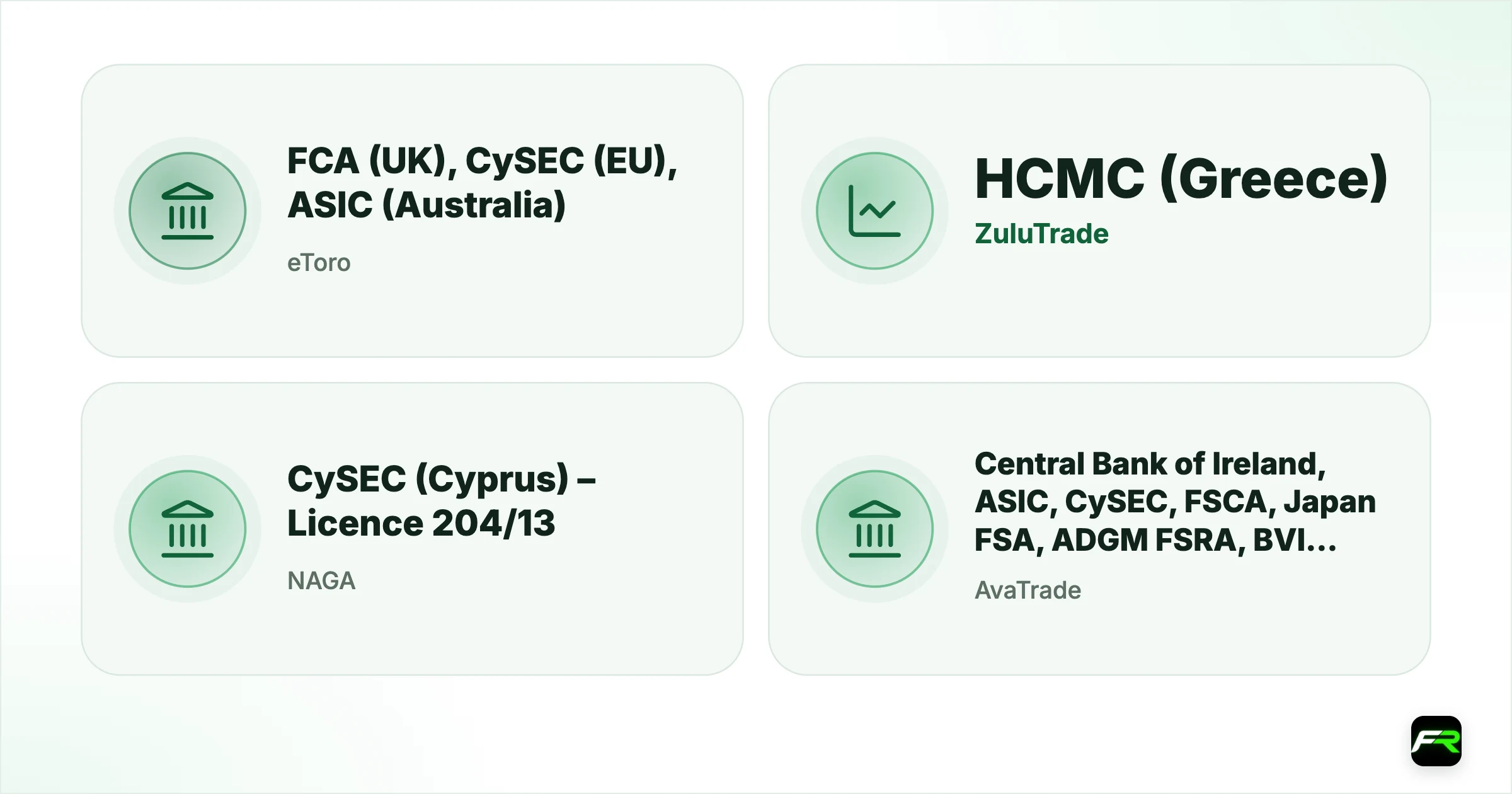
| Platform | Regulation | Assets | Core Feature | Min. Deposit | Overview |
| eToro | FCA (UK), CySEC (EU), ASIC (Australia) | Forex, Stocks, Crypto, ETFs | Popular Investor programme with tier-based provider rewards | USD 200 to copy a trader | Industry benchmark with millions of users. Strong provider filtering by risk score, drawdown, and activity history. |
| ZuluTrade | HCMC (Greece) | Forex, CFDs, Stocks, Crypto CFDs, Commodities | ZuluRank scoring plus ZuluGuard risk control | Broker-dependent | Copy layer that connects to partner brokers. ZuluRank scores providers by performance and drawdown consistency. |
| NAGA | CySEC (Cyprus) – Licence 204/13 | Forex, Stocks, Crypto, ETFs, Commodities | Social feed integrated with Autocopy | Check with NAGA | Merges community interaction with copy execution. Listed on Frankfurt Stock Exchange. |
| AvaTrade | Central Bank of Ireland, ASIC, CySEC, FSCA, Japan FSA, ADGM FSRA, BVI FSC, CMA Kenya, ISA | Forex, CFDs, Crypto, Stocks, ETFs | AvaSocial, DupliTrade and ZuluTrade | USD 100 | Licensed by nine regulators. Copy access through AvaSocial, DupliTrade and ZuluTrade. |
| Myfxbook AutoTrade | Broker-agnostic (connects to regulated partner brokers) | Forex | Third-party verified trade history via Myfxbook analytics | Broker-dependent | Best for data-focused traders. Provider performance independently verified before copying begins. |
Regulation data is cross-referenced with each broker’s official disclosure page and the respective regulator’s public register. It remains essential to cross-check regulatory licensing numbers directly with official public registries.
Top Platform Profiles
eToro
Regulation: FCA (eToro (UK) Ltd, FRN 583263), CySEC (eToro (Europe) Ltd, licence 109/10), ASIC (eToro AUS Capital Limited, AFSL 491139) and the FSA in Seychelles (SD076). eToro says its European company was granted a MiCA licence by CySEC in January 2025, covering crypto-asset trading and custody across the European Economic Area.
Operating as a pioneer in the social trading sector, eToro. Its Popular Investor programme utilizes a multi-tiered compensation framework where top providers earn additional income based on follower volume, incentivising sustainable performance rather than short-term positioning. Strategy search tools filter by risk score, asset class, gain history, drawdown, and tenure. The built-in social feed shows providers’ market commentary alongside their trade activity, adding context that purely data-driven platforms lack. Asset coverage spans Forex, stocks, ETFs, and crypto.
ZuluTrade
Regulation: ZuluTrade’s site says its service is regulated by the Hellenic Capital Market Commission in Greece, under licence 2/540/17.2.2010. The protection you get also depends on the broker your account sits with.
ZuluTrade is a copy layer that connects to partner brokers and is not a broker itself. Its ZuluRank system scores providers on performance, consistency and drawdown, and ZuluGuard can stop copying a provider whose trading departs from their usual pattern.
NAGA
Regulation: NAGA Markets Europe LTD is authorised and regulated by CySEC under licence 204/13. The group also has companies regulated in South Africa (FSCA), Abu Dhabi (ADGM) and Seychelles (FSA). NAGA is a trademark of The NAGA Group AG, which is listed on the Frankfurt Stock Exchange.
NAGA structurally integrates community networking with automated trade replication. Its Autocopy function is integrated with a social feed, so users can see what top traders are discussing alongside which positions they hold. Coverage spans Forex, stocks, ETFs, crypto, and commodities. The community interaction layer adds decision context that data-only platforms do not provide.
AvaTrade
Regulation: Central Bank of Ireland (C53877), ASIC (406684), CySEC (347/17), FSCA (45984), Japan FSA (1662), ADGM FSRA (190018), BVI FSC (SIBA/L/13/1049), CMA Kenya (262) and the Israel Securities Authority.
AvaTrade’s companies are licensed by nine regulators. Copy trading is available through its own AvaSocial app and through DupliTrade and ZuluTrade. The minimum deposit is USD 100.
Services That Have Closed
Two services that used to appear in this list are no longer available. Exness says its Copy Trading service stopped taking new strategies and investments, and that all existing ones were closed on 25 June 2026. FXTM’s website no longer lists FXTM Invest among its platforms or accounts.
If you used either one, check your account area for any remaining balance and contact the broker’s support if something is missing.
Myfxbook AutoTrade
Regulation: Myfxbook AutoTrade acts strictly as a software-as-a-service provider, integrating with licensed brokerages. It operates through regulated partner brokers. Regulatory protection for your funds depends entirely on the partnered broker you use.
The primary strength of Myfxbook AutoTrade lies in the depth of independently verified data it presents for each provider. Because Myfxbook’s analytics platform already tracks trader performance through third-party verification, the statistics displayed for AutoTrade providers are among the most data-rich available at retail level. Coverage is focused on Forex. For traders who base provider selection on statistical evidence rather than community reputation, this is a strong fit.
Risk Management in Copy Trading
Copy trading does not remove risk. When a provider enters a poor trade, your account mirrors that loss proportionally. Managing this exposure requires the same discipline as any other form of market participation.
Diversifying your capital among several providers, rather than concentrating everything behind one, is the most straightforward way to reduce vulnerability. Poor short-term performance by a single strategist should not pull down your entire allocation. Most platforms also let you set a maximum drawdown threshold on each copied allocation, after which copying pauses or stops automatically. Using this feature on every allocation, without exception, is one of the most practical controls available.
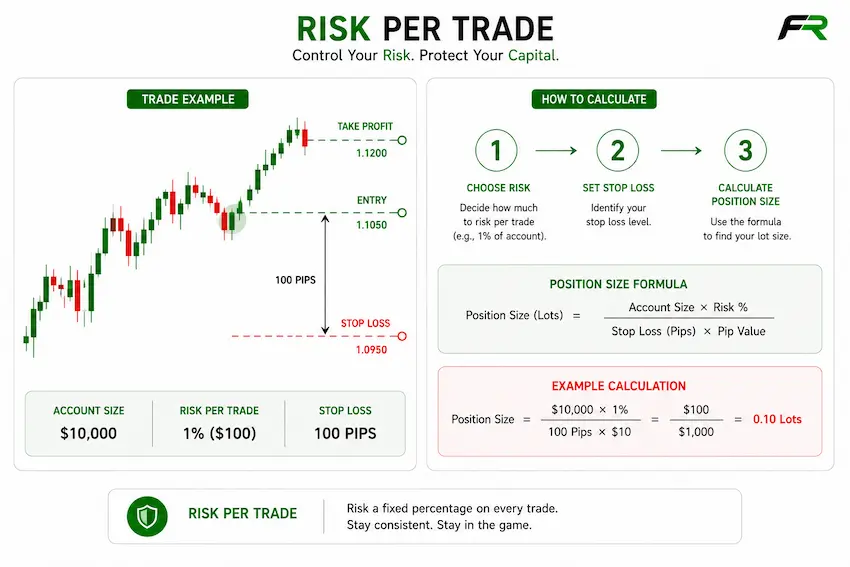
The metrics you assess matter as much as the controls you set. A provider with a 40% annual return and three 20% drawdowns is a very different risk proposition from one delivering 25% annually with a maximum 7% drawdown. Drawdown behaviour is more predictive of long-term stability than gross gains, and a long, consistent tenure across different market conditions is more informative than strong recent performance alone.
Macro events are worth watching regardless of which providers you follow. Central bank decisions, inflation data, and geopolitical developments can affect all positions simultaneously. A provider with a solid track record in calm conditions may still perform poorly through sudden volatility. Staying aware of the economic calendar protects you from being caught off-guard by market-wide moves that hit every copied position at once.
Reading a Provider Profile
Most platforms display a version of these metrics for each signal provider, and each one reveals something specific. Win rate tells you the percentage of trades closed at a profit, but a high win rate paired with a high drawdown often means the provider is holding losing trades open for extended periods, a pattern that carries significant hidden risk. Maximum drawdown is the largest peak-to-trough loss in the provider’s history and is the most honest indicator of worst-case exposure.
Historical tenure is vital because a six-month track record with strong numbers tells you far less than three years of consistent data across varying market conditions. Trade frequency indicates how often the provider is active. High-frequency providers generate more data points but also accumulate spread and commission costs, while lower-frequency providers may be more selective but are statistically harder to assess. Risk score, where platforms assign one, is a useful starting filter based on volatility, drawdown, and leverage use, but it is not a substitute for examining the full performance history directly
Getting Started: A Practical Sequence
The systematic onboarding sequence copy traders follow when starting with a new platform or provider:
- Select a regulated platform. Use the comparison table above as a starting point. Verify regulatory status directly on the relevant regulator’s public register, not only on the broker’s own website.
- Study provider metrics before committing. Look at win rate, maximum drawdown, tenure, and trade frequency across at least twelve months. Recency alone is not sufficient.
- Begin with a minimal capital deployment. Test a provider with a minor portion of your intended capital. Observe how it performs over two to four weeks before adding more.
- Apply risk controls immediately. Set a maximum drawdown stop on every copied allocation before the first trade is replicated. Do not skip this step.
- review account performance weekly and optimize monthly. Daily monitoring tends to produce reactive decisions. Weekly checks give enough information to detect problems without overreacting to normal short-term volatility.
- Rebalance when provider behaviour changes. If a provider’s drawdown pattern, trade frequency, or consistency shifts from their historical profile, reduce or stop the allocation. Market conditions evolve, and so do individual traders.
What Experienced Traders Have Learned
Traders who have used copy platforms for more than a year tend to reach the same conclusion: social copy systems operate best as learning resources to observe and learn from, not a passive income button.
Providers who perform consistently across different market phases tend to have clear, repeatable approaches rather than fortunate short-term positioning. Identifying this requires reading more than the returns column. The traders who struggle most are those who copy without tracking what is happening, or who switch providers at the first sign of a drawdown. Both habits undermine what copy trading can genuinely offer.
The most effective approach is treating copy trading as one component of a broader strategy, not a replacement for market awareness or personal risk management.
FAQs
Is copy trading legal?
Yes, copy trading is legal in most jurisdictions when conducted through a properly regulated platform. The legal standing of your account depends on the regulations governing the platform’s entity and your country of residence. Always verify the platform holds a recognised licence before depositing funds.
Can I lose money with copy trading?
Yes. Copy trading carries the same market risk as any other form of trading. Your account is exposed to the losses of whoever you follow, in proportion to your allocation. The risk is real and can exceed your initial expectation if the provider uses high leverage or trades through volatile conditions.
How much capital do I need to start?
Minimum amounts vary by platform. eToro’s minimum amount to copy a trader is USD 200. Other platforms set their own minimums, and services that run through a partner broker follow that broker’s minimum deposit. The starting amount matters less than making sure you are not allocating more than you can afford to hold at risk during an unfavourable period.
What is the difference between copy trading and a managed account?
Copy trading preserves your full ownership of the account. You can stop, pause, or exit any copied position at any time. A managed account typically involves granting a third party discretionary control over your funds, which carries different legal and regulatory implications. Copy trading gives you more direct oversight and transparency over what is happening with your capital.
What fees are involved?
Fee structures vary considerably. Some platforms take a performance share from profitable trades. Others build their margin into the spread. Some charge subscription or premium feature fees. Myfxbook AutoTrade charges depend on the partnered broker. Calculate the total effective cost before selecting a platform, not just the headline rate.
How do I select a reliable provider?
Focus on drawdown history, tenure, and consistency across different market periods rather than headline returns. A provider with a long, steady record and controlled drawdowns across varied conditions is a more reliable selection than one with high recent gains and no prior history. Use the platform’s risk score as an initial filter, then review the full performance profile before committing capital.
Final Notes from FX Recap
The platforms reviewed here offer real utility for traders at multiple experience levels. They remove some of the technical barriers to market participation and give you access to strategy providers you would otherwise have no way to track.
That access comes with responsibility. While the platform automates trade execution, you remain fully responsible for capital allocation, portfolio diversification, and maximum drawdown limits.
Before opening any copy position, decide how much capital you are genuinely prepared to put at risk. Set drawdown limits on every allocation from day one. Review performance against your own risk appetite, not solely against a provider’s historical returns.
Copy trading is a tool. Applied with attention, it fills real gaps in execution experience and market exposure. Applied carelessly, it simply passes your losses to someone else’s decisions.
 United Kingdom
 Brazil
 China
 India
 Indonesia
 Japan
 Malaysia
 Nepal
 Pakistan
 Philippines
 Singapore
 South Africa
 Sri Lanka
 Thailand
 Vietnam


Your capital is at risk. FX Recap rates brokers available in each country on regulation, trading conditions and user trust. How we rank
 XM: accounts from a $5 depositXM from $5AdT&Cs apply. Your capital is at risk.T&Cs apply · Capital at riskVisit XM