 IC Markets

 3:09
 2:39
 2:10
 2:18
 3:43
 8:42




































Prop Firm Rules Compared: A Side-by-Side
The rules that pass or fail you, laid out across the main firms. Read down the columns for the constraint that matches how you trade.
 WriterAbir KhanWriterWrites the guides · checks every figure against primary sources View profileAbout Abir →

 Market analysisTanbir Habib RiyadForex & Crypto AnalystForex and crypto analyst · technical and fundamental analysis View profileAbout Tanbir →

 Fact-checking & riskJannatul FerdaushFact-Checker & Risk AnalystFact-checks every figure · risk analysis · Applied Statistics, University of Dhaka View profileAbout Jannatul →

 Trading reviewJowel RanaForex TraderForex trader · reviews guides from a trader's view View profileAbout Jowel →

 Final approvalRanjan N. MondolForex TraderForex trader · signs off every guide View profileAbout Ranjan →

Every firm's marketing leads with the profit split. The rules that actually decide whether you keep an account are the daily loss limit, the type of drawdown, the consistency rule, and what you are allowed to trade. This page puts those side by side for the firms that come up most, as of 2026. Terms change often, so treat it as a shortlist to verify, not a fixed reference.
Forex and CFD firms
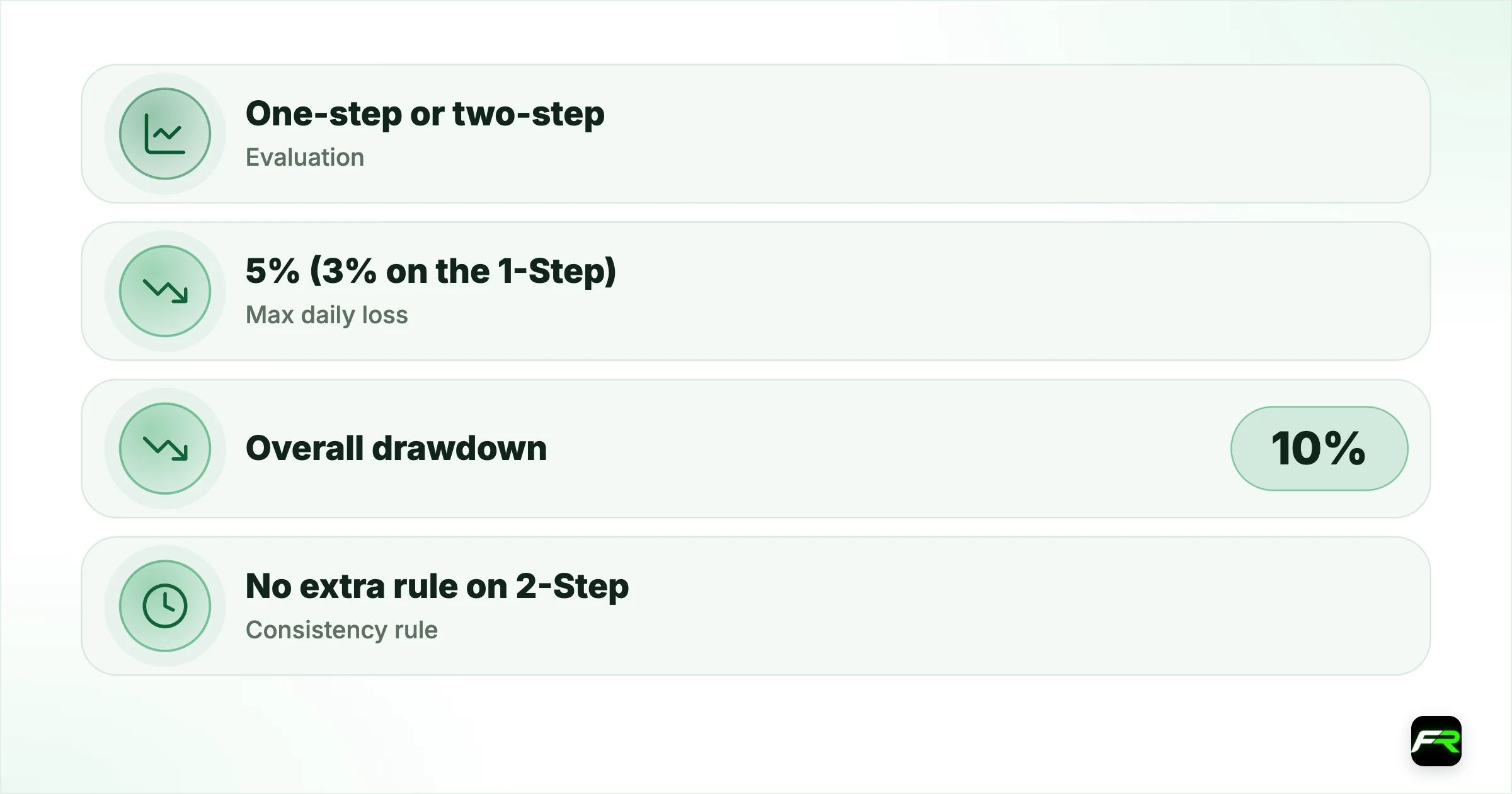
| Rule | FTMO | FundedNext | The5ers |
|---|---|---|---|
| Evaluation | One-step or two-step | One-step, two-step, instant | 1-Step, 2-Step (High Stakes), 3-Step (Bootcamp) |
| Max daily loss | 5% (3% on the 1-Step) | Varies by plan | 3% on the 1-Step; varies by plan |
| Overall drawdown | 10% | Varies by plan | 6% on the 1-Step; varies by plan |
| Consistency rule | No extra rule on 2-Step; Best Day Rule on 1-Step | Varies by model | 50% per day on the 1-Step |
| News / scalping / EAs | Allowed | Allowed | Allowed |
| Reward share | Up to 90% | Up to 95% | 75% on the 1-Step; varies by plan |
Watch this on video
The rules
From our lesson "Prop Firm Challenges Explained" (Forex basics, part 9). This part starts at 0:33 of the 2:34 video and plays in a large player.
Futures firms
| Rule | Topstep | MyFundedFutures | Tradeify |
|---|---|---|---|
| Evaluation | Trading Combine, then Express Funded | Evaluation, then Sim Funded | Evaluation or instant funding |
| Drawdown type | Maximum Loss Limit (see its parameters) | End-of-day trailing; intraday on Rapid | End-of-day trailing |
| Consistency rule | 55% target in the Combine; 40% on the Consistency payout path | None on Pro once funded; 50% on some plans | 40 to 50% on evaluation; none once funded |
| Payout days | 5 winning days of $150+, or 3 days on the Consistency path | Every 48 hours, or daily on Rapid | Daily or every 5 days, by plan |
| Pricing | Monthly subscription (Combine) | One-time payment, no renewals | One-time payment |
| Profit split | 90/10 | 80/20 or 90/10, by plan | Check the plan |
A firm with no consistency rule often runs a tighter trailing drawdown, and a firm with a generous drawdown often adds a consistency rule. You are choosing which constraint to live with, not avoiding all of them.
Reading the table for your style
- News or breakout trader: avoid a consistency rule. FTMO on forex, MyFundedFutures Pro on futures.
- Steady intraday scalper: a consistency rule barely matters. Choose on drawdown type and payout speed instead.
- Swing trader holding overnight: check the overnight and weekend holding rules first, then the drawdown.
- Slow, low-frequency trader: plans with a generous daily loss limit and a fixed drawdown suit you; futures firms with trailing drawdown do not.
- Cost-sensitive: Tradeify's one-time fee beats a subscription if you expect to take several months; the reverse if you pass quickly.
The individual guides go deeper: the trailing drawdown guide, the consistency rule guide, and the daily loss limit guide.
Traders pick a firm on the split and the price, then get failed by a drawdown rule they never read. Spend the twenty minutes to map your own trading against the four rules that matter, because the right firm is the one whose constraints you would have followed anyway.
How to read a rules comparison
- Find the rows that decide your trading: daily loss, maximum loss and its type, consistency.
- Compare the same plan type across firms, not a one-step at one firm with a two-step at another.
- Check the funded-stage rules, which can differ from the evaluation.
- Confirm every figure on the firm’s own site, because rules change.
The rules that differ most
| Rule | Range we have seen | Why it matters |
|---|---|---|
| Daily loss limit | None to 5% (or a fixed dollar amount on futures) | Decides how bad a day can be |
| Maximum loss | 6% to 10%, static or trailing | Decides how much room you have overall |
| Consistency | None to 20–55% caps | Decides whether one big day helps or hurts |
| Minimum days | None to 5 per phase | Decides the fastest possible pass |
| Payout timing | On demand to every 14–21 days | Decides how soon you are paid |
Rules that look similar but are not
- A 10 per cent static floor and a 10 per cent trailing floor give very different room after a winning run.
- A 5 per cent daily limit tested on equity, including open trades, is stricter than one tested only on closed balance.
- A consistency rule in the evaluation and one on payouts affect different stages.
Two plans both list 5 per cent daily and 10 per cent maximum loss. One measures the maximum loss from the starting balance; the other trails the end-of-day balance. After a trader reaches $106,000 and gives back $5,000, the first plan has $11,000 of room left and the second only $5,000.
Key terms
| Term | Meaning |
|---|---|
| Evaluation rules | The rules during the challenge |
| Funded-stage rules | The rules after passing, which can differ |
| Fixed-dollar limit | A loss limit stated in dollars, common on futures plans |
| Soft limit | A limit that pauses trading rather than failing the account |
Related guides
For the firms and rules in this table, see these guides.
- FTMO review: rules, payouts and who it suits.
- FundedNext review: four CFD routes, futures and rewards.
- Topstep review: the futures benchmark, from its own pages.
- Futures prop firms compared: Topstep, FundedNext Futures, MyFundedFutures and Tradeify.
The short version
Compare like with like: the same plan type, the funded-stage rules as well as the evaluation, and the type of each limit as well as its size. Then confirm every figure on the firm’s own site on the day you buy.
Cite this guide
FX Recap, "Prop Firm Rules Compared: A Side-by-Side", updated 9 September 2026, https://fxrecap.com/prop-trading/prop-firm-rules-compared
Free to quote with a link. Journalists: data and comment in our press room.
Frequently asked
Which prop firm has the easiest rules?
There is no single easiest firm, because firms trade one lenient rule for a stricter one. A firm with no consistency rule usually has a tighter trailing drawdown; a firm with a generous drawdown usually adds a consistency rule. The easiest firm for you is the one whose constraints match how you already trade.
What prop firm rules matter most?
The maximum daily loss, the type of overall drawdown (fixed or trailing), the consistency rule, and any limit on what you can trade or how much you can risk per trade. The profit split, which the marketing leads with, decides how much you keep but not whether you keep the account.
Do prop firms allow news trading and EAs?
Most of the major forex firms allow news trading, scalping and your own EAs. Commercial or copied strategies shared across many accounts are usually banned. Some funded plans restrict trading in a short window around high-impact news. Check the specific plan, because this varies by account type within the same firm.
What is the max risk per trade rule?
Some firms cap how much of the account you can risk on a single position. Where it exists it is separate from the daily loss limit, so a wide stop on a volatile instrument can breach it even if the trade is small in your own terms. Check the firm's Trading Objectives for the plan you buy.
Which prop firm rules differ most?
The type of maximum loss (static or trailing), the daily loss limit, consistency rules, minimum trading days and payout timing.
Are two plans with the same percentages the same?
Not necessarily. Whether the maximum loss is static or trailing, and what the daily limit is measured from, can make plans with identical percentages very different.
Related reading
The team behind this guide
Researched, checked and approved by five forex specialists
Every guide is written, fact-checked and edited before it goes live, and updated when the facts change. Spotted an error? Tell us.