 IC Markets

 3:09
 2:39
 2:10
 2:18
 3:43
 8:42




































Last updated
This tool is for education and planning only and is not financial advice. Forex and CFD trading carries a high risk of losing money rapidly due to leverage. Check your broker's own contract specifications, fees and margin rules before you trade.
Watch this on video
The position size formula
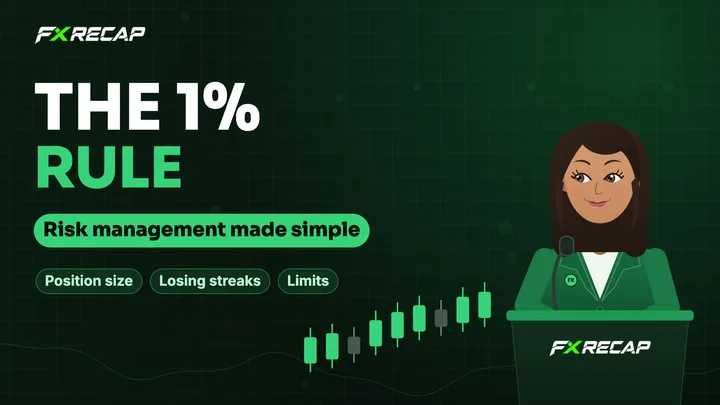
From our lesson "The 1% Rule" (Forex basics, part 4). This part starts at 0:28 of the 2:10 video and plays in a large player.
What is position sizing?
Position sizing means choosing how many lots to trade so that, if your stop-loss is hit, you lose a planned amount and no more. It is the link between your analysis, which sets the stop, and your account, which sets the risk.
This calculator works from prices rather than pips: enter where you would buy or sell and where the trade is proven wrong, and it measures the stop for you. For a quicker version that takes the stop in pips, use the lot size calculator.
The position size formula
- Money at risk
Balance × risk %, or a fixed amount. $10,000 at 1% is $100.
- Stop distance in pips
|entry − stop| ÷ pip size. Entry 1.1000, stop 1.0970 = 30 pips.
- Lots
$100 ÷ (30 × $10) = 0.333, rounded down to 0.33 lots, or 33,000 units.
- Check the margin
33,000 EUR at 1.1000 is $36,300 of currency. At 1:30 leverage that needs about $1,210 of margin.
Choosing your risk percentage
On a $10,000 account with a 30-pip stop on EUR/USD:
| Risk per trade | Money at risk | Position | After 10 losses in a row |
|---|---|---|---|
| 0.5% | $50 | 0.16 lots | about $9,511 |
| 1% | $100 | 0.33 lots | about $9,044 |
| 2% | $200 | 0.66 lots | about $8,171 |
| 5% | $500 | 1.66 lots | about $5,987 |
Why the stop decides the size
Wider stop, smaller position
Doubling the stop from 30 to 60 pips halves the position for the same $100 risk.
Put the stop where the idea fails
Set the stop from the chart, not from how many lots you want to trade.
Never widen it later
Moving the stop after sizing turns a planned loss into a bigger one.
Before every trade
- Risk set as a fixed share of the account
- Stop placed where the trade idea is wrong
- Position size worked out and rounded down
- Margin checked against your free margin
- No big news due before you plan to exit
Position Size Calculator FAQs
What is position sizing in forex trading?
Choosing how many lots to trade so that a stop-out costs a planned amount, usually a small percentage of the account.
How do I calculate forex position size?
Money at risk ÷ (stop distance in pips × pip value per lot). With $100 at risk and a 30-pip stop on EUR/USD: 100 ÷ (30 × 10) = 0.33 lots.
What percentage of my account should I risk per trade?
Many traders risk 0.5% to 2%. Lower risk means a losing streak does less damage while you learn.
Why does position size change depending on the stop-loss distance?
Because the money at risk is fixed. A stop twice as far away needs half the position to keep the same loss.
Does pip value differ between currency pairs?
Yes. Pairs quoted in USD are $10 per pip per lot in a USD account; yen and cross pairs depend on exchange rates, which the calculator includes.
What is the difference between fixed lot sizing and fixed risk sizing?
Fixed lots keep the size the same and let the risk vary; fixed risk keeps the money at risk the same and changes the size.
What is the minimum position size at most forex brokers?
Usually 0.01 lots, a micro lot of 1,000 units. Some cent accounts allow smaller sizes.
Sources: European Central Bank: euro reference rates, ESMA: CFD product intervention measures.