 IC Markets

 3:09
 2:39
 2:10
 2:18
 3:43
 8:42












Last updated
This page is general information, not legal advice. Rules change and can depend on your residency, the product and the broker entity. Check with the regulator in your country before opening an account. CFDs are complex instruments and carry a high risk of losing money rapidly due to leverage.
Forex legality by country
| Country | Status | Regulator | Key rules |
|---|---|---|---|
| IndiaAsia | Limited | SEBI, RBI | Currency derivatives on NSE or BSE through SEBI-registered brokers are legal. Offshore margin forex is not a permitted use of the LRS, and the RBI Alert List names unauthorised platforms. |
| PakistanAsia | No licence | SECP, SBP | No retail forex broker is licensed; currency futures trade on PMEX. The SECP warns against unauthorised platforms and the SBP restricts funding abroad. |
| BangladeshAsia | Not permitted | Bangladesh Bank | Residents may not send money abroad for margin trading under the Foreign Exchange Regulation Act, 1947. No local broker is licensed. |
| Sri LankaAsia | Not permitted | Central Bank of Sri Lanka | CBSL notices state that leveraged forex through electronic platforms is not permitted and outward remittance for it is not allowed. |
| NepalAsia | Not permitted | Nepal Rastra Bank | Nepal Rastra Bank public notices state that online forex trading by Nepali citizens is illegal. |
| ChinaAsia | Limited | PBOC, SAFE, NFRA | Spot currency exchange at licensed banks within the USD 50,000 annual quota is legal. Leveraged forex margin trading has been prohibited since 2008. |
| Hong KongAsia | RegulatedLeverage cap 1:20 | SFC | Leveraged forex requires an SFC Type 3 licence; retail leverage is capped at 20:1. |
| JapanAsia | RegulatedLeverage cap 1:25 | FSA | FSA-registered brokers, 25x leverage, trust-protected client money. Overseas brokers may not solicit Japanese residents. |
| SingaporeAsia | RegulatedLeverage cap 1:20 | MAS | Brokers need a MAS Capital Markets Services licence; retail leverage on majors is capped at 20:1. |
| MalaysiaAsia | Limited | Bank Negara Malaysia, SC | Legal through licensed channels such as banks and Bursa Malaysia. Unlicensed offshore brokers are not permitted and appear on BNM's alert list. |
| IndonesiaAsia | Regulated | Bappebti | Bappebti licenses local brokers and runs a register and a blocked-sites list. Using a broker licensed abroad is not an offence. |
| ThailandAsia | No licence | Bank of Thailand, SEC | No Thai company can offer retail forex, and the SEC flags unlicensed platforms. Trading your own account abroad is not a crime. |
| PhilippinesAsia | No licence | BSP, SEC | No Philippine company is licensed to offer retail forex; the SEC targets local promoters. Individuals trading abroad are not committing a crime. |
| VietnamAsia | No licence | State Bank of Vietnam | Only licensed banks may deal foreign exchange. Local trading floors are declared illegal; individuals trading offshore are in a grey area with no protection. |
| South KoreaAsia | Regulated | FSC, FSSRegulator source | Under the Financial Investment Services and Capital Markets Act, retail investors may trade FX margin only through an authorised domestic investment broker. |
| CambodiaAsia | Regulated | SERCRegulator source | The SERC licenses derivative brokers that offer currency pairs and metals, and publishes the list of approved brokers. |
| United Arab EmiratesMiddle East | Regulated | SCA, DFSA, FSRA | Brokers are licensed onshore by the SCA or in the DIFC (DFSA) and ADGM (FSRA) financial free zones. |
| Saudi ArabiaMiddle East | No licence | Capital Market Authority | The CMA does not license retail forex brokers. Individuals using brokers regulated abroad do not need a licence, but have no local recourse. |
| TurkeyMiddle East | RegulatedLeverage cap 1:10 | Capital Markets Board (SPK) | Residents may trade leveraged forex only with CMB-licensed brokers; foreign brokers may not serve them. Leverage is capped at 10:1. |
| IsraelMiddle East | Regulated | Israel Securities Authority | Online forex and CFD providers need an ISA trading-platform licence. |
| JordanMiddle East | Regulated | Jordan Securities CommissionRegulator source | The JSC licenses only specialised financial services companies to deal in foreign exchanges, and publishes the list; money exchange companies may not offer it. |
| BahrainMiddle East | Regulated | Central Bank of BahrainRegulator source | The CBB licenses investment firms and warns residents to confirm that anyone offering foreign exchange or securities trading online holds a CBB licence. |
| LebanonMiddle East | Regulated | Capital Markets AuthorityRegulator source | Financial intermediaries need a CMA licence; the dealing category covers spot, forward, futures, options and swap transactions and derivatives. |
| South AfricaAfrica | Regulated | FSCA | Brokers need FSCA authorisation, and CFD providers an ODP licence. Check the FSP number on the FSCA register. |
| KenyaAfrica | RegulatedLeverage cap 1:400 | Capital Markets AuthorityRegulator source | The CMA licenses online forex brokers under the Online Foreign Exchange Trading Regulations, 2017; regulation 19 caps leverage at 400 times the client's deposit. |
| NigeriaAfrica | No licence | SEC Nigeria | No online forex broker is licensed yet. The SEC published proposed rules on 1 September 2026 that would license domestic and offshore operators and cap leverage at 1:400 on majors. |
| MauritiusAfrica | Regulated | Financial Services CommissionRegulator source | The FSC licenses investment dealers, including a currency derivatives segment, and keeps a public register of licensees. |
| SeychellesAfrica | Regulated | Financial Services AuthorityRegulator source | The FSA licenses securities dealers, many of them forex and CFD brokers. The licence covers business in Seychelles; serving other countries needs their approval. |
| RwandaAfrica | No licence | Capital Market AuthorityRegulator source | Regulations Governing Leveraged Foreign Exchange Trading were published in 2024, but the CMA said in November 2024 that it had not yet licensed anyone and that unlicensed dealing is unlawful. |
| United KingdomEurope | RegulatedLeverage cap 1:30 | FCA | FCA-authorised brokers; retail leverage capped at 30:1 on majors, negative balance protection and FSCS cover. |
| European UnionEurope | RegulatedLeverage cap 1:30 | ESMA and national regulators (CySEC, BaFin, AMF…) | Brokers authorised in any member state; ESMA rules cap retail leverage at 30:1 and ban bonuses. |
| SwitzerlandEurope | Regulated | FINMA | Retail forex is offered by FINMA-licensed banks and securities firms. |
| NorwayEurope | Regulated | FinanstilsynetRegulator source | Investment firms are authorised by Finanstilsynet. Restrictions on selling CFDs to non-professional clients, following ESMA, have applied since 1 August 2018. |
| IcelandEurope | Regulated | Financial Supervisory Authority, Central Bank of IcelandRegulator source | Iceland's financial supervisor, part of the Central Bank since 2020, applies ESMA's 2018 restrictions on selling CFDs to retail investors. |
| LiechtensteinEurope | Regulated | FMARegulator source | An FMA general ruling lets firms sell CFDs to non-professional investors only under set conditions and bans certain binary options. |
| RussiaEurope | Regulated | Bank of RussiaRegulator source | Forex dealers need a Bank of Russia licence, and the leverage clients may use depends on whether they are qualified investors. The Bank of Russia keeps a warning list of unlicensed firms. |
| BelarusEurope | Regulated | National Bank of the Republic of BelarusRegulator source | Over-the-counter forex is governed by Presidential Edict No. 231 of 2015, and the National Bank keeps a register of forex companies. |
| UkraineEurope | Regulated | NSSMCRegulator source | Firms trading financial instruments need an NSSMC licence. The NSSMC lists unlicensed forex projects as dubious and says it cannot recover money lost with them. |
| GeorgiaEurope | RegulatedLeverage cap 1:50 | National Bank of GeorgiaRegulator source | Since 2018 forex firms need an NBG brokerage licence. NBG Order N107/04 caps CFD leverage at 1:50 on major pairs and bars negative client balances. |
| AzerbaijanEurope | Regulated | Central Bank of AzerbaijanRegulator source | The Central Bank licenses investment companies, and margin trading is one of the core investment services they may provide. |
| United StatesAmericas | RegulatedLeverage cap 1:50 | CFTC, NFA | Only CFTC-registered firms that are NFA members may serve US residents; leverage is capped at 50:1 on majors and forex CFDs are not offered to retail clients. |
| CanadaAmericas | Regulated | CIRO and provincial regulators | Brokers are regulated by CIRO and provincial securities commissions. |
| BrazilAmericas | No licence | CVM | No CVM-licensed retail forex brokers. Individuals may trade with brokers abroad, but foreign firms may not solicit Brazilians without authorisation. |
| PanamaAmericas | Regulated | Superintendencia del Mercado de Valores (SMV)Regulator source | Only SMV-licensed brokerage houses may offer forex, with a business plan approved under Acuerdo 4-2013. |
| BahamasAmericas | Regulated | Securities Commission of The BahamasRegulator source | Firms dealing in CFDs in or from The Bahamas must register under the Securities Industry (Contracts for Differences) Rules, 2020. |
| Cayman IslandsAmericas | Regulated | CIMARegulator source | Broker-dealers need a securities investment business licence from the Cayman Islands Monetary Authority. |
| BermudaAmericas | Regulated | Bermuda Monetary AuthorityRegulator source | CFDs are investments under the Investment Business Act 2003. The BMA code requires negative balance protection and a set risk warning for retail CFD clients. |
| BelizeAmericas | Regulated | Financial Services CommissionRegulator source | Trading in foreign exchange is a licensed activity, and the FSC issues cease-and-desist orders against unlicensed operators. |
| ColombiaAmericas | No licence | Superintendencia Financiera (SFC)Regulator source | The SFC says no platform is authorised to operate or promote forex in Colombia. Foreign firms may promote only through representative offices or correspondent agreements. |
| PeruAmericas | No licence | Superintendencia del Mercado de Valores (SMV)Regulator source | The SMV says no company is authorised to publicly offer forex products in Peru and urges the public not to invest through firms that promote them. |
| AustraliaOceania | RegulatedLeverage cap 1:30 | ASIC | ASIC-licensed brokers; the CFD product intervention order caps retail leverage at 30:1 on majors and bans incentives. |
| New ZealandOceania | Regulated | FMA | Brokers need an FMA derivatives issuer licence. |
| VanuatuOceania | Regulated | Vanuatu Financial Services CommissionRegulator source | Forex trading needs a licence under the Financial Dealers Licensing Act, and the VFSC publishes its licensee list. |
What each status means
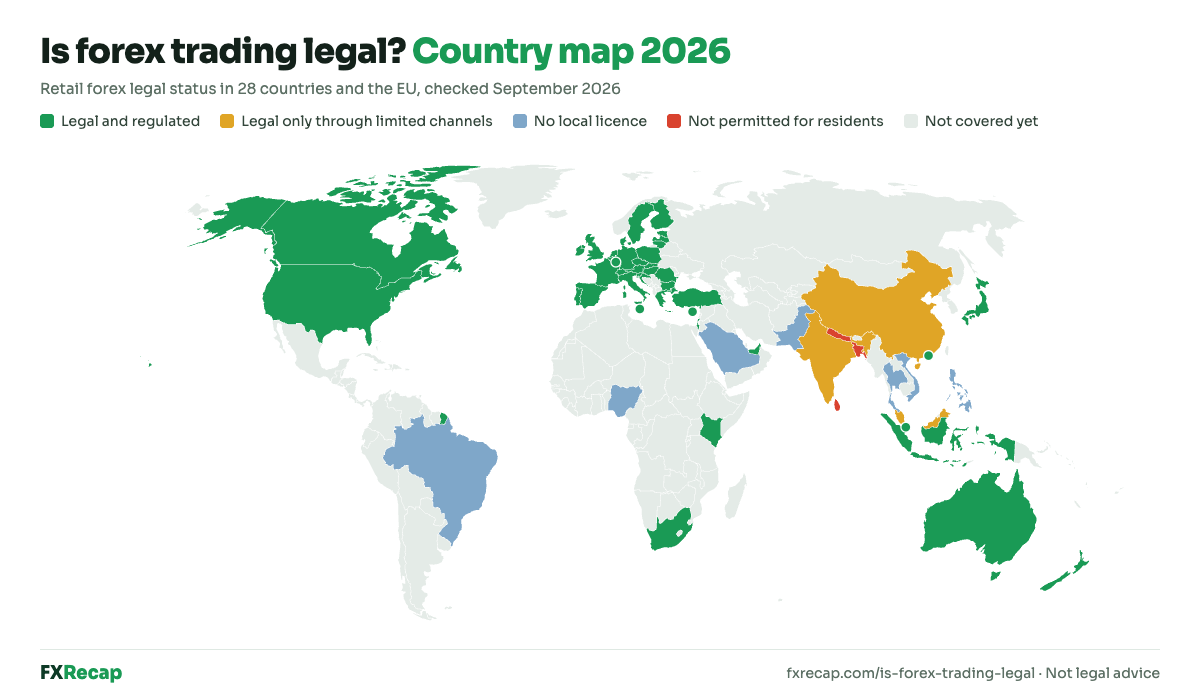
Legal and regulated
Locally licensed brokers, with rules such as leverage caps and client-money protection.
Legal only through limited channels
Allowed through specific local routes, such as exchanges or banks; offshore margin trading is not permitted.
No local licence
No local broker is licensed; individuals trading with a broker abroad are generally not committing an offence, but have no local protection.
Not permitted for residents
The regulator has said residents may not trade leveraged forex online or send money abroad to do so.
How to check if a forex broker is legal where you live
- Find the exact entity
Brokers run several companies. The name on the client agreement, not the brand, decides which regulator protects you.
- Search the regulator's own register
Use the FCA Register, ASIC Connect, the CySEC database, the FSCA FSP search, the MAS directory or the SFC register, never a link from the broker's own site.
- Match the details
Check the website address, phone number and licence number against the register. Clone firms copy real names.
- Check warning lists
Search the broker on your regulator's alert list, such as the RBI Alert List, BNM Financial Consumer Alert or the SEC's advisories, and on our scam broker blacklist.
- Confirm the product is allowed for you
Some regulators allow forex but restrict leverage, bonuses or CFDs for retail clients.
What each regulator protects: forex regulators explained.
Trading where forex is restricted: the real risks
If an offshore broker refuses a withdrawal, no regulator at home will take your complaint.
Where exchange controls apply, sending money abroad through agents, e-wallets or crypto to fund margin trading can itself be an offence.
Banks may freeze or question incoming transfers from offshore brokers, and informal agents can disappear with your money.
Profits are usually taxable at home even when the trading itself sits outside local rules.
Use this map on your site
Writing about forex regulation? You are welcome to publish this map on your site or in an article, free of charge, with a credit link.
Forex legality FAQs
Is forex trading legal?
In most major economies, yes, through locally licensed brokers: the UK, EU, US, Japan, Australia, Singapore, Hong Kong, the UAE and South Africa all regulate it. A few countries, including Bangladesh, Nepal and Sri Lanka, do not permit residents to trade leveraged forex online.
Is forex trading legal in India?
Partly. Currency derivatives on NSE or BSE through SEBI-registered brokers are legal. Trading margin forex with an overseas broker is not a permitted use of the Liberalised Remittance Scheme.
Is forex trading legal in Pakistan?
No local broker is licensed for retail forex; currency futures trade on PMEX. The SECP warns against unauthorised platforms, and there is no local protection if something goes wrong.
Is forex trading legal in Bangladesh?
Not for residents. The Foreign Exchange Regulation Act does not allow sending money abroad for margin trading, and no local broker is licensed.
Is forex trading legal in the United States?
Yes, through CFTC-registered, NFA-member firms. Leverage is capped at 50:1 on major pairs and forex CFDs are not offered to retail clients.
Can I use an offshore broker if my country has no local licence?
In several countries, such as Thailand, the Philippines and Brazil, individuals trading with a broker abroad are not committing an offence, but they have no local regulator to complain to. Where the regulator says it is not permitted, as in Bangladesh or Nepal, funding abroad can breach exchange-control law.
How do I check if a forex broker is licensed?
Search the firm's exact name and licence number on the regulator's own register, such as the FCA Register, ASIC Connect, the CySEC database or the FSCA FSP search, and confirm the website address matches.
How often is this map updated?
We review it whenever a regulator changes its rules, and at least every quarter. It was last checked on 13 October 2026.
Sources: FCA Register, ESMA CFD measures, CFTC: retail forex, Kenya CMA: online forex brokers, SEC Nigeria: proposed online forex and CFD rules.