IC Markets

 3:09
 2:39
 2:10
 2:18
 3:43
 8:42


































JSE Currency Futures vs Offshore CFD Forex
JSE rand currency futures are cash-settled through JSE Clear, with no counterparty risk or allowance limit. How they differ from offshore CFDs.
 WriterAbir KhanWriterWrites the guides · checks every figure against primary sources View profileAbout Abir →

 Market analysisTanbir Habib RiyadForex & Crypto AnalystForex and crypto analyst · technical and fundamental analysis View profileAbout Tanbir →

 Fact-checking & riskJannatul FerdaushFact-Checker & Risk AnalystFact-checks every figure · risk analysis · Applied Statistics, University of Dhaka View profileAbout Jannatul →

 Trading reviewJowel RanaForex TraderForex trader · reviews guides from a trader's view View profileAbout Jowel →

 Final approvalRanjan N. MondolForex TraderForex trader · signs off every guide View profileAbout Ranjan →

Almost everything else in this section covers CFD forex through an FSCA-licensed or offshore broker, because that is what most South Africans mean by "forex trading". There is a second, locally regulated route that gets far less attention: currency futures traded directly on the JSE. It works differently enough from broker CFDs that it is worth understanding before you assume the offshore route is the only one.
What a JSE currency future actually is
A JSE currency future is a contract to buy or sell a set amount of a currency pair, USD/ZAR among the most liquid, at a fixed rate on a future date. Nothing physical changes hands. The contract is cash-settled in rand against the exchange rate on the day, so you are trading the rand's movement without ever holding foreign currency, sending money offshore, or opening an account with a broker based outside South Africa.
| Where it trades | On the JSE's Currency Derivatives Market |
|---|---|
| Settlement | Cash-settled in rand, no physical delivery |
| Counterparty | JSE Clear, the exchange's own clearing house |
| Pairs available | USD/ZAR, EUR/ZAR, GBP/ZAR and several others |
| Access | Through a JSE-authorised broker or derivatives-enabled stockbroker |
The counterparty difference
With an offshore CFD broker, your counterparty is that broker. If it fails, as several have, your open positions and any balance are only as safe as that company's own finances and its regulator's enforcement reach. On the JSE, once a trade is matched, JSE Clear becomes the counterparty to both sides and guarantees settlement. This does not make the trade risk-free, the currency can still move against you, but it removes the specific risk of your broker itself collapsing or mishandling client funds, which is the recurring failure mode in the scam and shutdown stories elsewhere in this section.
The exchange-control difference
This is the detail most traders never hear. Funding an offshore CFD account uses your Single Discretionary Allowance or Foreign Investment Allowance, because the money is leaving South Africa. JSE currency futures do not send money anywhere. Under a dispensation from the Minister of Finance dating to 2007, individuals can trade JSE currency futures without a SARB exchange-control limit, because the rand never leaves the country and the position is cash-settled locally. For a trader who wants exposure to the rand without touching the allowance system at all, this is the one route that offers it.
What you give up
- Fewer pairs. A CFD broker offers dozens of crosses; JSE futures cover a shorter list, USD/ZAR, EUR/ZAR, GBP/ZAR and a handful of others.
- Contract sizes and expiry dates, unlike a CFD, which you can open and close at any size, any time. A future has a fixed contract size and a set expiry, which some traders find restrictive and others find disciplining.
- Different platform and access route. You need a JSE-authorised derivatives broker or stockbroker, not a standard MT4/MT5 forex account, so the account-opening process looks more like opening a share-trading account.
- Less familiar to most traders, so community knowledge, tutorials and comparison content are thinner than for CFD forex.
Themba wanted exposure to a weakening rand without moving money offshore or trusting an unfamiliar broker with it. He opened a derivatives account through a JSE-authorised stockbroker and traded USD/ZAR futures instead of an offshore CFD account. The fixed contract size took some adjusting to, and the available pairs were narrower than he was used to, but the JSE Clear settlement and the absence of any exchange-control question were exactly what he wanted. He still uses an FSCA-licensed CFD broker for pairs the JSE does not offer, treating the two as complementary rather than picking one over the other.
Contract sizes, compared with a CFD lot
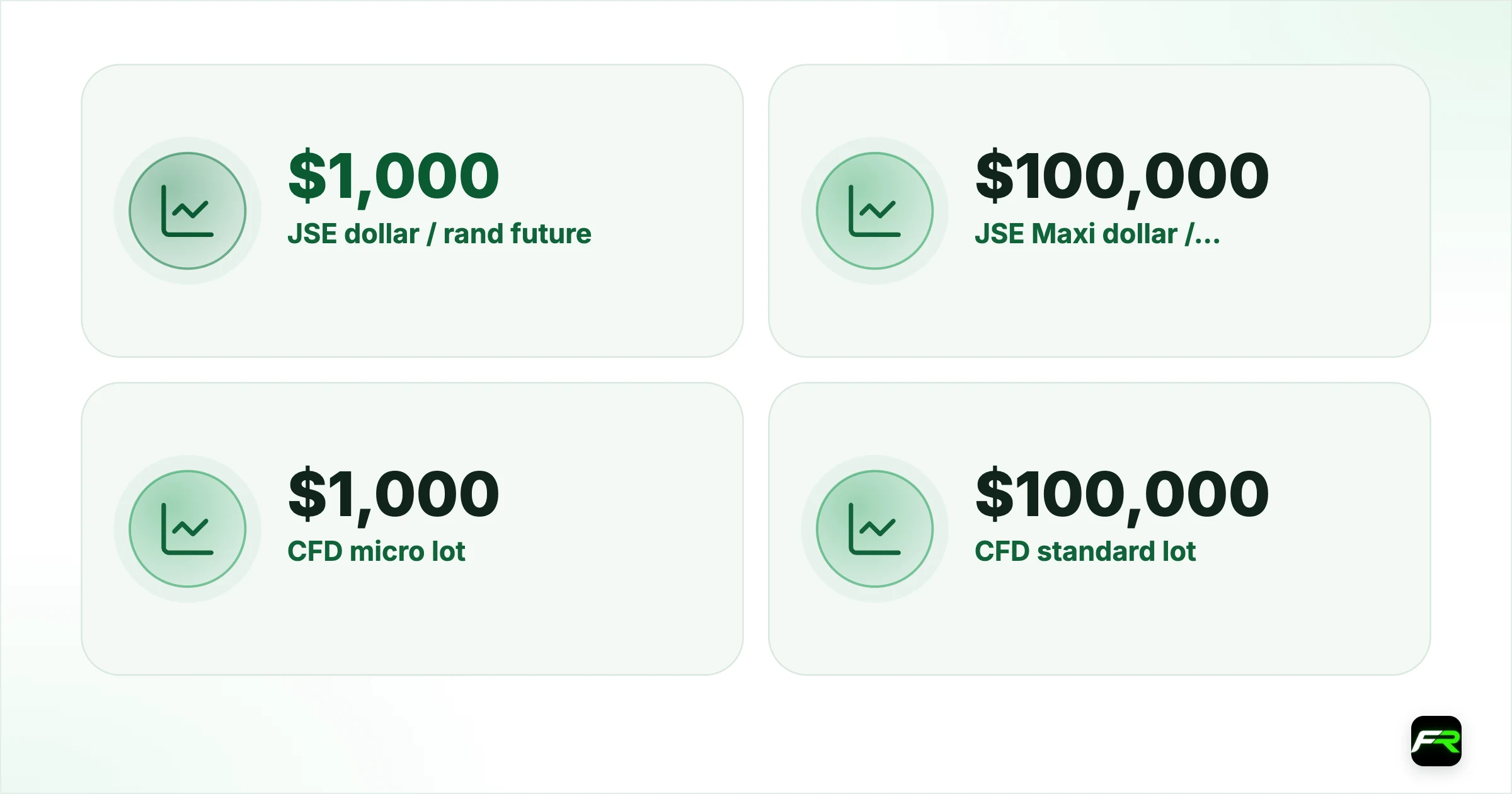
The JSE's standard currency futures are small. Its own product material sets the minimum contract at 1,000 units of the foreign currency, so one dollar/rand contract covers $1,000. For larger traders there is a Maxi dollar/rand future of $100,000 per contract. Set against a CFD lot, the sizes line up like this:
| Product | Size of one unit | Rand value of a 10-cent move |
|---|---|---|
| JSE dollar/rand future | $1,000 | R100 |
| JSE Maxi dollar/rand future | $100,000 | R10,000 |
| CFD micro lot (0.01) USD/ZAR | $1,000 | R100 |
| CFD standard lot (1.00) USD/ZAR | $100,000 | R10,000 |
A 10-cent move means USD/ZAR going from, say, 17.50 to 17.60. The table shows why the standard JSE contract suits small accounts: one contract carries about the same exposure as a micro lot on a CFD platform, so a beginner can size positions sensibly without fractional lots.
Margin, settlement and costs
You put up initial margin set by JSE Clear rather than by a broker, and your account is marked to market every day, so gains and losses are settled in cash daily. On expiry the contract settles in rand against the reference rate. Costs come from the exchange and clearing fees plus your member firm's commission, so ask the broker for its full fee schedule and work out the cost of a round trip before you compare it with a CFD spread.
Ask the member firm whether its platform shows the full order book. Seeing bids and offers on the exchange is one of the advantages of futures over CFDs, so use it.
Which route fits which trader
- Want exposure to a wide range of global pairs, leverage flexibility and the ability to trade any size at any time? A licensed CFD broker is the practical choice.
- Want rand exposure specifically, are wary of broker counterparty risk, and do not want to touch your exchange-control allowance? JSE currency futures are worth learning.
- Trading a strategy that needs a fixed expiry and cash settlement, such as hedging a known future rand cost? Futures fit that purpose directly; CFDs do not have an expiry to hedge against.
- Not sure yet? A small position in each, run in parallel for a few months, shows which mechanics and costs actually suit how you trade.
This is not investment advice, and JSE currency futures are still a derivatives product carrying real risk of loss. The point of this guide is that the route exists and works differently from broker CFDs, not that it is safer to trade or guaranteed to suit you.
Most South African traders have never been told the JSE route exists, because the CFD broker industry has no reason to mention it. It will not replace a CFD account for most people, the pair selection is too narrow, but for rand-specific exposure without exchange-control questions or offshore counterparty risk, it deserves to be on the list of options, not left off it entirely.
Cite this guide
FX Recap, "JSE Currency Futures vs Offshore CFD Forex", updated 9 September 2026, https://fxrecap.com/south-africa-forex/jse-currency-futures-vs-offshore-forex
Free to quote with a link. Journalists: data and comment in our press room.
Frequently asked
Can I trade forex on the JSE instead of a CFD broker?
Yes, through the JSE's Currency Derivatives Market, which offers cash-settled rand futures on USD/ZAR, EUR/ZAR, GBP/ZAR and several other pairs, accessed through a JSE-authorised derivatives broker or stockbroker rather than a standard MT4/MT5 account.
Do JSE currency futures use my exchange-control allowance?
No. Because the contracts are cash-settled in rand and no money leaves South Africa, a 2007 dispensation from the Minister of Finance allows individuals to trade them without a SARB exchange-control limit, unlike funding an offshore CFD account, which does use your discretionary or investment allowance.
Is JSE currency futures trading safer than a CFD broker?
It removes one specific risk: your broker itself failing or mishandling funds, because JSE Clear is the counterparty to every trade, not the broker. The market risk of the currency moving against you is exactly the same as with a CFD, and the product still carries real risk of loss.
Why haven't I heard of JSE currency futures before?
The CFD forex broker industry, which advertises heavily to retail traders, has no commercial reason to mention an exchange-traded alternative that does not involve their platform. It is a real, retail-accessible product; it is simply outside the marketing most traders encounter.
How big is a JSE dollar/rand futures contract?
The standard contract is $1,000, the JSE's minimum size for currency futures, so a 10-cent move in USD/ZAR changes its value by R100. A Maxi dollar/rand future of $100,000 per contract is available for larger traders.
Related reading
The team behind this guide
Researched, checked and approved by five forex specialists
Every guide is written, fact-checked and edited before it goes live, and updated when the facts change. Spotted an error? Tell us.