IC Markets

 3:09
 2:39
 2:10
 2:18
 3:43
 8:42





































Gold Climbs Back Above $4,000 as the Dollar Slips After the US Midterm Vote
Spot gold rose about 3.7% from Friday's close as early midterm results came in. The measured levels, the yields to watch and what could reverse the move.
 WriterAbir KhanWriterWrites the guides · checks every figure against primary sources View profileAbout Abir →

 Market analysisTanbir Habib RiyadForex & Crypto AnalystForex and crypto analyst · technical and fundamental analysis View profileAbout Tanbir →

 Fact-checking & riskJannatul FerdaushFact-Checker & Risk AnalystFact-checks every figure · risk analysis · Applied Statistics, University of Dhaka View profileAbout Jannatul →

 Trading reviewJowel RanaForex TraderForex trader · reviews guides from a trader's view View profileAbout Jowel →

 Final approvalRanjan N. MondolForex TraderForex trader · signs off every guide View profileAbout Ranjan →

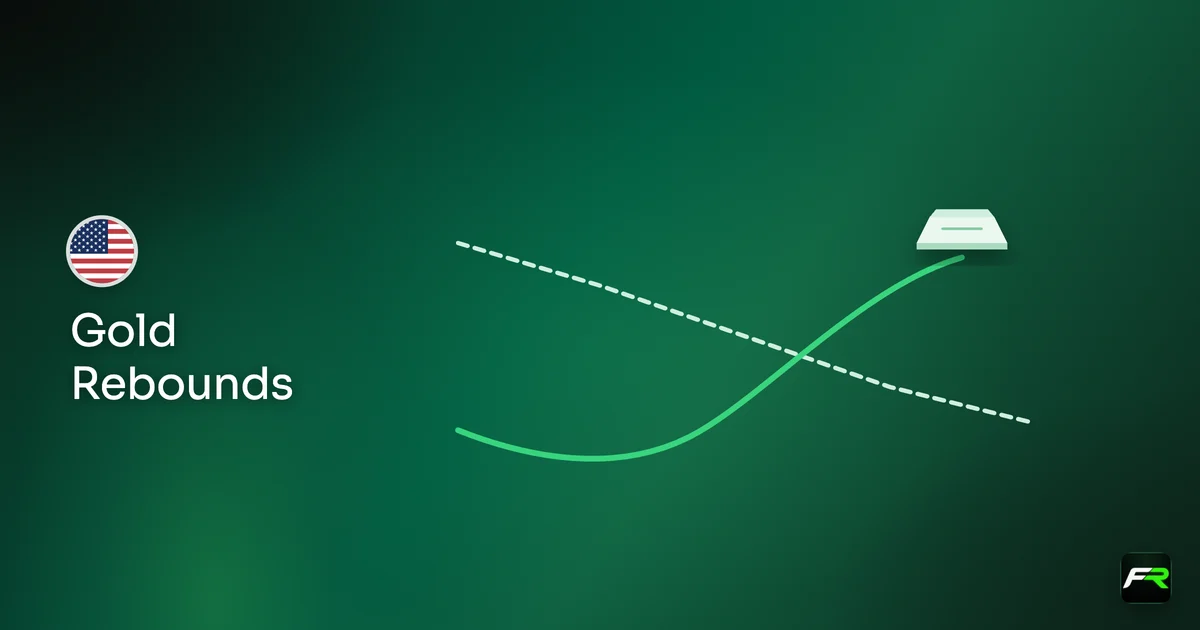
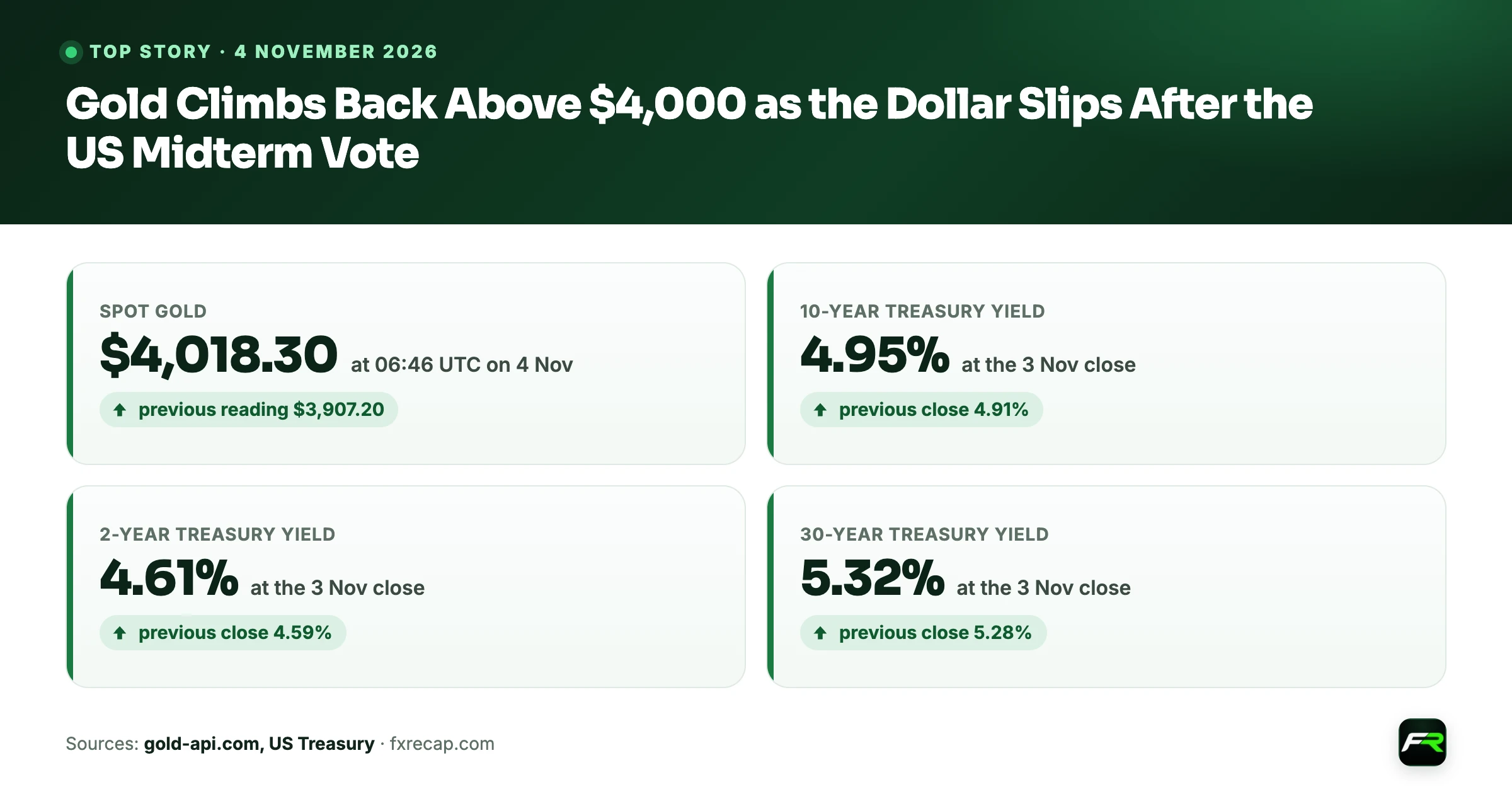
Spot gold was $4,018.30 an ounce at 06:46 UTC on Wednesday 4 November, according to gold-api.com, its first reading above $4,000 in our daily log since Thursday 29 October. Our reading at Friday's close, taken on Saturday morning, was $3,876.40, so the metal has gained about $142, or 3.7%, in two trading sessions. On Monday morning it was $3,907.20.
The move came as results from Tuesday's US midterm elections arrived overnight. The Associated Press called control of the Senate for the Democrats, as reported by PBS NewsHour, and several US networks projected a Democratic majority in the House, as reported by Variety and Axios. These are media calls and projections, not certified results, and some races were still being counted on Wednesday. FXStreet reported that the US Dollar Index fell to late-September levels near 101.25 as the results came in.
We do not take a view on the politics. The question for traders is narrower: what the vote may mean for the dollar, US bond yields and gold, and which levels matter now that $4,000 is back in play.
| Spot gold (gold-api.com) | $4,018.30 at 06:46 UTC on 4 Nov (previous reading $3,907.20) |
|---|---|
| 10-year Treasury yield (US Treasury) | 4.95% at the 3 Nov close (previous close 4.91%) |
| 2-year Treasury yield (US Treasury) | 4.61% at the 3 Nov close (previous close 4.59%) |
| 30-year Treasury yield (US Treasury) | 5.32% at the 3 Nov close (previous close 5.28%) |
What moved gold this week
Gold had a rough end to October. In our daily log it was $4,045.20 on the morning of 29 October, hours after the Federal Reserve held its target range at 3.75% to 4.00%, then fell to $3,994.90 on 30 October and $3,876.40 by Friday's close. That was a drop of about 4.2% in two days. Monday brought a small recovery. We have no reading for Tuesday, but FXStreet reported that gold fell back on Tuesday and then surged past $4,000 while results were being called overnight.
FXStreet linked the rise to the election results and softer yields weighing on the dollar. Gold pays no interest and is priced in dollars, so it tends to gain when the dollar falls or when the yield on safe US government bonds drops, because the cost of holding a metal that pays nothing goes down. A change in who controls Congress can shift expectations for government spending, borrowing and fiscal policy, and those expectations feed into both the dollar and Treasury yields.
Be careful with the timing. The official Treasury yields above are closing figures for Tuesday 3 November, set before most results were known, and they rose that day: the 10-year from 4.91% to 4.95% and the 30-year from 5.28% to 5.32%. Any fall in yields after the results took place overnight and will show up only in Wednesday's official figures. Until then, reports of lower yields are market commentary, not a measured number.
Where yields and the dollar stand
Long-dated US yields remain high by the standards of recent years. The 10-year was 5.13% on 21 October and 5.05% on 28 October, before easing to 4.91% on Monday, so it has already come down from its October peak. The 30-year at 5.32% is still above 5%. That matters for gold: if yields slide further, the metal's main headwind weakens; if they bounce back above 5% on the 10-year, the rebound could stall.
On the currency side, the ECB's euro reference rate put EUR/USD at 1.1179 on Tuesday, down from 1.1216 on Monday. That rate is set around 13:15 UTC, well before polls closed, so it does not reflect the results. The next reference rate, due on Wednesday afternoon European time, will be the first official daily reading after the vote.
- A weaker dollar has helped gold priced in dollars, but for buyers in euros, pounds or rupees the gain is smaller, because their own currency rose against the dollar at the same time.
- The Fed's next decision is on 9 December. Gold is sensitive to any change in how many more rate moves markets expect from the Fed.
- Friday 6 November brings the US October jobs report. A strong or weak payrolls figure can easily outweigh the election in the short run.
Gold levels from our daily readings
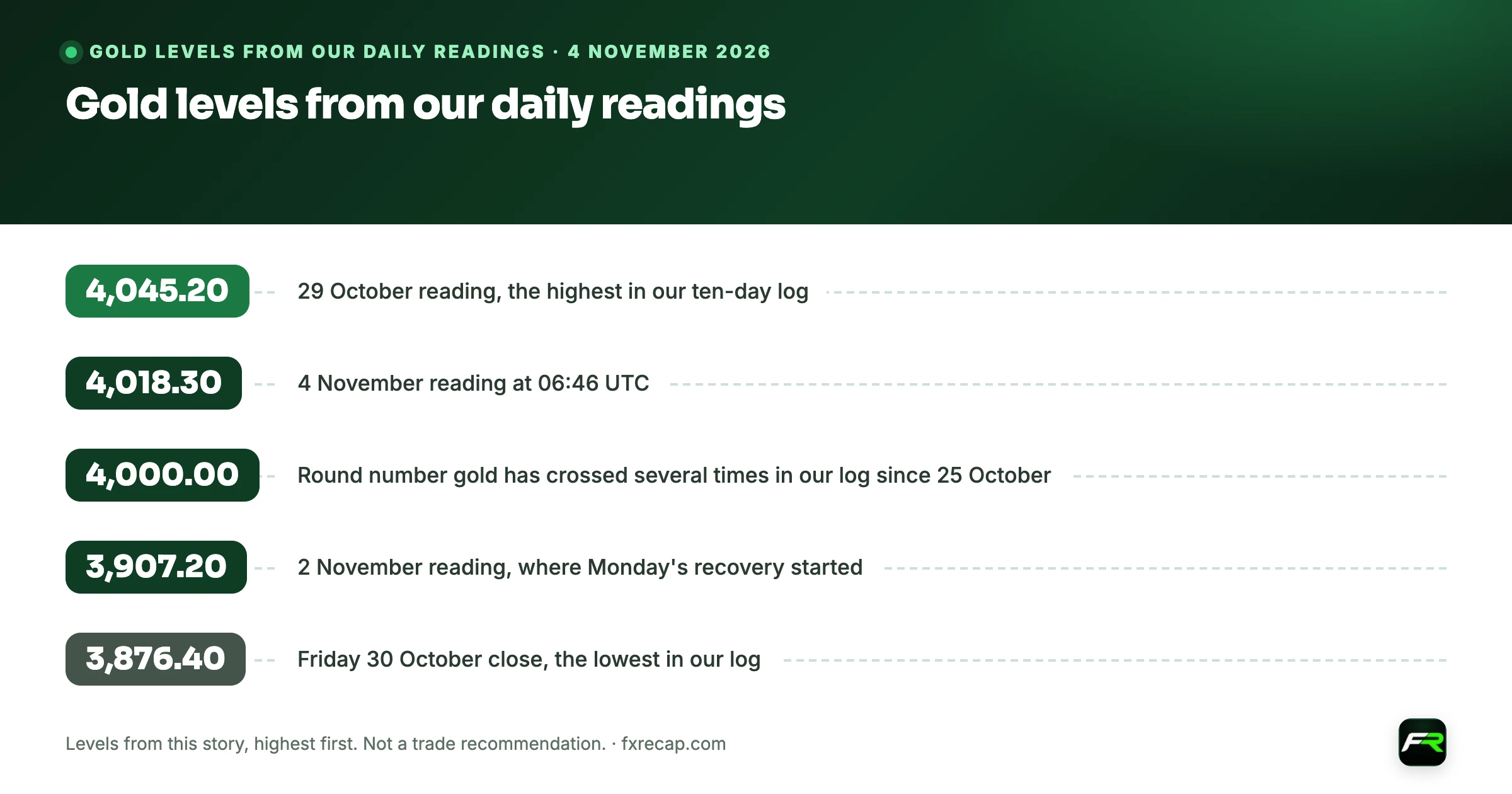
The levels below come from our own once-a-day gold-api.com readings, not from intraday highs or lows. They show where gold stood at specific times in the last ten days, which is useful for judging whether this week's rebound has gone far enough to change the picture.
| Level | Why it matters |
|---|---|
| 4,045.20 | 29 October reading, the highest in our ten-day log |
| 4,018.30 | 4 November reading at 06:46 UTC |
| 4,000.00 | Round number gold has crossed several times in our log since 25 October |
| 3,907.20 | 2 November reading, where Monday's recovery started |
| 3,876.40 | Friday 30 October close, the lowest in our log |
Gold is now about $27 below the 29 October reading. A move back above that area would put the metal at its highest level in our log, although our record covers only ten days. On the downside, a slide back under $4,000 and towards $3,907 would suggest the election bounce was short-lived. A return to $3,876 would erase the whole rebound.
What could reverse the move
Rebounds built on one night's news are fragile. Three things could pull gold back below $4,000 in the coming days, and each can be checked against an official source rather than a headline.
First, yields. If Wednesday's and Thursday's official Treasury figures show the 10-year back near 5%, the main support for the rebound disappears. Investors could then return to bonds that pay close to 5% a year instead of a metal that pays nothing. Second, the dollar. A strong US jobs report on Friday would revive talk of a firmer Fed and could lift the currency, which usually weighs on gold. Third, the count itself. If close races change hands as votes are counted, the reasoning behind the overnight moves may be revisited.
There are also forces pushing the other way. In our log, gold was above $4,000 on every reading from 26 to 29 October, so buyers have shown interest at these prices before. Uncertainty about policy in Washington, with control of Congress changing hands according to the media calls, may keep some investors holding gold as a hedge. Neither side is certain, which is why position size matters more than any forecast.
What it means for traders
Political news can move markets fast, but the effect often fades once the result is priced in. The parts that last are changes to the outlook for US spending, borrowing and interest rates. For gold, that means watching yields and the dollar more than the headlines.
- Check Wednesday's official Treasury yields when they are published. If the 10-year closes well below 4.91%, the drop in yields that markets reported overnight is confirmed.
- Wait for certified or near-final results before trading on a specific outcome. Early calls can change as counting continues, especially in close races.
- Keep Friday's US jobs report in your plan, along with the Bank of England decision on Thursday, which can move the dollar through GBP/USD.
- Use our gold analysis for the daily view and the economic calendar for release times.
Say you want to buy gold at $4,010 after the move, with a stop at $3,975, $35 below. On a $6,000 account risking 1%, your loss limit is $60. One ounce of gold moves $1 for each $1 change in price, so a $35 stop allows a position of about 1.7 ounces, or 0.017 of a standard 100-ounce lot. If gold drops back towards Monday's $3,907 reading, the stop limits the damage. The same plan with a 1-lot position would put $3,500 at risk.
Election results and data releases can move gold and currencies by large amounts in minutes, and prices can gap past stop orders. Leverage magnifies losses as well as gains, so trade only with money you can afford to lose. This article is news and education, not a recommendation to buy or sell.
Gold prices are spot readings from gold-api.com taken once a day for our log; they are not intraday highs or lows. Treasury yields are official daily par yield curve rates from the US Treasury. EUR/USD is the ECB euro reference rate. Election information is reported by the named media outlets and is unofficial until results are certified.
Cite this guide
FX Recap, "Gold Climbs Back Above $4,000 as the Dollar Slips After the US Midterm Vote", updated 4 November 2026, https://fxrecap.com/forex-news/top-stories/gold-back-above-4000-after-us-midterms
Free to quote with a link. Journalists: data and comment in our press room.
Frequently asked
What is the gold price today?
Spot gold was $4,018.30 an ounce at 06:46 UTC on 4 November 2026, according to gold-api.com. Our reading at Friday's close was $3,876.40, so gold gained about 3.7% in two sessions.
Why did gold rise after the US midterm elections?
Market reports linked the rise to a weaker US dollar and expectations of lower US yields as results came in. Gold is priced in dollars and pays no interest, so it tends to benefit when the dollar or yields fall.
Are the 2026 midterm results official?
No. Control of the Senate was called by the Associated Press and the House was projected by several networks, according to media reports. Results become official only when states certify them.
What gold levels matter now?
From our daily readings: $4,045.20 on 29 October is the highest in our ten-day log, $4,000 is the round number, and $3,907.20 and $3,876.40 are the 2 November and 30 October readings where the rebound began.
Sources: gold-api.com: spot gold price (XAU) · US Treasury: Daily Treasury par yield curve rates · Federal Reserve: FOMC statement, 28 October 2026 · ECB: euro foreign exchange reference rates · PBS NewsHour (reported): Democrats take control of the Senate
The team behind this guide
Researched, checked and approved by five forex specialists
Every guide is written, fact-checked and edited before it goes live, and updated when the facts change. Spotted an error? Tell us.