IC Markets

 3:09
 2:39
 2:10
 2:18
 3:43
 8:42





































US Dollar Eases From 18-Month High as September Jobs Disappoint
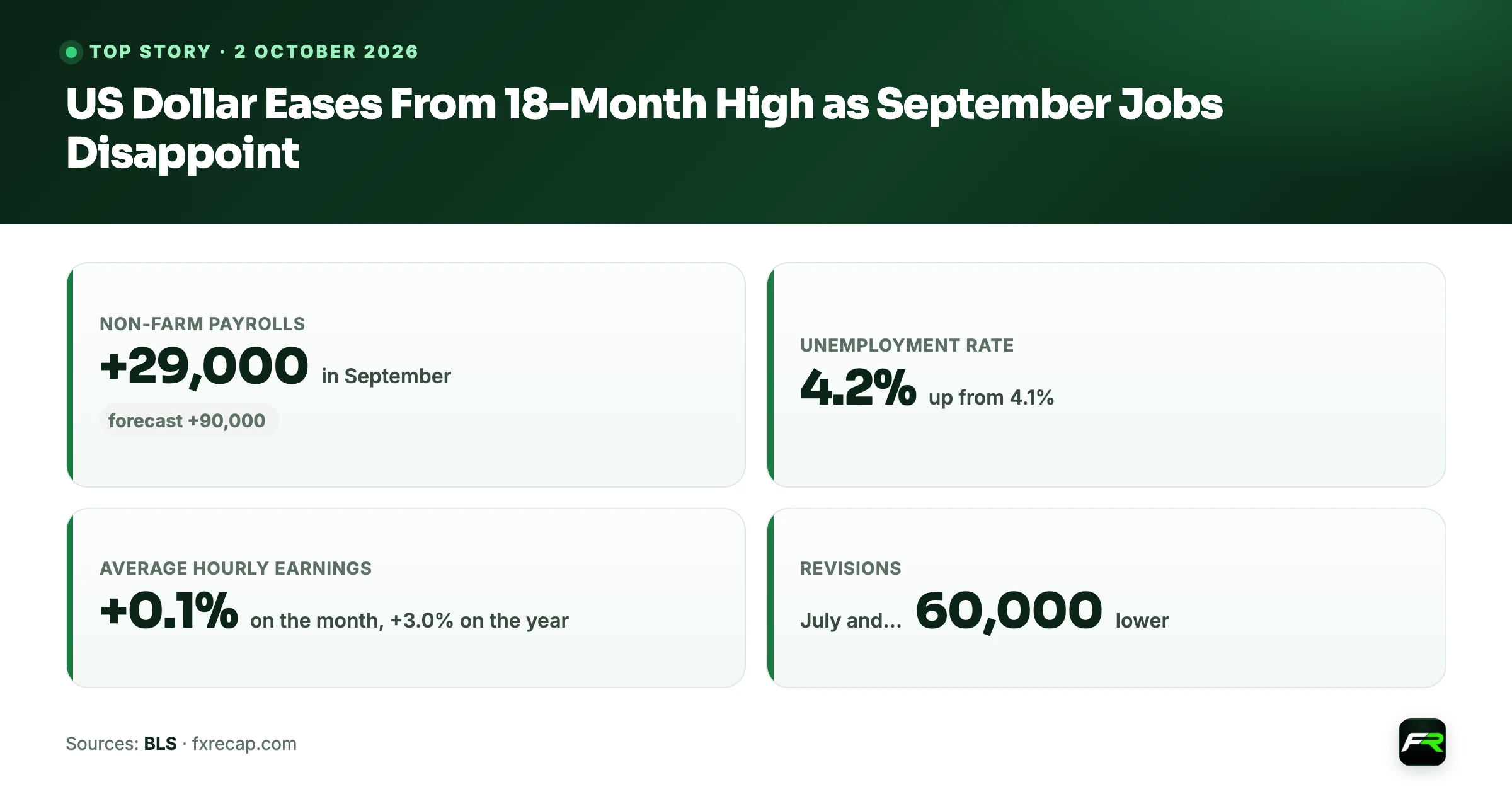
US employers added just 29,000 jobs in September and unemployment rose to 4.2%, the Bureau of Labor Statistics reported. The Dollar Index, which hit 102.20 on Thursday, eased after the data.
 WriterAbir KhanWriterWrites the guides · checks every figure against primary sources View profileAbout Abir →

 Market analysisTanbir Habib RiyadForex & Crypto AnalystForex and crypto analyst · technical and fundamental analysis View profileAbout Tanbir →

 Fact-checking & riskJannatul FerdaushFact-Checker & Risk AnalystFact-checks every figure · risk analysis · Applied Statistics, University of Dhaka View profileAbout Jannatul →

 Trading reviewJowel RanaForex TraderForex trader · reviews guides from a trader's view View profileAbout Jowel →

 Final approvalRanjan N. MondolForex TraderForex trader · signs off every guide View profileAbout Ranjan →

The September jobs report came in well below forecasts. On Friday 2 October the US Bureau of Labor Statistics said non-farm payrolls rose by 29,000, against a consensus of 90,000, and that the unemployment rate rose to 4.2% from 4.1%. Revisions took a further 60,000 jobs off July and August: July now shows a fall of 10,000, and August a gain of 133,000 instead of 162,000.
The report interrupted a strong run for the dollar. On Thursday the Dollar Index (DXY), which tracks the greenback against six major currencies, climbed to 102.20, a level last seen in April 2025, according to market data reported by FXStreet. Market reports put it near 101.90 after the release, as traders trimmed bets on another Federal Reserve rate hike.
| Non-farm payrolls (BLS) | +29,000 in September (forecast +90,000) |
|---|---|
| Unemployment rate (BLS) | 4.2%, up from 4.1% |
| Average hourly earnings (BLS) | +0.1% on the month, +3.0% on the year |
| Revisions (BLS) | July and August combined 60,000 lower |
| 10-year Treasury yield (US Treasury) | 5.28% official close, 2 October |
| Dollar Index high (market data) | 102.20 on 1 October, highest since April 2025 |
Why the dollar has been climbing
Three forces have pushed the greenback higher since early September. US inflation came in hot in August, and the Fed answered with a rate hike on 16 September that markets read as hawkish. Treasury yields then surged, with the 10-year note rising to around 5.33% on Thursday, its highest level in about two decades. Higher yields make dollar assets pay more, so global money flows towards them.
Growth data has helped as well. The Atlanta Fed's GDPNow model estimates third-quarter growth at 3.7% annualised, up from 2.2% in the second quarter. An economy running that hot gives the Fed little reason to ease, and futures markets now imply about 75 basis points of further hikes over the next twelve months.
Oil adds a final push. Tension around the Strait of Hormuz has kept crude prices high for months, lifting inflation fears in Europe and Asia more than in the US, which produces much of its own energy. Each jump in oil therefore tends to favour the dollar over the euro and the yen.
What the dollar did against each major currency this week
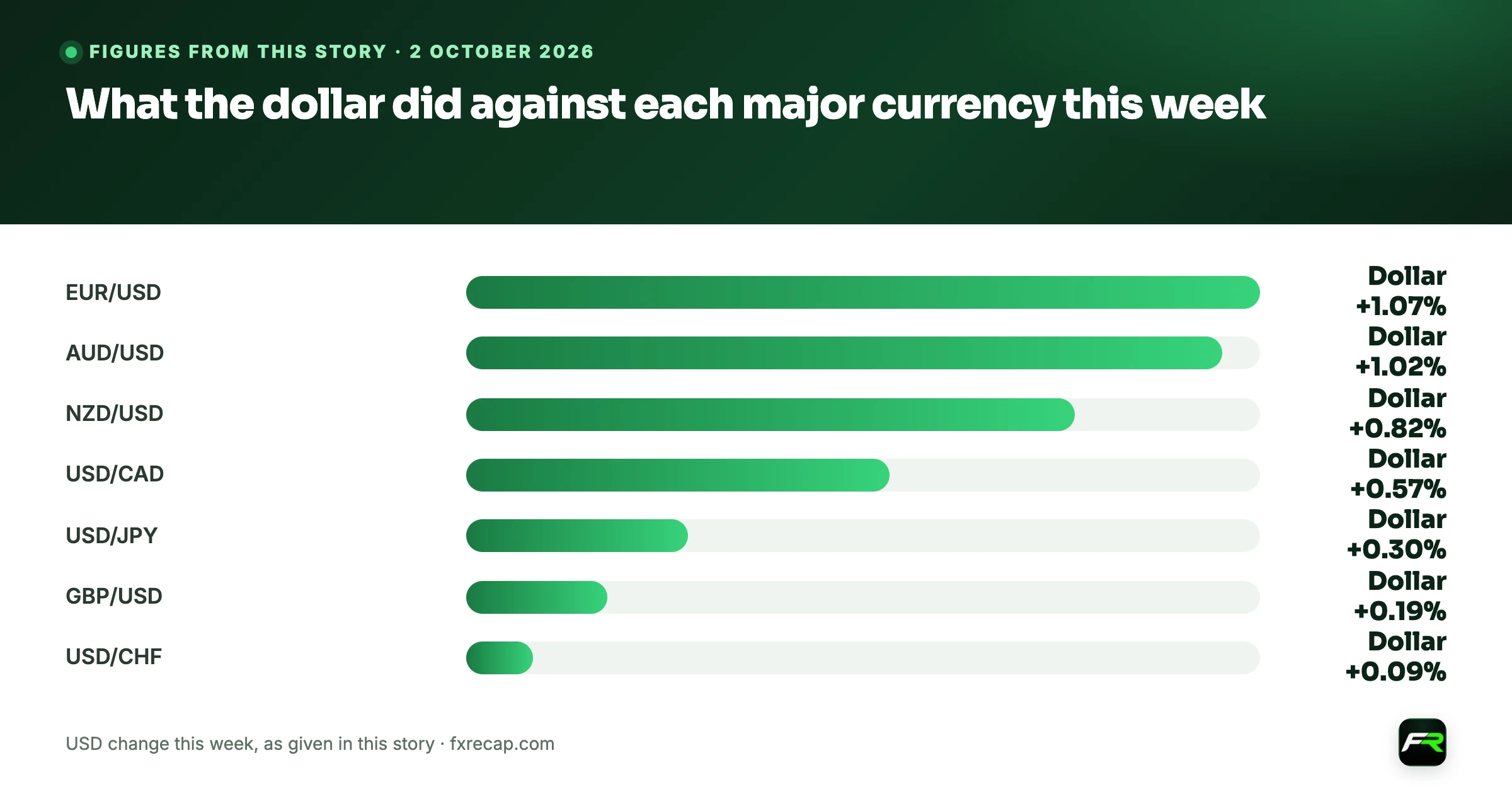
Gains were broad but uneven. Commodity currencies and the euro took the heaviest hits, while sterling and the Swiss franc held up best.
| Pair | USD change this week | Where it stands |
|---|---|---|
| EUR/USD | Dollar +1.07% | Hit 1.1210 on Thursday, near 1.1250 on Friday |
| AUD/USD | Dollar +1.02% | Three-month low near 0.6900 |
| NZD/USD | Dollar +0.82% | Weaker with other commodity currencies |
| USD/CAD | Dollar +0.57% | Canadian dollar softer despite high oil |
| USD/JPY | Dollar +0.30% | Back below 158.00 after hot Tokyo inflation |
| GBP/USD | Dollar +0.19% | Briefly under 1.3200, lowest since late June |
| USD/CHF | Dollar +0.09% | Franc almost flat |
Source for weekly changes: FXStreet's currency heat map as of Friday morning, 2 October.
What markets expected, and what came out
Economists polled before the release had expected non-farm payrolls to rise by 90,000 in September, with unemployment steady at 4.1% and average hourly earnings up 0.3% on the month. The actual figures were weaker on every count: 29,000 jobs, 4.2% unemployment and pay up 0.1%.
Some forecasters had warned of a soft number. Before the release, BBH reported that Bloomberg's whisper estimate was 84,000 and that the ADP and Revelio Labs private payroll series pointed to about 67,000, while TD Securities forecast 50,000 jobs and unemployment of 4.2%. TD came closest.
Wages matter as much as the headline. According to the BLS, average hourly earnings rose 5 cents, or 0.1%, to $37.81, and were up 3.0% on the year. Slower pay growth eases one of the Fed's inflation worries.
By sector, the BLS reported gains in health care (+17,000), construction (+11,000) and manufacturing (+9,000), while financial activities lost 7,000 jobs. That mix points to a cooling labour market rather than a collapse, which is why the dollar eased rather than fell sharply.
What Fed officials are saying
Comments this week have cooled expectations for an October move without ruling one out. Minneapolis Fed President Neel Kashkari said inflation is "still too high at around 3%" and pencilled in one more hike this year and another in 2027. Governor Michael Barr also signalled that further increases may be needed to bring sticky inflation down.
Pricing has swung sharply. Early in the week markets put the odds of an October hike above 70%, according to Convera's October outlook; softer inflation data and more cautious Fed remarks then pulled that lower. A soft jobs report generally lowers the odds of another hike, but inflation still sits near 3%, so the Fed's decision on 28 October remains open.
How to trade the release
Payroll Fridays bring some of the fastest moves of the month. Spreads widen in the seconds around the release, and stop orders can fill far from where you set them. You can reduce the damage with a few simple habits.
- Cut your position size or step aside for the first five minutes after 12:30 GMT.
- Check how far your broker's spread widens around news; some accounts widen far more than others.
- Watch the revisions as well as the headline. In September's report they cut 60,000 jobs from the previous two months.
- Use our economic calendar for the exact time in your zone and the next releases.
Say you hold 1 standard lot of EUR/USD with a stop 20 pips away. On a normal day that is a $200 risk. If the spread jumps from 0.2 to 3 pips at the release and the price gaps 15 pips through your stop, the loss can reach about $350. Halving the position before the data keeps the worst case near $175.
Leverage magnifies these moves. Size every trade by the money you can afford to lose, not by the margin your account allows.
Key levels for the dollar
For the Dollar Index, Thursday's 102.20 high is the first resistance, with 102.00 acting as a pivot. Support sits near 101.50, then around 101.00. A daily close above 102.20 would confirm the uptrend that began in early September; a drop below 101.00 would be the first sign that the rally is fading.
Gold traded just under $4,200 an ounce before the report, and market reports had it back above $4,200 after the soft data. Track every pair in real time on our live rates page.
Jobs figures are from the US Bureau of Labor Statistics release of 2 October 2026, and yields from the US Treasury's official daily yield curve. Dollar Index, currency and gold levels are market data as reported by FXStreet and other market outlets, and differ slightly between providers.
Cite this guide
FX Recap, "US Dollar Eases From 18-Month High as September Jobs Disappoint", updated 3 October 2026, https://fxrecap.com/forex-news/top-stories/us-dollar-18-month-high-nfp
Free to quote with a link. Journalists: data and comment in our press room.
Frequently asked
What did the September 2026 jobs report show?
The US Bureau of Labor Statistics reported on 2 October 2026 that payrolls rose by 29,000, against a forecast of 90,000. Unemployment rose to 4.2% and July and August were revised down by a combined 60,000 jobs.
Why is the US dollar so strong right now?
A hot August inflation reading, a Fed rate hike on 16 September, US Treasury yields at about two-decade highs and solid growth data have all drawn money into the dollar. High oil prices also hurt Europe and Japan more than the US.
What is the Dollar Index (DXY)?
The DXY measures the US dollar against six currencies: the euro, yen, pound, Canadian dollar, Swedish krona and Swiss franc. Its largest weight is the euro, so EUR/USD moves drive much of the index.
What NFP number would push the dollar higher?
A reading well above the 90,000 consensus, especially with wages up 0.4% or more, would likely lift yields and the dollar. Anything under 50,000 with unemployment rising to 4.2% would probably weaken it.
Is it safe to trade during the NFP release?
It carries extra risk. Spreads widen, prices can jump past stop losses and fills can slip. Many traders reduce size or wait a few minutes for the first reaction to settle before entering.
Sources: FXStreet: Forex Today, 2 Oct · BBH via FXStreet · Convera October outlook · US Bureau of Labor Statistics: Employment Situation, September 2026 · US Treasury daily yield curve
The team behind this guide
Researched, checked and approved by five forex specialists
Every guide is written, fact-checked and edited before it goes live, and updated when the facts change. Spotted an error? Tell us.