IC Markets

 3:09
 2:39
 2:10
 2:18
 3:43
 8:42





































RBA Raises the Cash Rate to 4.85% in a 6-3 Vote and Pushes Its Inflation Forecasts Higher
Three members wanted to wait, but the Board went ahead with a fifth rise this year and now sees inflation above 3% until late 2027. What it means for AUD/USD.
 WriterAbir KhanWriterWrites the guides · checks every figure against primary sources View profileAbout Abir →

 Market analysisTanbir Habib RiyadForex & Crypto AnalystForex and crypto analyst · technical and fundamental analysis View profileAbout Tanbir →

 Fact-checking & riskJannatul FerdaushFact-Checker & Risk AnalystFact-checks every figure · risk analysis · Applied Statistics, University of Dhaka View profileAbout Jannatul →

 Trading reviewJowel RanaForex TraderForex trader · reviews guides from a trader's view View profileAbout Jowel →

 Final approvalRanjan N. MondolForex TraderForex trader · signs off every guide View profileAbout Ranjan →

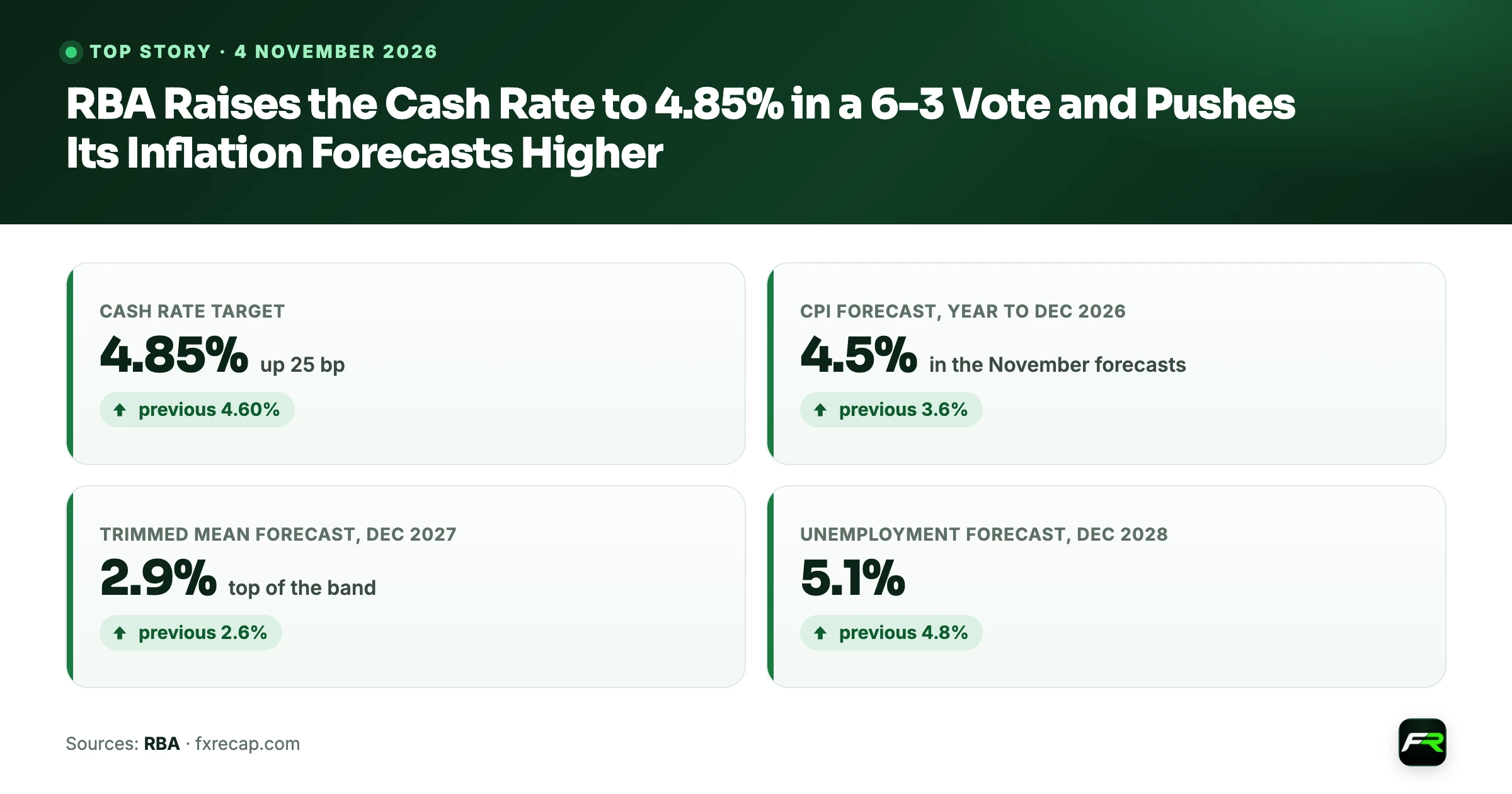
The Reserve Bank of Australia raised its cash rate target by 25 basis points to 4.85% on Tuesday 3 November. It was the fifth rise of 2026 and the second in a row after the September move to 4.60%. This time the Board was split: “six members voted to increase the cash rate target by 25 basis points to 4.85 per cent; three members voted to leave the cash rate target unchanged at 4.60 per cent,” the decision statement says.
A split vote matters for traders because the September rise was unanimous. Three of nine members now think policy is tight enough, or close to it, so every data release before the 8 December meeting will be read for which side it helps. The new staff forecasts, published in the Statement on Monetary Policy at the same time, show why the majority still acted: inflation is expected to stay above the 2 to 3% target band for longer than the bank thought in August.
| Cash rate target (RBA) | 4.85%, up 25 bp (previous 4.60%) |
|---|---|
| CPI forecast, year to Dec 2026 (RBA) | 4.5% in the November forecasts (previous 3.6%) |
| Trimmed mean forecast, Dec 2027 (RBA) | 2.9%, top of the band (previous 2.6%) |
| Unemployment forecast, Dec 2028 (RBA) | 5.1% (previous 4.8%) |
Why the Board raised again
The statement gives a short list of reasons. Underlying inflation “remains broadly based”, capacity pressures “appear a little tighter than previously estimated”, and there are “indications that higher fuel prices are being passed through to prices of other goods and services.” Inflation, it adds, “is now expected to remain above 3 per cent for the coming year and there is an increasing risk that higher inflation expectations will become embedded.”
That last phrase carries the most weight. Central banks worry most when households and firms start to treat high inflation as normal and set prices and wages on that basis. The Board said some measures of expectations “are assessed to have risen lately”, and its liaison programme found many firms raising prices or planning to. Faced with that, the majority judged that “a further tightening in financial conditions is warranted to support the return of inflation to target.”
Energy is part of the story but not all of it. According to the bank, higher fuel and commodity prices tied to the conflict in the Middle East explain some of the forecast upgrade. It also points to rapid price growth for technology goods driven by AI-related investment, and to inflation in “many goods and services” that remains high. Both the decision statement and the overview say staff now believe the economy has been running a little hotter than its sustainable pace.
What the new forecasts say
The forecast table in the Statement on Monetary Policy, finalised on 28 October, is where the change is clearest. Headline CPI inflation is now expected to reach 4.5% in the year to December 2026, against 3.6% in the August forecasts. Trimmed mean inflation, the RBA's preferred underlying measure, is expected to be 3.6% at the end of this year and 2.9% by December 2027, at the top of the target band rather than comfortably inside it.
In the overview's words, headline and underlying inflation are expected “to remain above 3 per cent until end-2027” and to reach the 2.5% midpoint only in mid-2028. The decision statement says the top of the band is now reached around three quarters later than forecast in August. For context, headline inflation was 3.9% over the year to the September quarter and trimmed mean inflation was 3.7%, the overview reports.
| RBA forecast | Previous (August) | Now (November) |
|---|---|---|
| CPI, year to Dec 2026 | 3.6% | 4.5% |
| CPI, year to Jun 2027 | 2.8% | 3.7% |
| Trimmed mean, year to Dec 2026 | 3.3% | 3.6% |
| Trimmed mean, year to Jun 2027 | 3.0% | 3.5% |
| Trimmed mean, year to Dec 2027 | 2.6% | 2.9% |
| Unemployment, Dec 2028 quarter | 4.8% | 5.1% |
Growth and jobs move the other way. GDP growth is forecast at 1.6% in the year to December 2026, then 1.3% through 2027, and the unemployment rate is expected to rise to 4.7% by December, 4.9% by the end of 2027 and 5.1% by the end of 2028. According to the overview, unemployment averaged 4.6% in the September quarter, more than expected, mostly because more people joined the labour force. House prices in September were almost 5% below their March peak.
One detail in the assumptions is worth noting. The forecasts use a cash rate path taken from market pricing on 28 October: an average of 4.9% for the 2026/27 financial year and 4.8% for 2027. Before the meeting, the RBA says, markets implied about one and a half further rises by mid-2027. Those are market expectations that the bank used as an input, not a promise of more hikes.
Why three members voted to hold
The statement does not say who voted which way or why; the minutes, due two weeks after the meeting, will give the arguments. The case for waiting can already be read in the bank's own text. The economy is slowing, housing prices “have fallen significantly” and the unemployment rate has risen. Financial conditions are judged to be restrictive, and the overview says the cash rate is now slightly above the top of the range of estimates of the neutral rate.
Those points did not win the vote, but they shape what comes next. A run of weak jobs figures or a sharp fall in spending could push one or two of the six towards a pause in December. A further jump in inflation would do the opposite. The final line of the statement leaves both doors open: the Board “will be attentive to the data and the evolving assessment of the outlook and risks to guide its decisions.”
How AUD/USD reacted
The Australian dollar did not get a lift from the hike. Using the ECB's euro reference rates, set around 13:15 UTC each working day, AUD/USD worked out at 0.7008 on Monday 2 November and 0.6984 on Tuesday 3 November, about ten hours after the 03:30 UTC decision. It had been 0.7005 on the day of the September rise, so two quarter-point hikes have left the pair almost unchanged.
There are a few reasons for that. Markets had already priced some chance of a rise, so part of the move was in the price before Tuesday. Rates and bond yields have climbed in many other countries too, which limits the extra return from holding Australian dollars. The split vote also told traders that the tightening cycle may be close to its end. The US dollar side of the pair has its own news this week, with the October US jobs report due on Friday.
| Level | Why it matters |
|---|---|
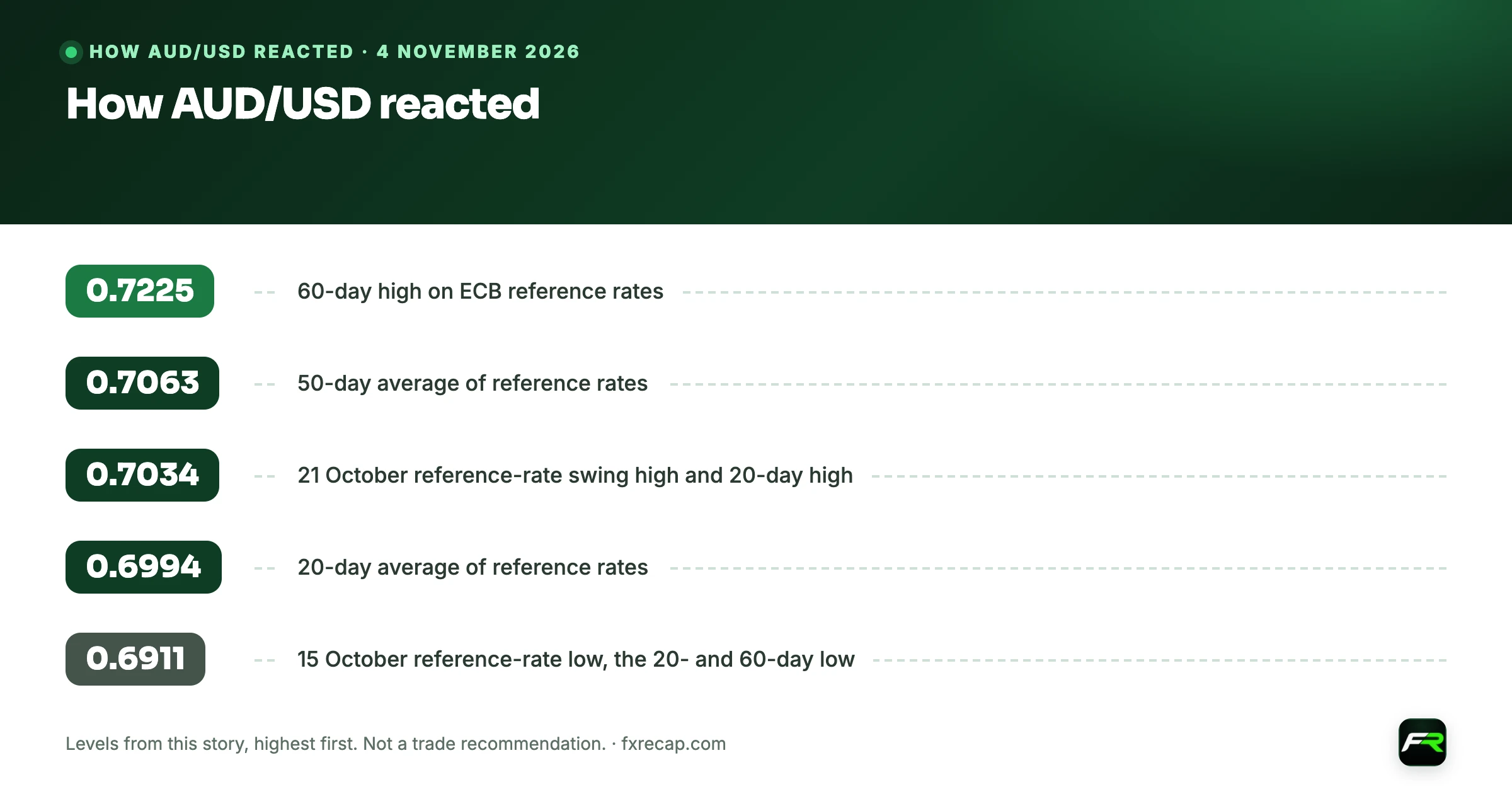
| 0.7225 | 60-day high on ECB reference rates |
| 0.7063 | 50-day average of reference rates |
| 0.7034 | 21 October reference-rate swing high and 20-day high |
| 0.6994 | 20-day average of reference rates |
| 0.6911 | 15 October reference-rate low, the 20- and 60-day low |
The pair sat just below its 20-day average of 0.6994 on Tuesday and well under the 50-day average of 0.7063, a sign that the short-term trend has turned soft even as rates rise. The 15 October low of 0.6911 is the lowest reference rate in the last 60 working days. On the upside, 0.7034 capped the pair in late October.
What it means for traders
Think of this decision as a hawkish hike with a dovish split. The forecasts argue for higher rates for longer, while the 6-3 vote shows the bar for another move is rising. For AUD trades that means the next few data releases carry more weight than usual.
- Read the minutes, due two weeks after the meeting. They will show what the three members who wanted to hold were worried about, and whether the majority sees December as live.
- Watch Australian monthly CPI and the October labour force figures. A rise in unemployment beyond the RBA's 4.7% forecast for December would strengthen the case for a pause.
- Remember the US side. AUD/USD often moves more on US data and risk appetite than on the RBA, so Friday's US jobs report can matter as much as Tuesday's hike.
- Check the levels in our AUD/USD analysis and the dates on our economic calendar before you plan a trade.
Say you think the hike will eventually support the Aussie and want to buy AUD/USD at 0.6990 with a stop at 0.6940, 50 pips away. On a $5,000 account risking 1%, your loss limit is $50, so each pip can be worth $1, a position of about 10,000 units (0.1 lot). If the pair slips to 0.6911, the 15 October low, before turning, your stop is hit first. Size the trade for that risk rather than for the profit you hope to make.
Rate decisions and data releases can move currencies sharply, and prices can gap past stop orders. Leverage magnifies losses as well as gains, so trade only with money you can afford to lose. This article is news and education, not a recommendation to buy or sell.
Quotations come from the RBA's decision statement of 3 November 2026 and the overview of its November 2026 Statement on Monetary Policy. Forecast figures are from the forecast table in that statement. AUD/USD rates are derived from ECB euro reference rates (EUR/USD ÷ EUR/AUD); they are one daily rate, not intraday highs or lows.
Cite this guide
FX Recap, "RBA Raises the Cash Rate to 4.85% in a 6-3 Vote and Pushes Its Inflation Forecasts Higher", updated 4 November 2026, https://fxrecap.com/forex-news/top-stories/rba-raises-cash-rate-4-85-percent-november-2026
Free to quote with a link. Journalists: data and comment in our press room.
Frequently asked
What is the RBA cash rate now?
The cash rate target is 4.85%. The Reserve Bank of Australia raised it by 25 basis points on 3 November 2026, from 4.60%, in its fifth increase of the year.
How did the RBA Board vote in November 2026?
The decision was by majority. Six members voted to raise the cash rate target to 4.85% and three voted to keep it at 4.60%. The September rise had been unanimous.
When does the RBA expect inflation to return to target?
The November Statement on Monetary Policy expects headline and trimmed mean inflation to stay above 3% until the end of 2027 and to reach the 2.5% midpoint of the target band in mid-2028.
When is the next RBA decision?
The Monetary Policy Board's last meeting of 2026 is on 7 and 8 December, with the decision on Tuesday 8 December at 14:30 Sydney time. The minutes of the November meeting come out two weeks after it.
Sources: Reserve Bank of Australia: Statement by the Monetary Policy Board, 3 November 2026 · Reserve Bank of Australia: Statement on Monetary Policy, November 2026, Overview · Reserve Bank of Australia: Cash rate target · ECB: euro foreign exchange reference rates · Reserve Bank of Australia: Board meeting schedules
The team behind this guide
Researched, checked and approved by five forex specialists
Every guide is written, fact-checked and edited before it goes live, and updated when the facts change. Spotted an error? Tell us.