 IC Markets

 3:09
 2:39
 2:10
 2:18
 3:43
 8:42


































How Much Can You Realistically Make With a Prop Firm?
The answer is a percentage of a percentage: your monthly return, times the account size, times the split, for as long as you keep the account.
 WriterAbir KhanWriterWrites the guides · checks every figure against primary sources View profileAbout Abir →

 Market analysisTanbir Habib RiyadForex & Crypto AnalystForex and crypto analyst · technical and fundamental analysis View profileAbout Tanbir →

 Fact-checking & riskJannatul FerdaushFact-Checker & Risk AnalystFact-checks every figure · risk analysis · Applied Statistics, University of Dhaka View profileAbout Jannatul →

 Trading reviewJowel RanaForex TraderForex trader · reviews guides from a trader's view View profileAbout Jowel →

 Final approvalRanjan N. MondolForex TraderForex trader · signs off every guide View profileAbout Ranjan →

Prop firm marketing shows the biggest payouts. The realistic number comes from four inputs you can estimate yourself: account size, monthly return, profit split and how many months you keep the account.
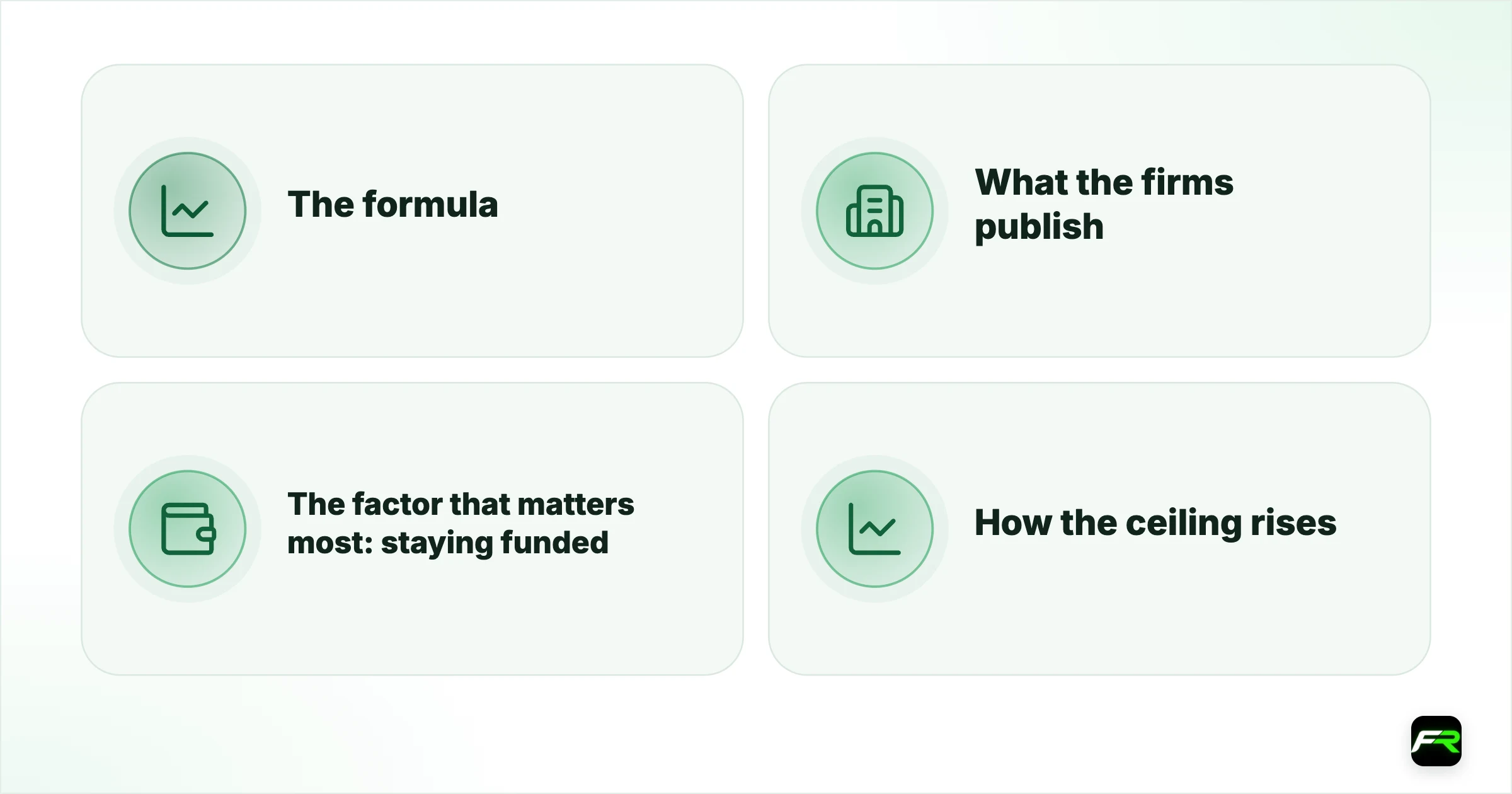
The formula
Monthly payout = account size × monthly return × split. Annual income = monthly payout × the months you stay funded.
| Monthly return | $50,000 at 80% | $100,000 at 80% | $100,000 at 90% | $200,000 at 90% |
|---|---|---|---|---|
| 1% | $400 | $800 | $900 | $1,800 |
| 2% | $800 | $1,600 | $1,800 | $3,600 |
| 3% | $1,200 | $2,400 | $2,700 | $5,400 |
Two per cent a month, every month, without breaching a 5 per cent daily or 10 per cent maximum loss limit, is a strong professional result. Most traders who manage it do so with small risk per trade and many flat or losing months along the way.
What the firms publish
FTMO’s pricing table shows an “average reward” for each 2-Step account size: €680 for $10,000, €1,431 for $25,000, €2,805 for $50,000, €5,957 for $100,000 and €12,234 for $200,000. FTMO does not say there over what period these averages run, so read them as its own indication rather than a monthly figure. They are averages among traders who are paid, and Topstep’s figures are a reminder of how many are not: in 2025, 33.3 per cent of its funded participants received a payout.
The factor that matters most: staying funded
A trader making 2 per cent a month on $100,000 at 80 per cent earns $1,600 a month, or $19,200 a year, only if they keep the account all year. Lose it in month three and the year is $4,800, less the cost of passing again. Survival is worth more than return.
A trader passes a $100,000 2-Step in month two, makes 1.5 per cent in months three to six, breaches in month seven, re-passes by month nine and makes 1 per cent a month to year end. Payouts: four months at $1,200 and three at $800, about $7,200, against two fees of €540 each with one refunded. That is a good year for a funded trader, and far below the marketing.
How the ceiling rises
- Scaling plans: FTMO adds 25 per cent to the account every four months for traders who make 10 per cent and take two payouts in that time.
- Several accounts: firms allow combined funding up to a cap, which multiplies both income and risk.
- A higher split: FTMO’s 2-Step rises from 80 to 90 per cent through scaling.
Use our prop firm calculator to plug in your own account size, return and split.
Costs to subtract
Gross payouts are not take-home income. Before judging a prop year, subtract:
- Challenge fees, resets and add-ons, net of any refunds.
- Payment, conversion and withdrawal fees. Topstep, for example, charges $30 for ACH and wire payouts.
- Tools and data you pay for to trade, such as platform subscriptions or a VPS.
- Tax on the payouts where you live.
A trader receives $9,600 in payouts in a year. They paid $650 in fees, received $300 back as a refund, paid $120 in payout fees and $240 for a VPS. Before tax, their net is $9,600 − $650 + $300 − $120 − $240 = $8,890. Tax then depends on their country.
Income across several accounts
Funded traders who earn more usually do it with more capital, either through scaling or by holding accounts at more than one firm. That multiplies income and risk together. A losing day hits every account trading the same idea, so the protection of diversification is weaker than it looks unless the accounts are run with different strategies or sizes.
| Setup | Monthly payout at 2% and 80% | Main risk |
|---|---|---|
| One $100,000 account | $1,600 | One firm, one breach |
| Two $100,000 accounts, same strategy | $3,200 | One bad day breaches both |
| Two accounts, different sizes or strategies | Up to $3,200 | Slower, but losses are less correlated |
Benchmarks to set your expectations
- Topstep reports 33.3 per cent of its funded participants received a payout in 2025.
- FTMO’s pricing table shows average reward figures per account size, without a stated period.
- The figures you see on social media are the top of the distribution, not the middle.
Set your first-year goal as staying funded for six months with regular small payouts. The income follows survival, not the other way round.
Related guides
Earnings depend on payouts, splits, scaling and the cost of getting funded.
- How payouts work: splits, waiting periods, minimums and reviews.
- Profit splits explained: why the headline percentage matters less than the rules.
- Scaling plans: how account size grows and what stops a scale-up.
- The real cost of funding: fees divided by your chance of passing.
A realistic progression
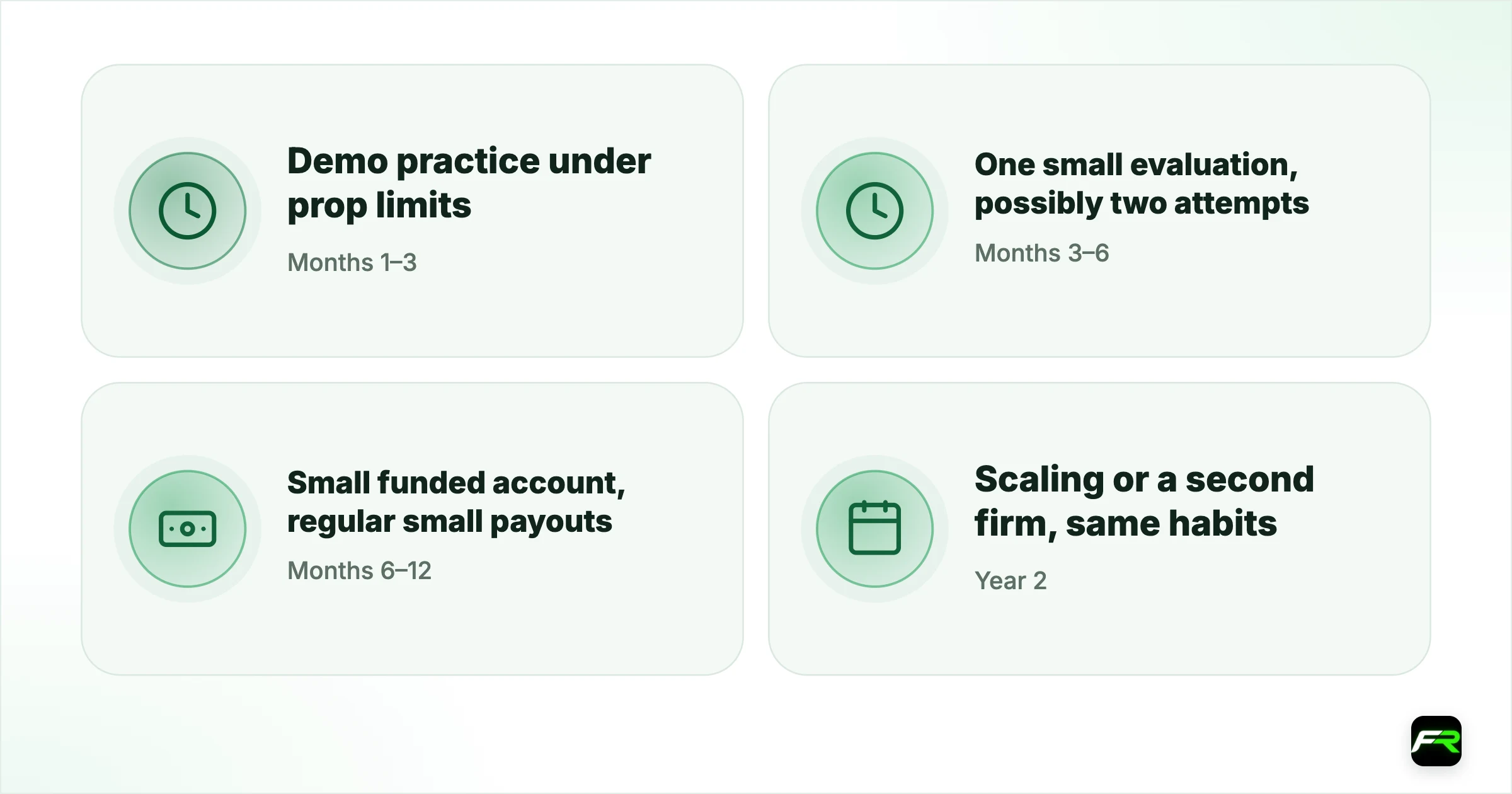
| Stage | Typical focus | Income |
|---|---|---|
| Months 1–3 | Demo practice under prop limits | None |
| Months 3–6 | One small evaluation, possibly two attempts | None yet; fees paid |
| Months 6–12 | Small funded account, regular small payouts | Modest, uneven |
| Year 2 | Scaling or a second firm, same habits | Larger, if the account survives |
This is a sketch of what a careful path can look like, not a promise. Many traders spend longer in the first two stages, and that is the right place to be until the demo record says otherwise.
- Measure progress by months funded, not by the largest payout.
- Treat the first year’s income as a bonus on learning, not a salary.
Key terms
| Term | Meaning |
|---|---|
| Profit split | The share of funded-account profit the firm pays you, such as 80 or 90 per cent |
| Payout cycle | How often you can request a payout, such as every 14 days |
| Scaling | An increase in account size after meeting the firm’s conditions |
| Net income | Payouts minus fees, payment costs and tools, before tax |
Cite this guide
FX Recap, "How Much Can You Realistically Make With a Prop Firm?", updated 14 October 2026, https://fxrecap.com/prop-trading/how-much-can-you-make-with-a-prop-firm
Free to quote with a link. Journalists: data and comment in our press room.
Frequently asked
How much do prop firm traders make?
Account size times monthly return times split. At 2 per cent a month on a $100,000 account with an 80 per cent split, that is $1,600 a month, but only for the months you keep the account. Many funded traders are never paid: Topstep reports 33.3 per cent of its funded participants received a payout in 2025.
What is a realistic monthly return on a prop account?
One to two per cent a month, sustained without breaching the loss limits, is a strong result. Higher returns usually require more risk, which makes losing the account more likely.
What is FTMO's average reward?
FTMO's pricing table shows an average reward per 2-Step account size, such as €5,957 for $100,000, without stating the period. Treat it as FTMO's own indication, not a monthly figure.
Can you make a living from prop trading?
A small number of consistent traders do, usually across several accounts and after a long record. For most, it is a supplement at best, and many are not paid at all.
What costs come out of prop firm payouts?
Challenge fees and add-ons net of refunds, payment and withdrawal fees, tools such as a VPS, and tax where you live.
Can I make more by trading several prop accounts?
Income rises with capital, but so does risk. Accounts trading the same idea lose together, so a single bad day can breach several at once.
Related reading
The team behind this guide
Researched, checked and approved by five forex specialists
Every guide is written, fact-checked and edited before it goes live, and updated when the facts change. Spotted an error? Tell us.