 IC Markets

 3:09
 2:39
 2:10
 2:18
 3:43
 8:42




































What a Prop Firm Challenge Actually Involves
One step, two steps, three steps, or instant funding. The route changes the price, the time, and the rules you trade under.
 WriterAbir KhanWriterWrites the guides · checks every figure against primary sources View profileAbout Abir →

 Market analysisTanbir Habib RiyadForex & Crypto AnalystForex and crypto analyst · technical and fundamental analysis View profileAbout Tanbir →

 Fact-checking & riskJannatul FerdaushFact-Checker & Risk AnalystFact-checks every figure · risk analysis · Applied Statistics, University of Dhaka View profileAbout Jannatul →

 Trading reviewJowel RanaForex TraderForex trader · reviews guides from a trader's view View profileAbout Jowel →

 Final approvalRanjan N. MondolForex TraderForex trader · signs off every guide View profileAbout Ranjan →

A prop firm challenge is a paid test. You trade an account to a profit target without breaking the drawdown rules, and if you finish clean the firm gives you a funded account and a profit split. The test comes in a few shapes, and picking the wrong one wastes both the fee and the weeks it takes.
The routes
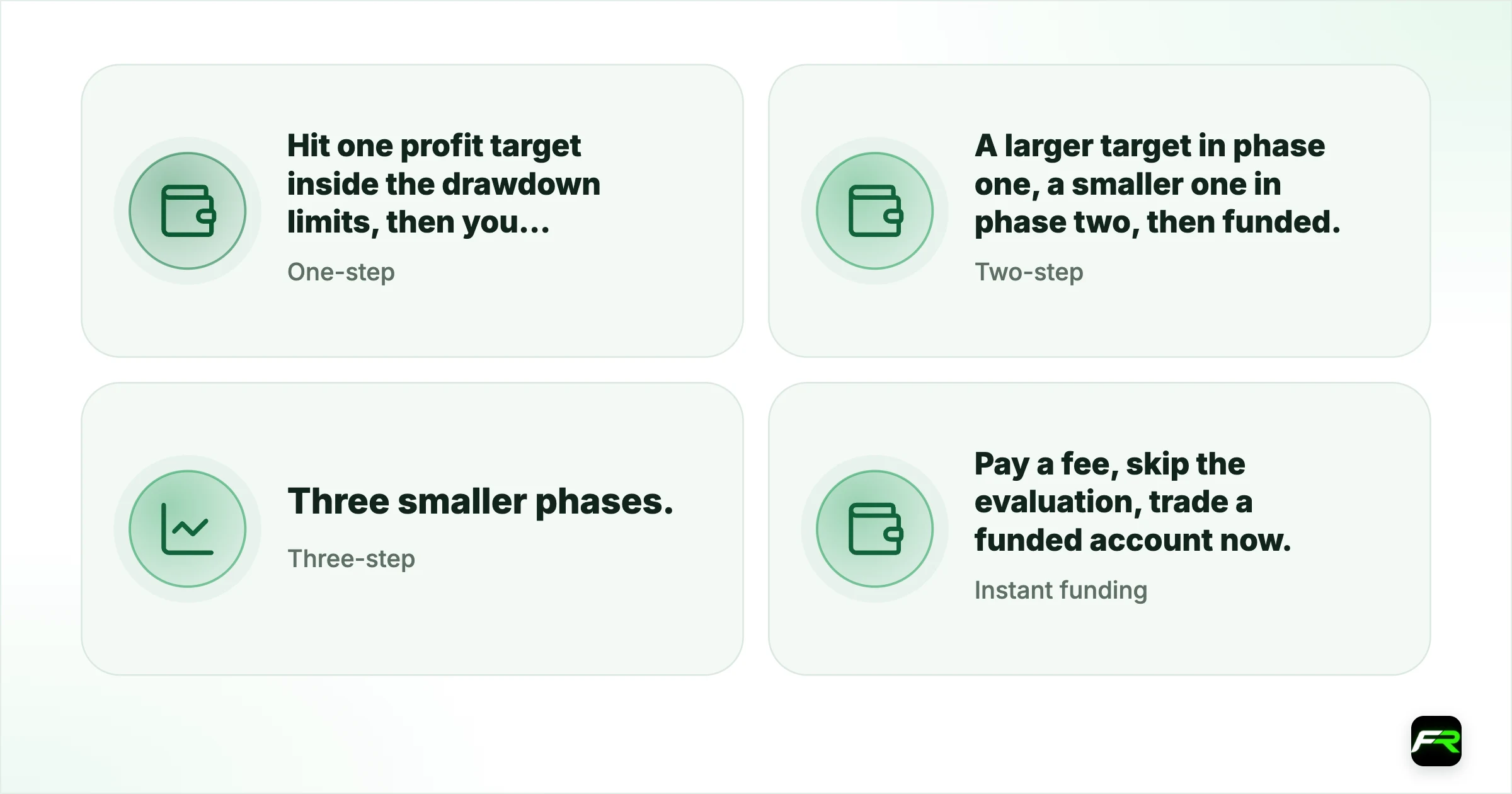
| Route | How it works | Trade-off |
|---|---|---|
| One-step | Hit one profit target inside the drawdown limits, then you are funded. | Faster and cheaper, but usually a tighter daily loss limit. |
| Two-step | A larger target in phase one, a smaller one in phase two, then funded. | The standard. More time, lower fee per dollar of funding, looser daily limits. |
| Three-step | Three smaller phases. | Cheapest entry fee, slowest, more chances to breach a rule. |
| Instant funding | Pay a fee, skip the evaluation, trade a funded account now. | No target to clear, but usually a strict consistency cap and a higher price. |
Expect weeks, not days: most firms set a minimum number of trading days, and a two-step takes longer than a one-step. Add reset fees if you breach and retry, and budget for the whole route to your first payout, not just the first fee.
Watch this on video
Prop Firm Challenges Explained, in 2:34
Prop firm challenges, honestly: fees, the target and loss limits, why the daily limit fails so many traders, and how payouts work.
The numbers that define a challenge
- Profit target. Commonly 8 to 10 per cent in phase one, 4 to 5 per cent in phase two.
- Maximum daily loss. Often 4 to 5 per cent of the starting balance or equity. Breach it once and the account is gone.
- Maximum overall drawdown. Usually 8 to 12 per cent, either fixed to the starting balance or trailing your highest equity.
- Minimum trading days. Often 3 to 5, to stop a single lucky day passing you.
- Time limit. Many firms have dropped this, but some still cap phase one at 30 days.
The daily loss limit is what fails most traders, not the profit target. A 5 per cent daily limit on a $100,000 account is $5,000, and it usually counts open trades at their worst point during the day, not just closed losses.
Position sizing for the target
The maths is the same as any account: risk a fixed fraction per trade, and let the number of trades do the compounding. On a $100,000 evaluation with an 8 per cent target and a 5 per cent daily limit, risking 1 per cent ($1,000) per trade at 1:2 reward gives you a $2,000 gain per winner. Eight winners clear the target, and you can lose four in a row without touching the daily limit.
Nadia took a $100,000 two-step challenge and tried to pass in three days by risking 4 per cent a trade. Two losses in one session put her down 8 per cent, past the 5 per cent daily limit, and the account was closed. The reset fee was $180. On the retry she risked 1 per cent, passed phase one in 19 days, phase two in 11, and has held the funded account for four months.
Trade the challenge at the size you would use on the funded account. Passing with reckless size just means you blow the funded account instead, and that one is not cheap to replace.
Challenge formats at firms we have checked
| Firm and plan | Targets | Daily / maximum loss | Minimum days |
|---|---|---|---|
| FTMO 2-Step | 10%, then 5% | 5% / 10% static | 4 per phase |
| FTMO 1-Step | 10% | 3% / 10% trailing | None (Best Day Rule) |
| FundedNext Stellar 2-Step | 8%, then 5% | 5% / 10% static | 5 per phase |
| FundedNext Stellar 1-Step | 10% | 3% / 6% static | 2 |
| Topstep $50K Combine | $3,000 | $1,000 / $2,000 trailing | None (55% consistency) |
What happens after you pass
- The firm reviews your trades for rule breaches.
- You complete identity checks if not done already.
- You sign or accept the funded-account terms.
- You receive funded-account credentials, sometimes with a different account type or rules.
- Payout conditions start counting from your first funded trade.
Read the funded-stage terms when you receive them. Some rules, such as FTMO’s news restriction on Standard accounts, apply only from this stage.
Free trials and demos before paying
Many firms let you practise their rules before buying. FTMO offers free trials under its challenge rules. A trial is the best way to check that the platform, the daily reset time and the loss limits work the way you expect, and that your method survives them, before any money changes hands.
A trader runs an FTMO free trial for two weeks and finds their worst day reaches 3.6 per cent twice. That rules out a 1-Step with its 3 per cent daily limit, so they buy a 2-Step instead and pass with room to spare.
Treat a challenge as a test of a method you already have, not a place to learn one. Learning costs less on demo.
Key terms
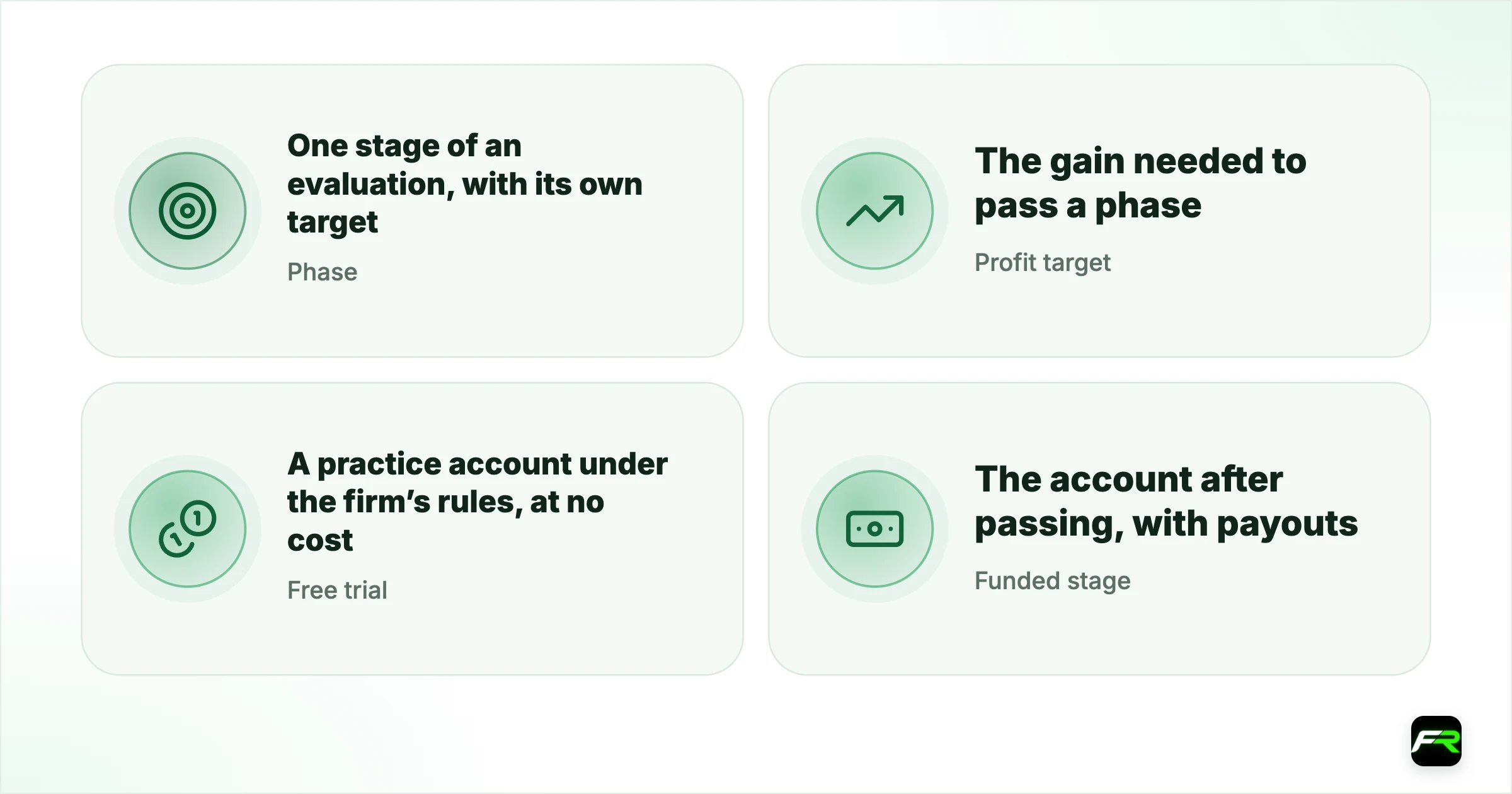
| Term | Meaning |
|---|---|
| Phase | One stage of an evaluation, with its own target |
| Profit target | The gain needed to pass a phase |
| Free trial | A practice account under the firm’s rules, at no cost |
| Funded stage | The account after passing, with payouts |
Related guides
For each part of a challenge, see these guides.
- One-step vs two-step: which format suits your losing and winning days.
- The daily loss limit: how it is measured, why equity counts and how to stay inside it.
- Minimum trading days: what counts as a day and how to finish early targets safely.
- A plan to pass a two-step: from demo practice to the first funded month.
Cite this guide
FX Recap, "What a Prop Firm Challenge Actually Involves", updated 9 September 2026, https://fxrecap.com/prop-trading/prop-firm-challenge-explained
Free to quote with a link. Journalists: data and comment in our press room.
Frequently asked
How long does it take to pass a prop firm challenge?
A one-step challenge usually takes 15 to 45 days, a two-step 30 to 90. Counting resets and the funded-account waiting period, most successful traders are 60 to 90 days from starting to their first payout. Rushing it is the most common way to fail, because aggressive sizing breaches the daily loss limit.
What is the difference between one-step and two-step challenges?
A one-step challenge has a single profit target and is faster and cheaper, but usually pairs with a tighter daily loss limit. A two-step splits the target across two phases, costs less per dollar of funding, and gives you more room on the daily limit. Two-step is the more forgiving choice for most traders.
Is instant funding better than a challenge?
Instant funding skips the evaluation, so there is no target to clear, but you pay more and usually accept a strict cap on how much of your profit can come from any single day. It suits a trader with a steady, low-variance method and no interest in a multi-week evaluation. It is worse value if you would have passed a normal challenge.
What happens if I fail a challenge?
The account closes and the fee is not refunded. Most firms sell a reset that lets you restart the same phase for a smaller fee, or you can buy a fresh challenge, sometimes at another firm. Before paying for a reset, work out what actually failed you, because the same mistake at the same size fails the retry too.
What happens after I pass a prop challenge?
The firm reviews your trades, completes identity checks, issues funded-account terms and credentials, and payout conditions start counting from your first funded trade.
Can I try a prop challenge for free?
Some firms offer free trials. FTMO, for example, offers free trials under its challenge rules, which are a good way to test your method before paying.
Related reading
The team behind this guide
Researched, checked and approved by five forex specialists
Every guide is written, fact-checked and edited before it goes live, and updated when the facts change. Spotted an error? Tell us.