 IC Markets

 3:09
 2:39
 2:10
 2:18
 3:43
 8:42





































The Prop Firm Consistency Rule, Explained
A consistency rule caps how much of your profit any single day can represent. It stops one lucky day passing you, and it can hold a payout hostage.
 WriterAbir KhanWriterWrites the guides · checks every figure against primary sources View profileAbout Abir →

 Market analysisTanbir Habib RiyadForex & Crypto AnalystForex and crypto analyst · technical and fundamental analysis View profileAbout Tanbir →

 Fact-checking & riskJannatul FerdaushFact-Checker & Risk AnalystFact-checks every figure · risk analysis · Applied Statistics, University of Dhaka View profileAbout Jannatul →

 Trading reviewJowel RanaForex TraderForex trader · reviews guides from a trader's view View profileAbout Jowel →

 Final approvalRanjan N. MondolForex TraderForex trader · signs off every guide View profileAbout Ranjan →

A consistency rule says no single trading day can account for more than a set share of your total profit, usually somewhere between 15 and 50 per cent depending on the firm and the account type. The purpose is to stop a trader passing an evaluation, or unlocking a payout, on one outsized day that owes more to luck than to a method.
How it is measured
Take your best day's profit and divide it by your total profit over the period. If a firm sets the cap at 40 per cent and your best day was $3,000 out of $6,000 total, that day is 50 per cent and you have failed the check. To fix it you either need more profit on other days, or you wait and trade smaller until the ratio comes down.
| Total profit | Best single day | Best day as % of total | Cap 40%? |
|---|---|---|---|
| $6,000 | $1,800 | 30% | Pass |
| $6,000 | $3,000 | 50% | Fail |
| $10,000 | $3,000 | 30% | Pass |
The same best day, $3,000, passes on a $10,000 total and fails on a $6,000 total. That is why the rule bites hardest right after a good day: your total has not caught up yet.
Where it applies
- Evaluation phases. Some firms apply it to passing the challenge, some do not. The one-, two- and three-step routes at many firms judge you only on the target and the drawdown.
- The funded account and payouts. This is where it is most common. Your first withdrawal can be blocked until your profit is spread across enough days.
- Instant funding accounts. Almost always, and usually tighter than on an evaluation, in exchange for skipping it.
A consistency rule can delay a payout you have genuinely earned. If you make most of a month's profit in one strong session, the firm can hold the withdrawal until you trade enough additional days to bring the ratio under the cap, which can mean weeks of trading you did not want to do.
Trading with it
- Aim for several moderate days rather than one big one. Close winners at a planned target instead of letting one run to an outlier.
- After an unusually good day, trade smaller for a while so your total profit grows and the ratio falls.
- If you only want a funded account to trade your own way, check whether the firm has a consistency rule on payouts before you buy. "No consistency rule" firms exist and advertise it.
Priya passed a $50,000 funded account and made $4,100 in her first month, but $2,700 of it came from one trade on a news day. The firm's payout consistency cap was 45 per cent, and that day was 66 per cent of her profit. Her withdrawal was held. She traded small for three more weeks, added $1,400 across twelve days, brought the best day down to 49 per cent, then to 41 after one more week, and the payout cleared six weeks later than she expected.
If your edge is news trading or a small number of large moves, a firm with a strict consistency rule works against your style. Match the rule set to how you actually trade before you pay.
Consistency rules at firms we have checked
| Firm and plan | Rule | If breached |
|---|---|---|
| FTMO 1-Step | 50% Best Day Rule | Per FTMO’s objectives |
| FTMO 2-Step | No additional consistency requirement | — |
| Topstep Trading Combine | Best day under 55% of the profit target | The target rises |
| Topstep XFA Consistency path | Largest day no more than 40% of net profit | Payout waits until met |
| FundedNext Futures Flex (challenge) | Largest day at or under 40% of total profit | Target recalculated upward |
| FundedNext Futures Direct | 20% across withdrawals | Per its rules |
Working out a raised target
Where a breach raises the target rather than failing the account, the new target is usually your best day divided by the cap. FundedNext states the formula as highest daily profit ÷ 40% = new required profit.
On a plan with a $3,000 target and a 40 per cent cap, a trader’s best day is $1,800. The new target becomes $1,800 ÷ 0.40 = $4,500. They now need $4,500 of total profit, $1,500 more than before, spread over other days.
Trading with a consistency rule
- Note your best day so far and the total profit you need for it to fit under the cap.
- After a very good day, trade normal size; trying to repeat it raises the bar further.
- If your method naturally produces a few big days, choose a plan without a cap.
A consistency rule rarely fails a disciplined trader; it mostly slows one down. Plan the extra days rather than fighting them.
Key terms
| Term | Meaning |
|---|---|
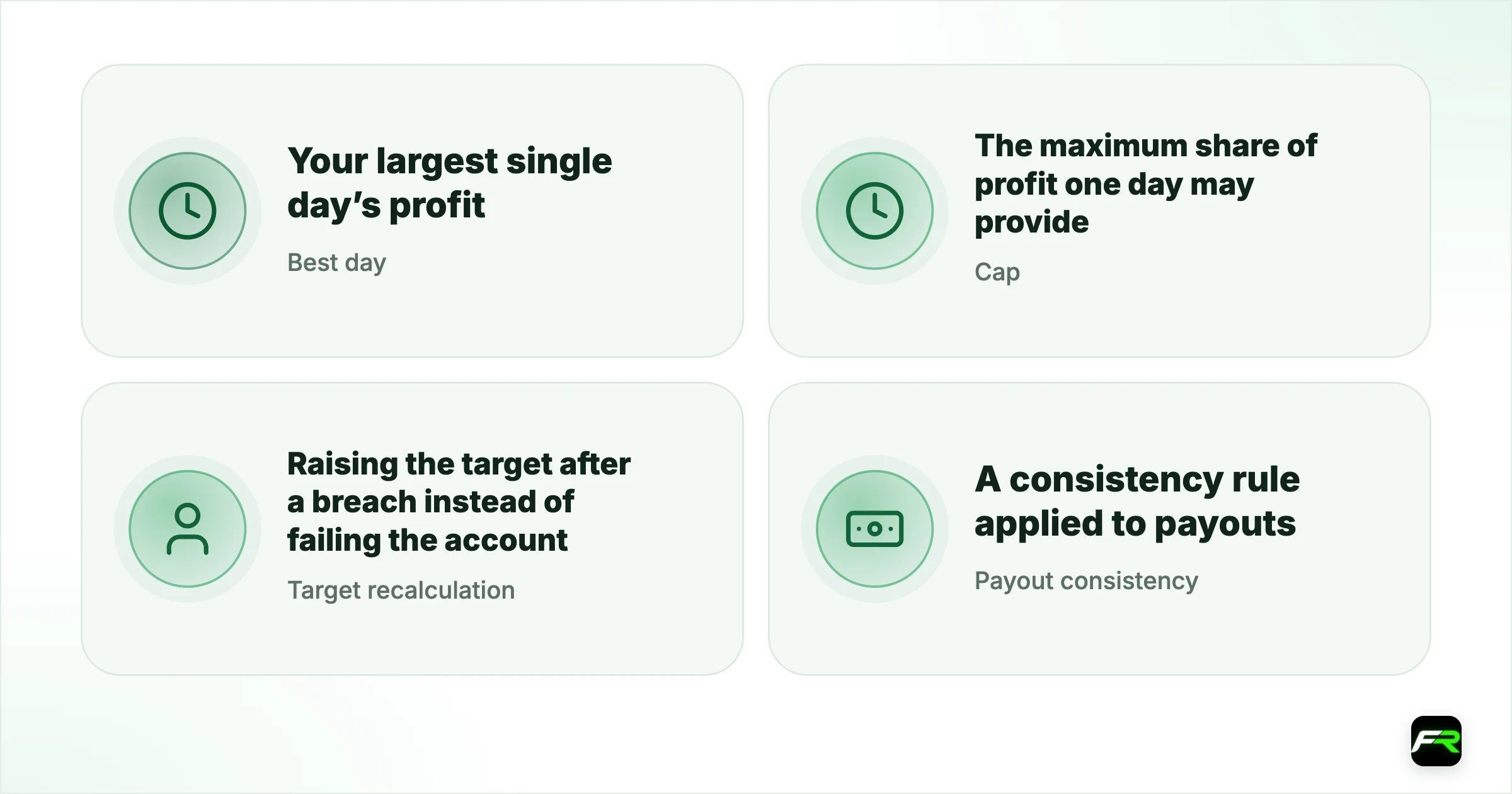
| Best day | Your largest single day’s profit |
| Cap | The maximum share of profit one day may provide |
| Target recalculation | Raising the target after a breach instead of failing the account |
| Payout consistency | A consistency rule applied to payouts |
Related guides
For plans with and without consistency rules, see these guides.
- Firms with no consistency rule: where best-day caps do not apply.
- Topstep review: the futures benchmark, from its own pages.
- One-step vs two-step: which format suits your losing and winning days.
- How payouts work: splits, waiting periods, minimums and reviews.
Cite this guide
FX Recap, "The Prop Firm Consistency Rule, Explained", updated 9 September 2026, https://fxrecap.com/prop-trading/prop-firm-consistency-rule
Free to quote with a link. Journalists: data and comment in our press room.
Frequently asked
What is the consistency rule at a prop firm?
It caps how much of your total profit any single trading day is allowed to represent, commonly 15 to 50 per cent depending on the firm. If your best day exceeds the cap as a share of your total, you fail the check until more profit on other days brings the ratio down. It is meant to stop one lucky day passing an evaluation or unlocking a payout.
Do all prop firms have a consistency rule?
No. Many firms apply it only to payouts, not to passing the evaluation, and some advertise no consistency rule at all. Instant funding accounts almost always have one, and it is usually tighter. Check the specific account type before buying, because the rule can hold up a withdrawal you have earned.
How do I calculate my consistency percentage?
Divide your single best day's profit by your total profit over the assessment period. If the result is above the firm's cap, you have failed the check. The ratio falls as you add profit on other days, so trading smaller after a big day is the usual way to bring it back under the cap.
Can the consistency rule stop me withdrawing?
Yes. If most of a month's profit came from one day, a firm with a payout consistency cap can hold the withdrawal until you trade enough additional days to spread the profit out. This can add weeks. If your method relies on a few large moves, choose a firm without a payout consistency rule.
How is a raised consistency target calculated?
Usually the best day divided by the cap. FundedNext states it as highest daily profit divided by 40 per cent equals the new required profit; a $1,800 best day gives a $4,500 target.
Does Topstep have a consistency rule?
Yes. In the Trading Combine your best day should stay below 55 per cent of the profit target, and its XFA Consistency payout path caps the largest day at 40 per cent of net profit.
Related reading
The team behind this guide
Researched, checked and approved by five forex specialists
Every guide is written, fact-checked and edited before it goes live, and updated when the facts change. Spotted an error? Tell us.