 IC Markets

 3:09
 2:39
 2:10
 2:18
 3:43
 8:42


































The Real Cost of Getting Funded
The challenge fee is the price of one attempt. Most traders need more than one, so the real cost of a funded account is the fee divided by your chance of passing.
 WriterAbir KhanWriterWrites the guides · checks every figure against primary sources View profileAbout Abir →

 Market analysisTanbir Habib RiyadForex & Crypto AnalystForex and crypto analyst · technical and fundamental analysis View profileAbout Tanbir →

 Fact-checking & riskJannatul FerdaushFact-Checker & Risk AnalystFact-checks every figure · risk analysis · Applied Statistics, University of Dhaka View profileAbout Jannatul →

 Trading reviewJowel RanaForex TraderForex trader · reviews guides from a trader's view View profileAbout Jowel →

 Final approvalRanjan N. MondolForex TraderForex trader · signs off every guide View profileAbout Ranjan →

A $100,000 challenge looks cheap next to $100,000 of your own capital. FTMO lists €540 for a $100,000 2-Step Challenge, refunded with your first reward. But a fee buys one attempt, and pass rates are low. The question is not what one attempt costs, but what it costs on average to end up funded and paid.
What the published numbers say
Few firms publish outcomes. Topstep does: in 2025, 16.8 per cent of its evaluations were passed, and 33.3 per cent of traders who reached a funded account received a payout. Those are one futures firm’s figures, not an industry average, but they are the clearest numbers available, and they show two filters, not one.
| Step | Topstep’s 2025 figure | Out of 1,000 evaluations |
|---|---|---|
| Evaluations passed | 16.8% | 168 traders funded |
| Funded traders who received a payout | 33.3% | about 56 traders paid |
On those numbers, roughly 1 in 18 evaluations ended in a payout. That is the base rate any individual trader should start from before adjusting for their own record.
Watch this on video
How Do Prop Firms Make Money?, in 2:57
Most prop firms earn from challenge fees, not trading. Here's what that means for your payout, in under 3 minutes.
Working out your own cost
Divide the fee by your realistic chance of passing to get the expected cost of being funded, then add the cost of resets and of failing again on the funded account.
A trader buys €540 challenges. If they have a 1 in 4 chance of passing each attempt, they should expect to spend about €2,160 in fees before passing once (4 attempts × €540). FTMO refunds the 2-Step fee with the first reward, so the passing attempt’s €540 comes back if they are paid, leaving about €1,620 net. At a 1 in 6 chance the same sum is about €3,240 gross.
The other side of the sum is what a funded account pays. On a $100,000 account at an 80 per cent split, a 2 per cent month is $1,600. A trader who needs four attempts to pass breaks even on the fees in the first good month, if they keep the account.
Costs people forget
- Resets and retries, often sold at a discount, which make it easy to buy attempt after attempt.
- Add-ons such as a higher split, longer time or a removed rule, each priced on top of the fee.
- Non-refundable plans. FTMO refunds the 2-Step fee with the first reward but not the 1-Step or Instant fee; other firms differ.
- Time. Weeks spent on evaluations are weeks not spent building a record on your own account.
- Payment and currency costs on the fee and on payouts.
How to keep the cost down
- Prove the method on a free demo account first, under the same daily and maximum loss limits.
- Start with a smaller, cheaper account size; the rules are the same in percentage terms.
- Set a budget for fees, such as two attempts, and stop when it is spent.
- Prefer plans that refund the fee with the first payout.
Buying challenge after challenge to “win back” fees is the same pattern as chasing losses. If you have failed several, pause and find out which rule failed you; our guide on what to do after failing covers how.
A cost calculator you can do by hand
| Step | Example |
|---|---|
| 1. Fee per attempt | €345 ($50,000 FTMO 2-Step) |
| 2. Your estimated pass chance | 1 in 3 |
| 3. Expected attempts | 3 |
| 4. Expected fees | 3 × €345 = €1,035 |
| 5. Minus refund if paid | − €345 = €690 |
| 6. Plus resets, add-ons, payment fees | Your own figures |
Estimate your pass chance honestly from demo results under the same limits. If you have no demo record, assume your chance is low, because that is what the published figures suggest.
Monthly subscription maths
On a monthly subscription, such as Topstep’s Trading Combine, the cost is the monthly price times the months you take, plus any activation fee when you pass ($149 on Topstep’s Standard route, $0 on its No Activation Fee route with a higher monthly price). A trader who takes four months to pass pays four subscriptions. Estimate your timeline first; our guide to how long passing takes shows how.
The cost of not passing
- Fees spent on attempts that fail.
- Time that could have built a record on a demo or small live account.
- Confidence, which affects the next attempt.
Setting a budget of attempts in advance, such as two, limits all three.
Trader A budgets two €89 attempts at a $10,000 account, passes on the second, and moves up later. Trader B buys a €540 $100,000 account four times in a row after failures. Both learned the same lessons; one paid €178, the other €2,160.
Key terms
| Term | Meaning |
|---|---|
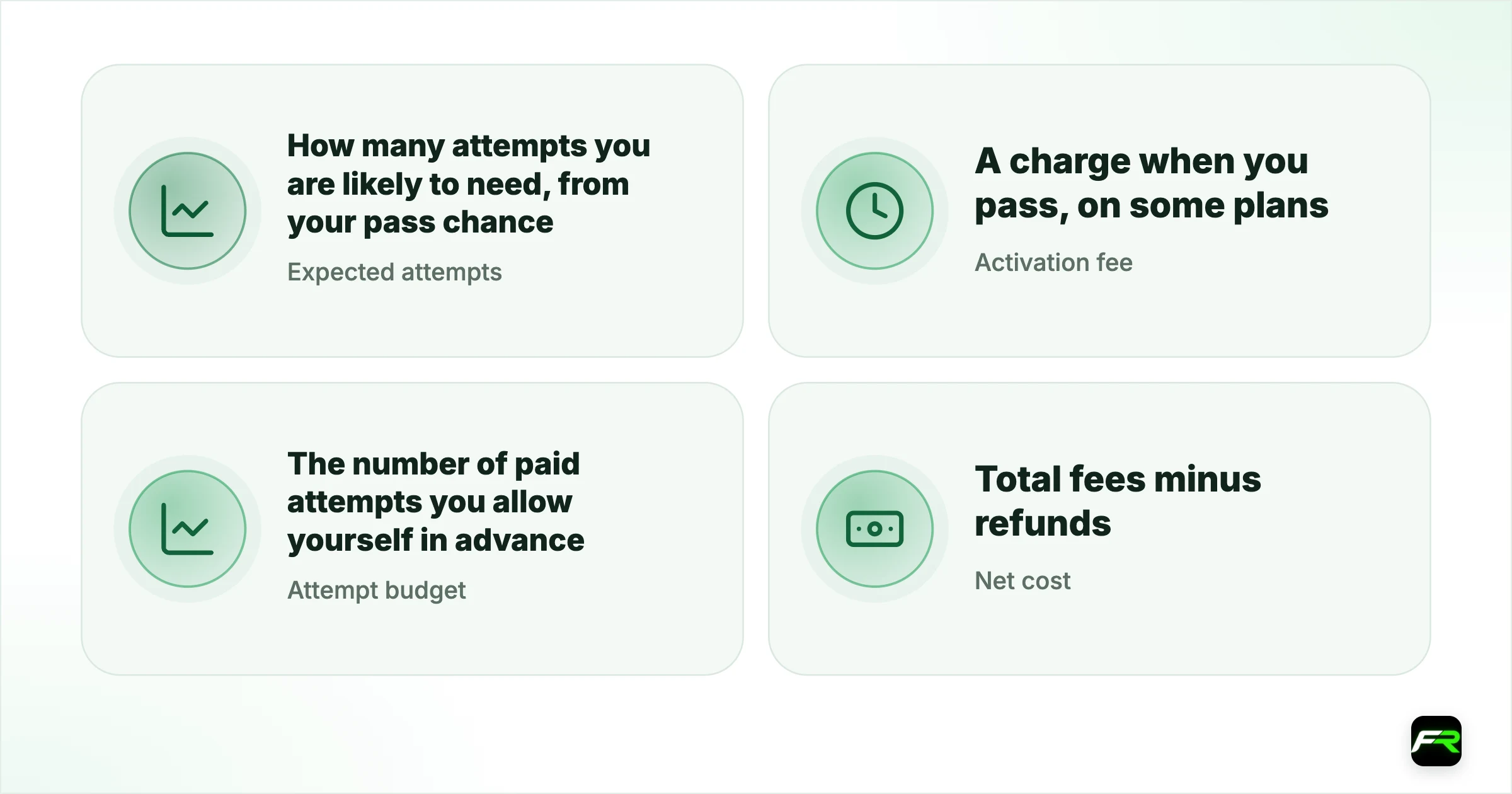
| Expected attempts | How many attempts you are likely to need, from your pass chance |
| Activation fee | A charge when you pass, on some plans |
| Attempt budget | The number of paid attempts you allow yourself in advance |
| Net cost | Total fees minus refunds |
Related guides
These guides cover the inputs to the cost: price, pass chance and time.
- Cheapest challenges: real prices and how to compare them per $1,000.
- Why most traders fail: the five reasons evaluations end, in order.
- Resets and add-ons: what each extra buys and when it is worth paying.
- Is prop trading worth it?: an honest cost-benefit, with a self-test before you pay.
The short version
The real cost is the fee multiplied by the attempts you are likely to need, minus refunds, plus extras. Estimate it honestly from a demo record, set a budget of attempts, and start small.
Cite this guide
FX Recap, "The Real Cost of Getting Funded", updated 14 October 2026, https://fxrecap.com/prop-trading/real-cost-of-getting-funded
Free to quote with a link. Journalists: data and comment in our press room.
Frequently asked
How much does it really cost to get funded by a prop firm?
The fee divided by your chance of passing. At €540 a challenge and a 1 in 4 chance, expect about €2,160 in fees before passing once, less any fee the firm refunds with your first payout.
What percentage of traders pass prop firm challenges?
Few firms publish it. Topstep reports that 16.8 per cent of its evaluations were passed in 2025, and that 33.3 per cent of funded traders received a payout, or roughly 1 in 18 evaluations ending in a payout.
Is the challenge fee refunded?
Sometimes. FTMO refunds the 2-Step Challenge fee with your first reward but not the 1-Step or FTMO Instant fee. Check each firm's terms.
Is a prop firm cheaper than trading my own money?
Only if you pass and keep the account. The fee caps your loss per attempt, but repeated attempts add up, and the funded account has strict rules. A trader with a proven method can come out ahead; a trader still learning usually pays more in fees than they would lose on a small live account.
How do I estimate my chance of passing a prop challenge?
From a demo record under the same daily and maximum loss limits. Without one, assume a low chance; Topstep, for example, reports 16.8 per cent of its 2025 Combines were passed.
How much does Topstep cost in total?
The monthly Combine subscription times the months you take, plus an activation fee when you pass: $149 on the Standard route, or $0 on the No Activation Fee route with a higher monthly price.
Related reading
The team behind this guide
Researched, checked and approved by five forex specialists
Every guide is written, fact-checked and edited before it goes live, and updated when the facts change. Spotted an error? Tell us.