 IC Markets

 3:09
 2:39
 2:10
 2:18
 3:43
 8:42


































Which Prop Firms Have Shut Down, and Why
Several well-known firms have closed or frozen withdrawals with little warning. The pattern is worth knowing before you hand one your fee.
 WriterAbir KhanWriterWrites the guides · checks every figure against primary sources View profileAbout Abir →

 Market analysisTanbir Habib RiyadForex & Crypto AnalystForex and crypto analyst · technical and fundamental analysis View profileAbout Tanbir →

 Fact-checking & riskJannatul FerdaushFact-Checker & Risk AnalystFact-checks every figure · risk analysis · Applied Statistics, University of Dhaka View profileAbout Jannatul →

 Trading reviewJowel RanaForex TraderForex trader · reviews guides from a trader's view View profileAbout Jowel →

 Final approvalRanjan N. MondolForex TraderForex trader · signs off every guide View profileAbout Ranjan →

A prop firm is a small financial company, and small financial companies fail. When one does, funded traders can lose access to their accounts and any pending payout overnight. The recent closures share a pattern, and that pattern is the useful part.
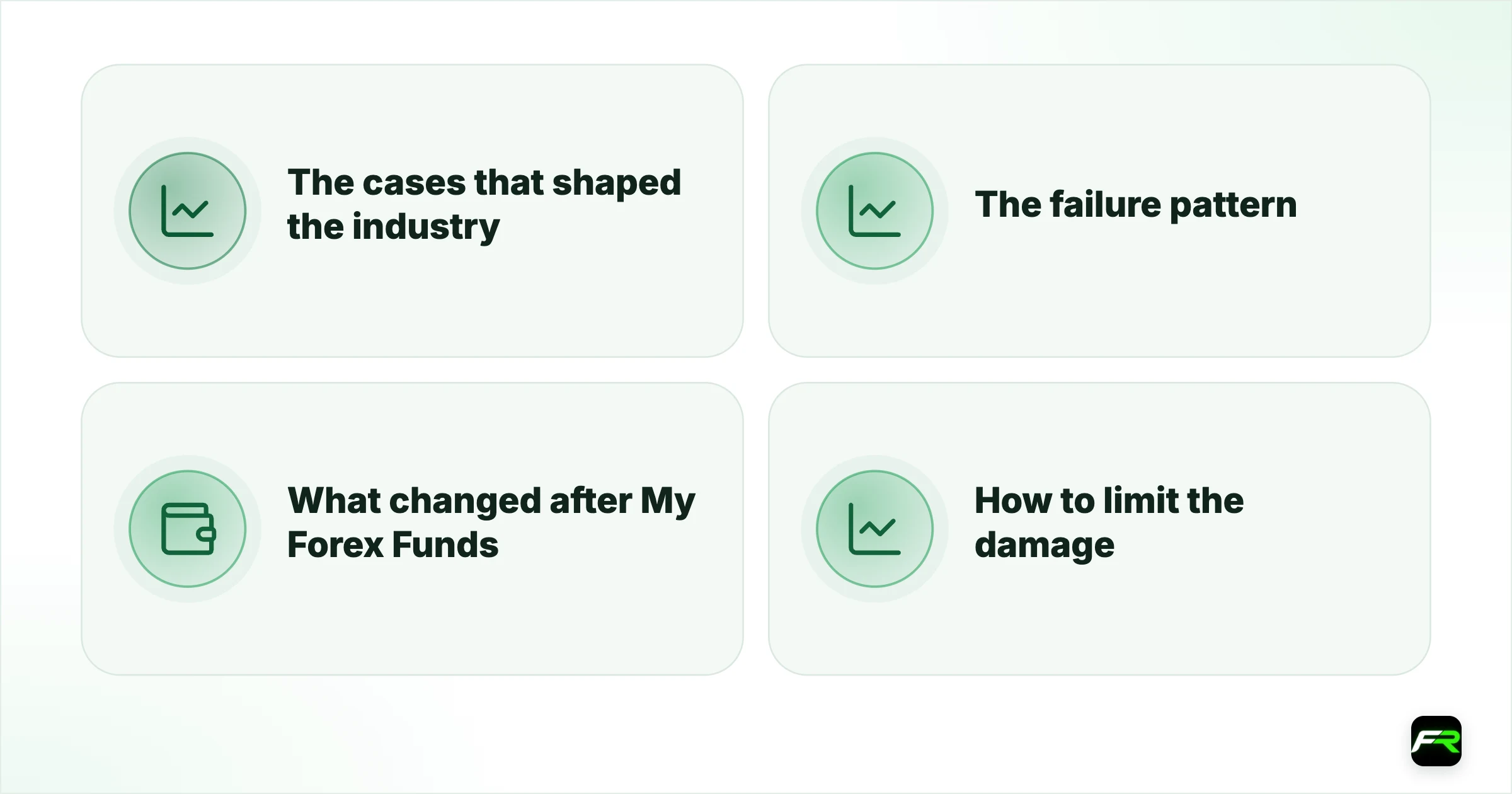
The cases that shaped the industry
| Firm | What happened | When |
|---|---|---|
| My Forex Funds | Stopped operating when the US CFTC sued it in August 2023, alleging fraud; the CFTC said more than 135,000 customers had paid at least $310 million in fees. In May 2025 a court-appointed Special Master recommended dismissing the complaint with prejudice as a sanction for the CFTC's conduct. | 2023 to 2025 |
| Various smaller firms | A steady stream of newer firms have closed after a payment-processor cut-off, a platform ban, or simply running short of cash to pay winners. | 2024 to 2026 |
The My Forex Funds story cuts both ways. The regulator's own conduct was criticised by the court's Special Master, which tells you the legal picture is unsettled. But customers still lost access to their accounts while the case played out, which tells you regulatory action is itself a risk.
The failure pattern
Most closures run through one or more of these:
- Payment processor cut-off. A card processor drops the firm, sales stop, and a B-book firm that lives on new sales runs out of cash within weeks.
- Platform ban. MetaQuotes or another platform provider revokes the firm's licence, and it cannot onboard or, sometimes, pay existing traders.
- Too many winners. A pure demo firm pays winners from losers' fees. A run of profitable payouts with slowing sign-ups turns the margin negative.
- Regulatory action. An investigation freezes accounts whether or not it is eventually upheld.
- Rule changes as a warning sign. Firms in trouble often tighten payout rules, add consistency caps, or delay withdrawals shortly before closing.
Withdrawals slowing down, support going quiet, and payout rules changing at short notice are the signals that most often precede a closure. If you see them, take a payout while you can rather than building the balance up.
What changed after My Forex Funds
The better firms adopted a set of practices, and their absence is now a red flag:
- KYC at sign-up, not held back until your first withdrawal. Verifying only at payout is a known stalling tactic and a live enforcement target.
- Client funds held in accounts separate from the firm's operating money.
- Public, dated payout reports rather than a scrolling feed of testimonials.
- A named parent company and a jurisdiction you can identify.
No regulator has yet put a specific framework for retail prop firms in force. Expect the rules to tighten over time, and expect some firms not to survive the transition.
How to limit the damage
- Never treat a funded account as savings. Withdraw profit on the firm's earliest allowed schedule.
- Spread capital across firms rather than scaling up with one.
- Favour firms with a multi-year payout record over a new firm with a better split.
- Keep your own records: every fee paid, every payout received, every dated screenshot of your account.
Sam had a $100,000 funded account and $3,200 in profit awaiting a scheduled payout when his prop firm stopped operating. There was no withdrawal, no support reply, and no legal route worth the cost. His takeaway was not to quit prop trading but to take every payout the moment it was allowed, and to keep no more than one payout cycle of profit sitting in any single firm.
The question is not whether prop firms are a scam. Most of the large ones pay. The question is what happens to your account if the firm has a bad quarter, and the honest answer is that you are an unsecured creditor of a lightly regulated company. Price that in, and withdraw early.
A checklist after any closure news
- Confirm the news from an official source, not a social media post.
- Request any eligible payout at firms you use, as a precaution.
- Check whether the firm you use shares a payment processor or platform with the closed one.
- Review how much you are owed at each firm and reduce it.
Closures cluster when a shared provider withdraws, so news about one firm can be a signal about others.
Key terms
| Term | Meaning |
|---|---|
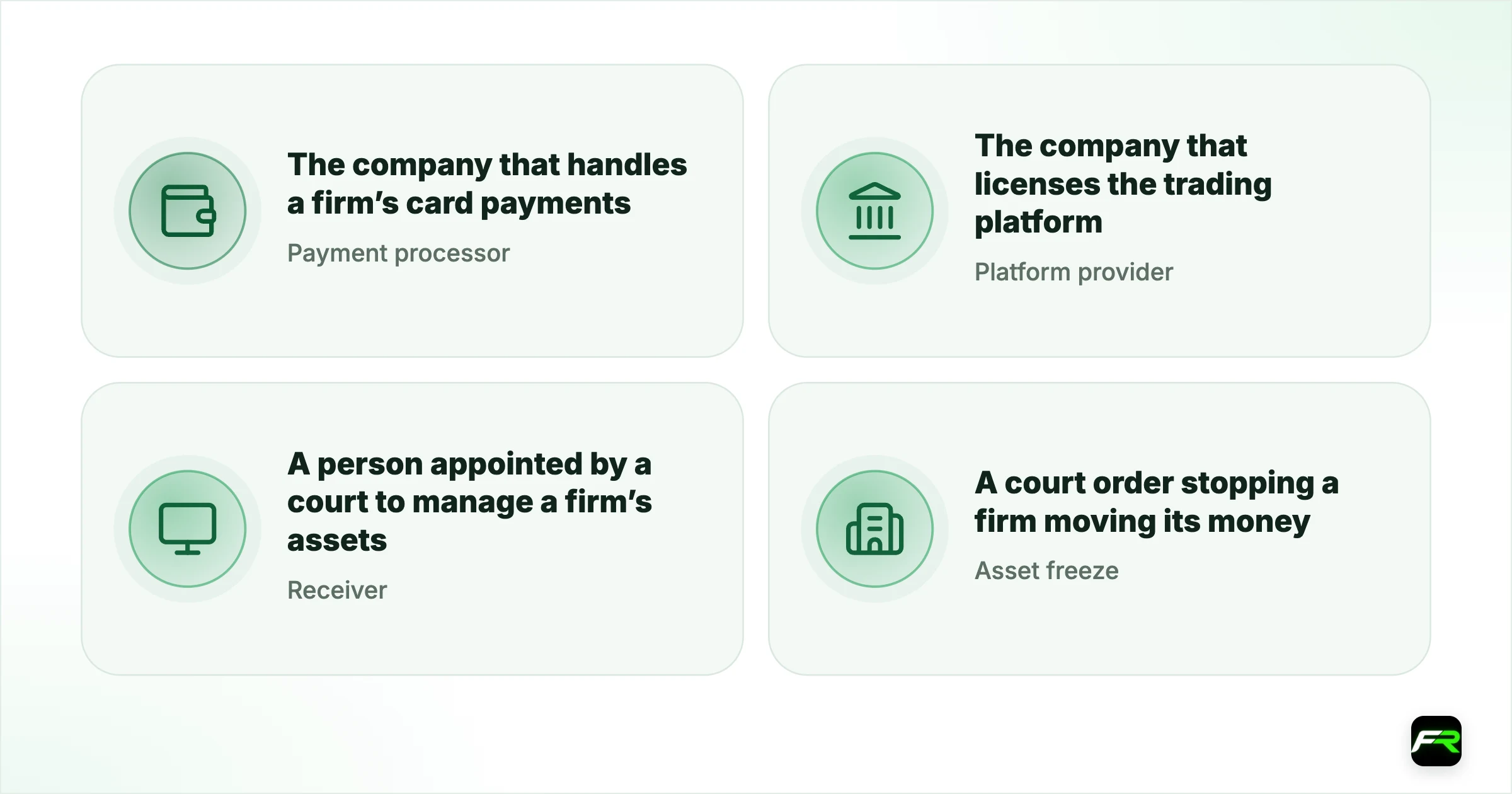
| Payment processor | The company that handles a firm’s card payments |
| Platform provider | The company that licenses the trading platform |
| Receiver | A person appointed by a court to manage a firm’s assets |
| Asset freeze | A court order stopping a firm moving its money |
Related guides
For how to protect yourself, see these guides.
- If a firm closes: what you lose, what you can do and how to limit the risk.
- The My Forex Funds case: the court record, step by step.
- Checking a firm pays: evidence to trust, evidence to ignore and a scoring sheet.
- Withdrawal problems: fair refusals, warning signs and how to write to a firm.
Lessons that carry over
- Take payouts on every eligible cycle.
- Keep balances owed by any one firm small.
- Prefer firms with long, dated payout records.
- Watch for slower payouts and rule changes, and act early.
- Keep records of fees, payouts and messages.
Every closure so far has rewarded traders who followed these habits and punished those who let balances build.
Cite this guide
FX Recap, "Which Prop Firms Have Shut Down, and Why", updated 9 September 2026, https://fxrecap.com/prop-trading/prop-firms-that-shut-down
Free to quote with a link. Journalists: data and comment in our press room.
Frequently asked
Which major prop firms have shut down?
My Forex Funds, once among the largest retail prop firms, stopped operating in August 2023 when the US CFTC sued it, alleging fraud and saying more than 135,000 customers had paid at least $310 million in fees. In May 2025 a court-appointed Special Master recommended that the complaint be dismissed with prejudice, as a sanction for the CFTC's conduct in the case. A number of other firms have closed after payment-processor cut-offs or cash shortfalls.
What happens to my account if a prop firm closes?
You usually lose access to the account and any pending payout, with little practical recourse because most firms are lightly regulated and based offshore. Funded balances are not real trading capital you can claim; they are a contract with a company that has stopped operating. Withdrawing profit early and not concentrating capital in one firm are the only real protections.
How can I tell a prop firm is in trouble?
Withdrawals slowing or being delayed, support becoming unresponsive, and payout rules being tightened or consistency caps added at short notice are the common warning signs before a closure. If you see them, take a payout rather than growing your balance.
Are prop firms getting regulated?
No regulator has yet put a specific framework for retail prop firms in force, and the My Forex Funds case showed how uncertain enforcement can be. The direction is still toward more oversight, so expect tighter rules on client-money handling and KYC, and expect some firms not to survive the change.
What should I do when a prop firm I don't use closes?
Check whether your own firm shares its payment processor or platform, request any eligible payout as a precaution, and reduce what you are owed.
Related reading
The team behind this guide
Researched, checked and approved by five forex specialists
Every guide is written, fact-checked and edited before it goes live, and updated when the facts change. Spotted an error? Tell us.