 IC Markets

 3:09
 2:39
 2:10
 2:18
 3:43
 8:42





































Regulated Prop Firms: Which Ones Actually Hold a Licence
Almost no retail prop firm is regulated as a prop firm. A few sit inside a licensed broker group, and that is a different, stronger thing.
 WriterAbir KhanWriterWrites the guides · checks every figure against primary sources View profileAbout Abir →

 Market analysisTanbir Habib RiyadForex & Crypto AnalystForex and crypto analyst · technical and fundamental analysis View profileAbout Tanbir →

 Fact-checking & riskJannatul FerdaushFact-Checker & Risk AnalystFact-checks every figure · risk analysis · Applied Statistics, University of Dhaka View profileAbout Jannatul →

 Trading reviewJowel RanaForex TraderForex trader · reviews guides from a trader's view View profileAbout Jowel →

 Final approvalRanjan N. MondolForex TraderForex trader · signs off every guide View profileAbout Ranjan →

Search results are full of "regulated prop firm" claims, and most of them are misleading. There is no licence category for a company that sells funded-account challenges, so a firm calling itself regulated is usually pointing at something else: a payment licence, an offshore company registration, or a group affiliation that does not cover the challenge product you are buying.
As of 2026, the honest position is that the retail prop sector is largely outside financial regulation. No regulator has put a specific framework for retail prop firms in force yet. That does not make prop firms illegal. It means the usual protections, segregated client money enforced by a regulator, a compensation scheme, an ombudsman, mostly do not apply.
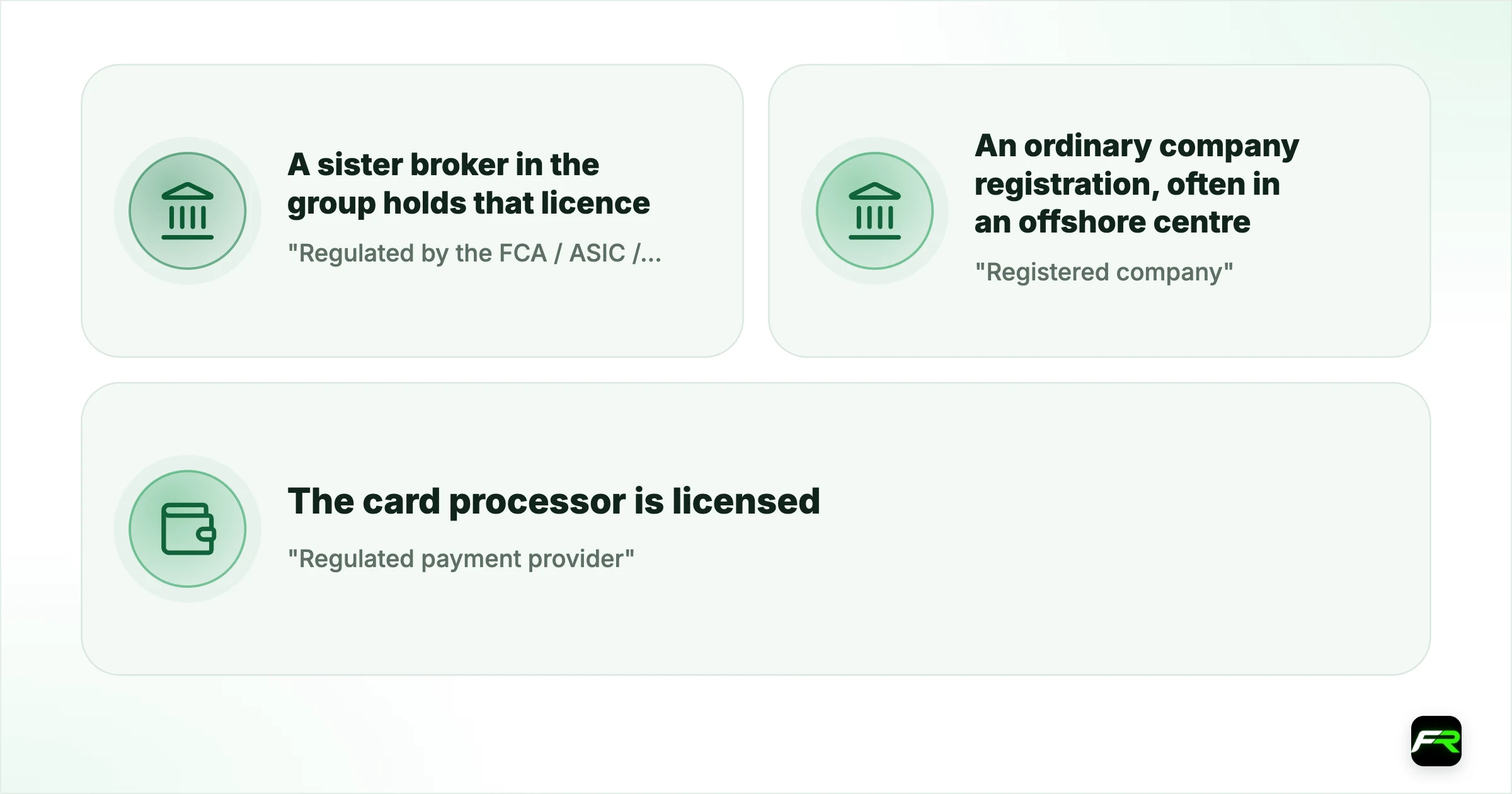
The three things a firm might mean by "regulated"
| Claim | What it usually is | Does it protect your payout? |
|---|---|---|
| "Regulated by the FCA / ASIC / CySEC" | A sister broker in the group holds that licence; the prop entity you contract with often does not | Only if your account is actually with the licensed entity, which is rare |
| "Registered company" | An ordinary company registration, often in an offshore centre | No. That is just incorporation, not financial oversight |
| "Regulated payment provider" | The card processor is licensed | No. That covers the transaction, not the firm |
A brand can display an FCA, CySEC or ASIC licence on its site while routing international clients, including you, to an offshore affiliate that the licence does not cover. The document that matters is your own account agreement. Read which legal entity it names, then check that entity, not the brand, on the regulator's register.
The firms that are genuinely inside a licensed group
A small number of prop firms are subsidiaries of regulated brokers, which means real capital rules and audited client-money handling at the group level. ThinkCapital, which says it is backed by ThinkMarkets, is the clearest example; ThinkMarkets lists FCA, ASIC and CySEC authorisations. A few other broker groups have launched similar arms.
This is not a recommendation of any firm. It is a category to prefer: a prop arm attached to a broker that a Tier-1 regulator already supervises is structurally safer than a standalone firm incorporated offshore, because the group has more to lose and more oversight. That protection covers the broker's own conduct and client-money rules; it does not make the challenge easier to pass or guarantee the prop arm itself is treated as a regulated activity, so check what is actually promised in its own terms.
What to actually check
- The exact legal entity on your account agreement, then that entity on the named regulator's public register.
- Whether client funds are described as held separately from the firm's operating account.
- Whether KYC happens at sign-up. Firms that verify only at your first withdrawal are using a known stalling tactic.
- A dated, multi-year payout record. In an unregulated sector this is the strongest evidence you can get.
Regulation is coming to this sector, and when it does, some firms will not meet the bar. A firm that already operates inside a licensed broker group has less to change, which is another reason to prefer that category now.
When a prop firm says it is regulated, assume it means a different company in the group is regulated, and check whether that applies to your contract. Nine times out of ten it does not. The realistic protection in this sector is a firm with years of paid withdrawals and money held separately, not a licence logo in the footer.
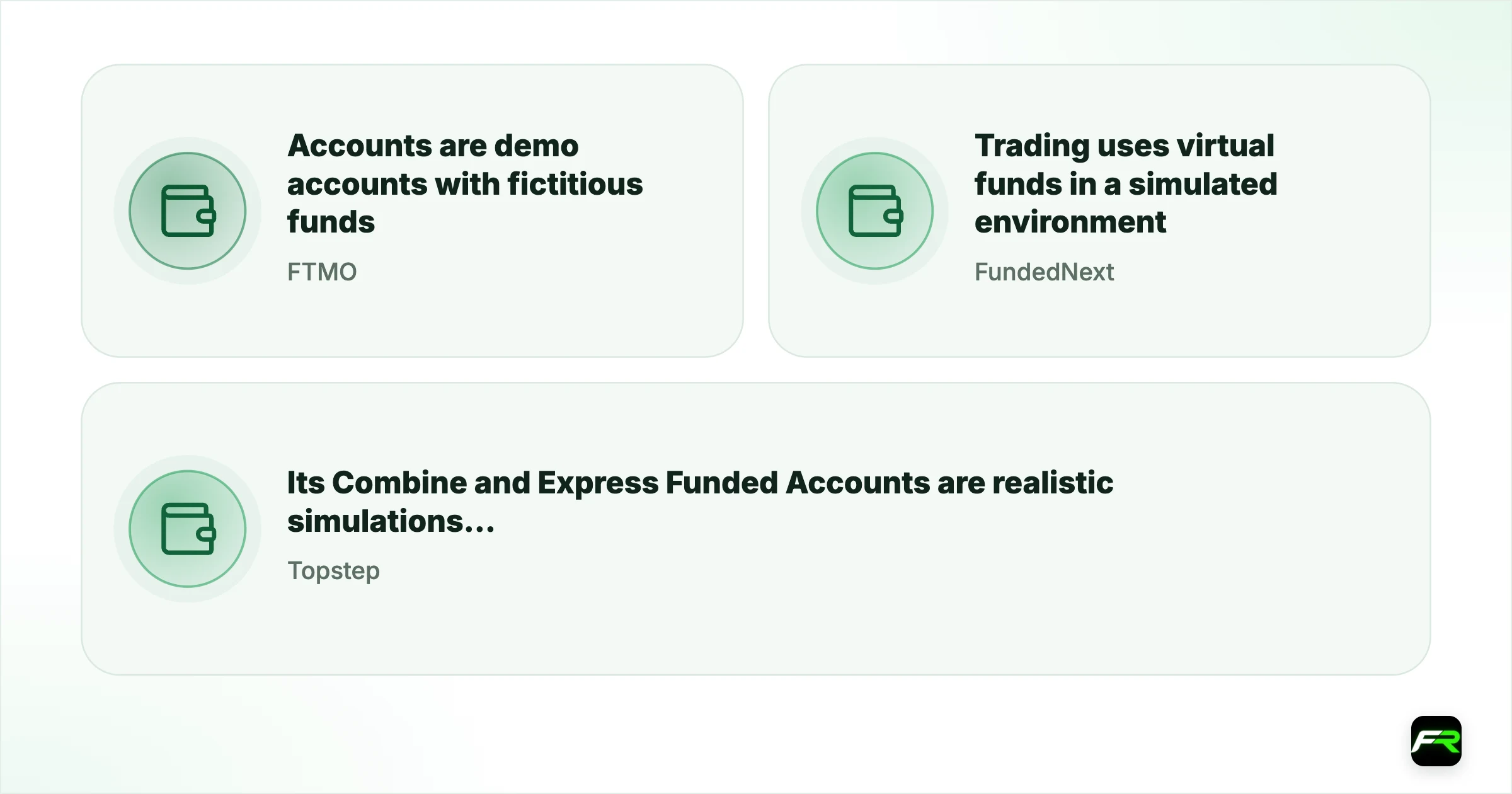
What the firms we have checked say about themselves
| Firm | What its own pages say |
|---|---|
| FTMO | Accounts are demo accounts with fictitious funds |
| FundedNext | Trading uses virtual funds in a simulated environment; it is not a broker, dealer, exchange or investment adviser; contracting company registered in the Comoros |
| Topstep | Its Combine and Express Funded Accounts are realistic simulations operated by TopstepTrader, LLC |
None of these describes itself as a regulated prop firm, which is the honest position: there is no such licence for the evaluation model in the countries we have checked.
Regulators’ lists to check
- Your own country’s financial regulator warnings, such as the FCA’s warning list in the UK.
- India: the RBI Alert List, which names FTMO, Smart Prop Trader and FundedNext.
- South Africa: the FSCA’s register and warnings.
- Nigeria: the SEC’s registration portal and alerts.
- Pakistan: the SECP’s warnings and the SBP’s circulars.
Why a licence logo can mislead
A footer showing several regulators’ logos can belong to a broker in the same group, not to the prop company you contract with. Ask which company in the group holds each licence and which company is named in your terms. If they differ, the licence does not cover your challenge.
A firm’s footer lists an EU regulator’s licence. The terms name a different company, registered offshore, as the contracting party. The licence covers the group’s broker; the prop challenge sits with the offshore company and is not covered by it.
Key terms
| Term | Meaning |
|---|---|
| Contracting company | The company named in the terms that you deal with |
| Group | Related companies under common ownership |
| Warning list | A regulator’s list of unauthorised firms |
| Simulated environment | Trading with virtual funds, not real markets |
Related guides
For the regulatory picture and how to protect yourself, see these guides.
- Prop firm regulation: what regulators have actually done so far.
- Prop trading in India: the RBI Alert List and LRS rules.
- Scams and red flags: warning signs before you pay and after you are funded.
- Checking a firm pays: evidence to trust, evidence to ignore and a scoring sheet.
Cite this guide
FX Recap, "Regulated Prop Firms: Which Ones Actually Hold a Licence", updated 9 September 2026, https://fxrecap.com/prop-trading/regulated-prop-firms
Free to quote with a link. Journalists: data and comment in our press room.
Frequently asked
Are any prop firms actually regulated?
Very few are regulated as prop firms, because no such licence category exists yet. A small number are subsidiaries of regulated brokers, such as ThinkCapital under ThinkMarkets, and inherit group-level oversight. Most "regulated" claims point at a sister company's licence, an offshore company registration, or a payment provider, none of which protects your funded account.
Is it safe to use an unregulated prop firm?
It can be, but the usual protections do not apply, so you are relying on the firm's own conduct. The realistic safeguards are choosing a firm with a multi-year record of paying withdrawals, one that holds client money separately and does KYC at sign-up, and withdrawing profit on the earliest schedule allowed rather than letting a balance build.
Why do prop firms say they are regulated when they are not?
Because a regulated sister broker in the same group holds an FCA, ASIC or CySEC licence, and the marketing borrows it. The prop entity you actually contract with is often a separate, unlicensed offshore company. Check the entity named in your account agreement against the regulator's register to see which one you are dealing with.
Will prop firms be regulated soon?
No framework for retail prop firms is in force yet. The direction is toward more oversight, so expect rules on client money and KYC first, and expect some firms to close rather than comply.
Are any prop firms regulated?
Not as prop firms in the countries we have checked; no licence exists for the evaluation model. Some sit in groups with regulated brokers, and their own pages describe their accounts as simulated.
Which regulator lists should I check?
Your own country's regulator warnings; in India the RBI Alert List, in South Africa the FSCA, in Nigeria the SEC and in Pakistan the SECP and SBP.
Related reading
The team behind this guide
Researched, checked and approved by five forex specialists
Every guide is written, fact-checked and edited before it goes live, and updated when the facts change. Spotted an error? Tell us.