 IC Markets

 3:09
 2:39
 2:10
 2:18
 3:43
 8:42




































Is Prop Trading Worth It? An Honest Cost-Benefit
For a disciplined trader with a tested method and little capital, it can be. For most others, the fees add up faster than the payouts.
 WriterAbir KhanWriterWrites the guides · checks every figure against primary sources View profileAbout Abir →

 Market analysisTanbir Habib RiyadForex & Crypto AnalystForex and crypto analyst · technical and fundamental analysis View profileAbout Tanbir →

 Fact-checking & riskJannatul FerdaushFact-Checker & Risk AnalystFact-checks every figure · risk analysis · Applied Statistics, University of Dhaka View profileAbout Jannatul →

 Trading reviewJowel RanaForex TraderForex trader · reviews guides from a trader's view View profileAbout Jowel →

 Final approvalRanjan N. MondolForex TraderForex trader · signs off every guide View profileAbout Ranjan →

Prop trading sells a simple trade: pay a small fee for the chance to earn on a large account. Whether that is worth it depends almost entirely on one thing you can measure before paying: whether you can already trade profitably inside the firm’s loss limits.
The case for
- A large account for a small, capped cost: FTMO’s $100,000 2-Step costs €540, refunded with the first payout.
- No risk beyond the fee; trading losses on a simulated account are not yours.
- A strict rule set that enforces the discipline most traders lack.
- Payouts of 80 to 90 per cent of profit at established firms.
The case against
- Most attempts fail. Topstep reports 16.8 per cent of its 2025 Combines passed.
- Most funded traders are not paid. Topstep reports 33.3 per cent of funded participants received a payout.
- Fees repeat. Several attempts can cost more than a small live account would have lost.
- The firm is usually unregulated, and your account is usually simulated, so payouts depend on its finances.
A quick test
| Question | If yes | If no |
|---|---|---|
| Have you traded profitably on demo for two months inside a 5% daily and 10% maximum loss? | Prop trading may suit you | Practise on demo first |
| Is your worst day usually under 2.5%? | You can pass most loss rules | Fix sizing before paying |
| Could you lose the fee without changing how you trade? | Buy that account size | Buy a smaller one |
| Would 80–90% of 2% a month on the account be meaningful to you? | The upside is worth it | A live account may suit you better |
Prop account vs a small live account
With €540 you could fund a small live account and keep 100 per cent of the profit, with no rules but the broker’s. The difference is scale: 2 per cent on a $100,000 prop account is $2,000, of which you keep $1,600 to $1,800; 2 per cent on €540 is about €11. If your method is proven, the prop route pays far more. If it is not, a small live account is a cheaper place to find out.
Trader A buys three €345 challenges before passing a $50,000 2-Step, then takes four payouts averaging $700: about $2,800 earned against about €1,035 in fees, less the €345 refunded with the first payout. Trader B buys six challenges and never passes: about €2,000 spent. Both are typical outcomes; which one you are depends on your record before you start.
Prop trading rewards traders who are already consistent and punishes those hoping it will make them consistent. Find out which one you are on a demo account. It costs nothing.
The hidden costs and benefits
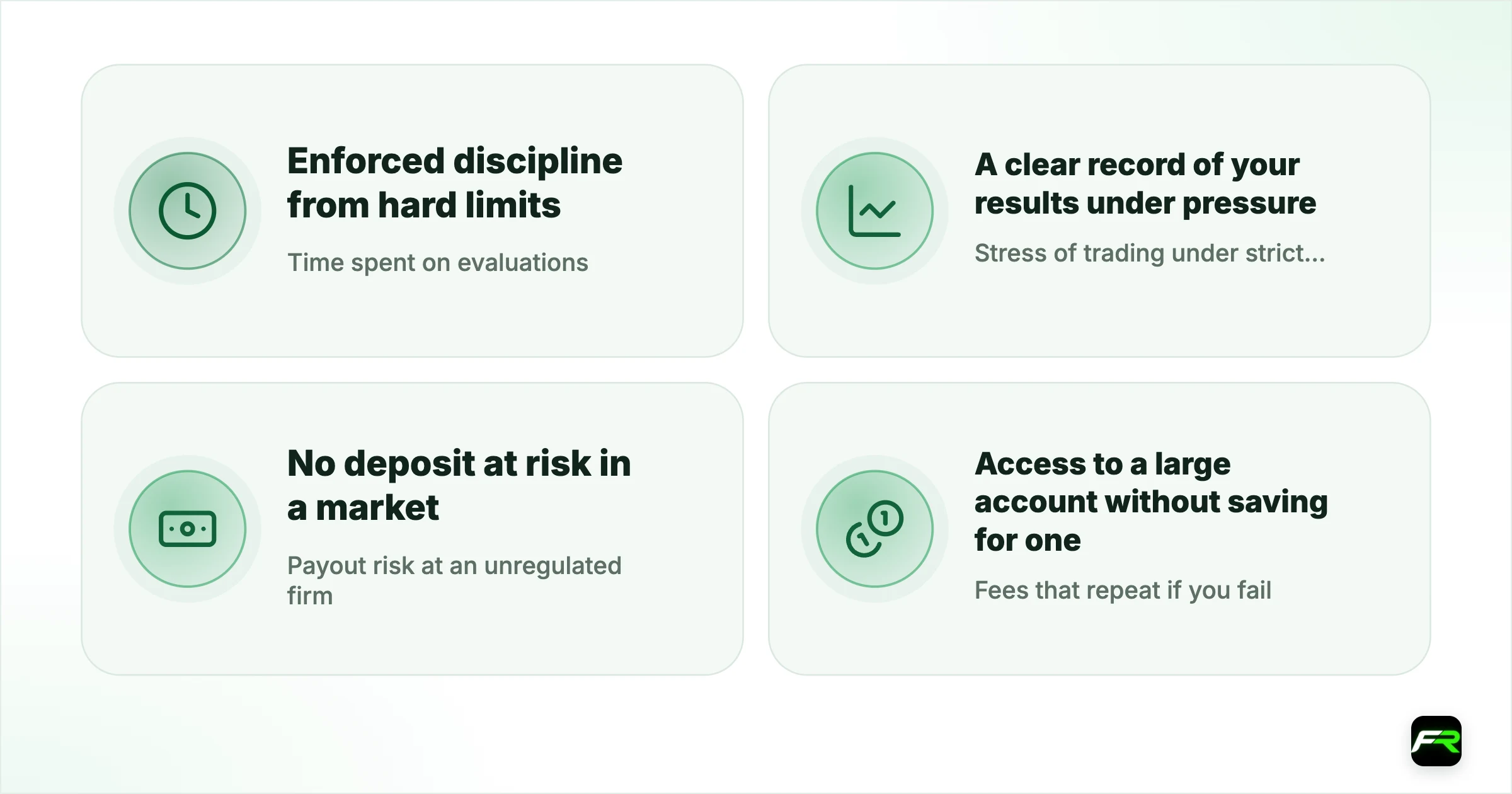
| Hidden cost | Hidden benefit |
|---|---|
| Time spent on evaluations | Enforced discipline from hard limits |
| Stress of trading under strict rules | A clear record of your results under pressure |
| Payout risk at an unregulated firm | No deposit at risk in a market |
| Fees that repeat if you fail | Access to a large account without saving for one |
For some traders, the discipline alone is worth the fee: strict daily and maximum loss limits force habits that their own accounts never did. For others, the pressure makes them trade worse. Knowing which you are is part of the answer.
Who it suits, and who it does not
- Suits: consistent traders with small capital, a tested method and controlled losing days.
- Suits: traders who want the structure of external rules.
- Does not suit: beginners still learning how markets move.
- Does not suit: traders who cannot afford to lose the fee, or who trade worse under pressure.
- Check first: traders in countries where the regulator restricts payments to offshore forex platforms, such as India and Pakistan.
A one-year decision framework
- Three months on demo under prop limits. If not profitable inside the limits, stop here.
- One small, refundable challenge at a firm with a long payout record.
- If passed, three months of small, regular payouts.
- Only then consider larger accounts or scaling.
After three months on demo under a 5 per cent daily and 10 per cent maximum loss, a trader’s record shows two profitable months and one flat, with a worst day of −2.2 per cent. That clears step one, so they buy one small refundable challenge, with a budget of two attempts.
“Is it worth it?” is easiest to answer after a demo trial under the real limits. It costs nothing and gives you your own numbers.
Related guides
These guides cover the costs, odds and earnings behind the decision.
- The real cost of funding: fees divided by your chance of passing.
- How much you can make: the earnings formula and why staying funded matters most.
- Why most traders fail: the five reasons evaluations end, in order.
- What is a prop firm?: the retail prop model in four steps, and how it differs from a broker account.
Alternatives worth comparing
- A small live account at a regulated broker: all the profit, real fills, deposit at risk.
- A free demo account: no cost, no payout, ideal for building a record.
- Exchange-traded products through a licensed local broker, where permitted.
Comparing prop trading with these, rather than with nothing, makes the decision clearer. For many traders, a demo record first and a prop challenge second is the cheapest route.
Key terms
| Term | Meaning |
|---|---|
| Evaluation | The paid test, one or more phases, before a funded account |
| Funded account | The account traded after passing, usually simulated, with payouts as a share of profit |
| Pass rate | The share of evaluations passed; Topstep published 16.8 per cent for 2025 |
| Refundable fee | A fee returned with the first payout, as on FTMO’s 2-Step |
Cite this guide
FX Recap, "Is Prop Trading Worth It? An Honest Cost-Benefit", updated 14 October 2026, https://fxrecap.com/prop-trading/is-prop-trading-worth-it
Free to quote with a link. Journalists: data and comment in our press room.
Frequently asked
Is prop trading worth it?
For a disciplined trader with a method already proven inside the firm's loss limits, it can be: a capped fee buys access to a large account and an 80 to 90 per cent split. For traders still learning, repeated fees usually cost more than they earn.
What percentage of prop traders make money?
Few firms publish it. Topstep reports that in 2025, 16.8 per cent of its Combines were passed and 33.3 per cent of funded participants received a payout.
Is a prop firm better than trading my own money?
If your method is proven, a prop account lets the same returns pay far more. If it is not, a small live account is a cheaper place to learn.
How do I know if I am ready for a prop challenge?
Trade on a free demo account for at least two months under the firm's daily and maximum loss limits. If you stay inside them and make money, you are ready to consider a challenge.
Is prop trading worth it for beginners?
Usually not. A challenge tests discipline under strict rules; beginners usually do better learning on a free demo account first.
How do I decide whether prop trading is worth it?
Trade three months on demo under the firm's limits. If you are profitable inside them, try one small refundable challenge at an established firm; if not, keep practising.
Related reading
The team behind this guide
Researched, checked and approved by five forex specialists
Every guide is written, fact-checked and edited before it goes live, and updated when the facts change. Spotted an error? Tell us.