 IC Markets

 3:09
 2:39
 2:10
 2:18
 3:43
 8:42





































A-Book vs B-Book Prop Firms, and Why It Affects Your Payout
Whether your trades reach a real market decides how a prop firm earns, what it can afford to pay, and what happens when too many traders win.
 WriterAbir KhanWriterWrites the guides · checks every figure against primary sources View profileAbout Abir →

 Market analysisTanbir Habib RiyadForex & Crypto AnalystForex and crypto analyst · technical and fundamental analysis View profileAbout Tanbir →

 Fact-checking & riskJannatul FerdaushFact-Checker & Risk AnalystFact-checks every figure · risk analysis · Applied Statistics, University of Dhaka View profileAbout Jannatul →

 Trading reviewJowel RanaForex TraderForex trader · reviews guides from a trader's view View profileAbout Jowel →

 Final approvalRanjan N. MondolForex TraderForex trader · signs off every guide View profileAbout Ranjan →

The terms come from brokerage. An A-book broker passes your orders to the market; a B-book broker takes the other side itself. Prop firms use the same words for a related question: is your funded account trading real money in a real market, or is it a simulation the firm pays out on?
The three models
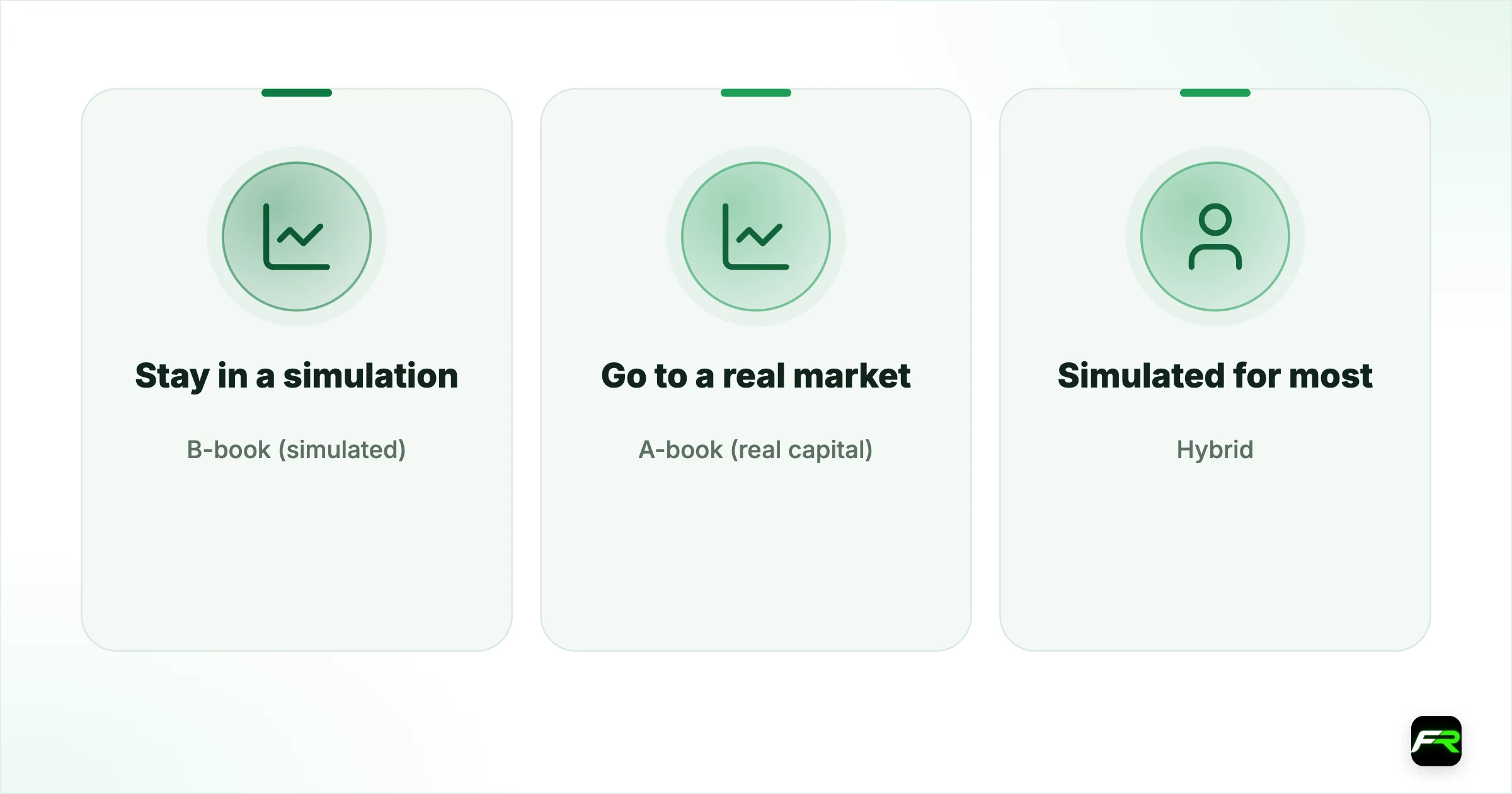
| Model | Your trades | Where payouts come from | Main risk to you |
|---|---|---|---|
| B-book (simulated) | Stay in a simulation | The firm’s revenue, mostly fees | The firm runs short of cash if payouts outgrow sales |
| A-book (real capital) | Go to a real market | Real trading profit, shared | Fewer firms; strict selection |
| Hybrid | Simulated for most; real for proven traders | Both | Depends on how many traders are moved to real capital |
Most retail forex prop firms are B-book: FTMO, for example, says its accounts use fictitious funds. Topstep is closer to a hybrid: its Combine and Express Funded Accounts are simulated, and a small share of traders, 0.71 per cent of Express Funded traders in 2025, are called up to a Live Funded Account trading Topstep’s capital.
Watch this on video
A-Book vs B-Book Prop Firms, in 3:11
Most prop firm funded accounts are simulations paid from fees. Here's why that matters for your payout, and what to check.
Why it affects your payout
In a B-book firm, every payout is a cost to the firm, paid from fees. The firm stays healthy as long as fee income comfortably exceeds payouts. That gives B-book firms a reason to keep rules strict and to scrutinise payouts closely, and it is why a sudden run of winning traders, or a drop in new sign-ups, can push a weak firm into delaying or stopping payouts.
A firm that routes proven traders to real capital earns when they earn. That aligns its interest with yours, but it can afford to do it for only a few traders, which is why real-capital programmes are selective.
What to look for
- A long, dated record of payouts: the best evidence a B-book firm’s finances work.
- Clear disclosure of whether accounts are simulated. Established firms state it.
- A route to real capital, if offered, with published criteria.
- Stable payout rules. Firms under financial strain tend to tighten rules first.
Neither model is a scam in itself. A simulated model that is disclosed and pays reliably is the industry norm; what matters is whether the firm can keep paying. See how to check a firm actually pays.
Where the terms come from
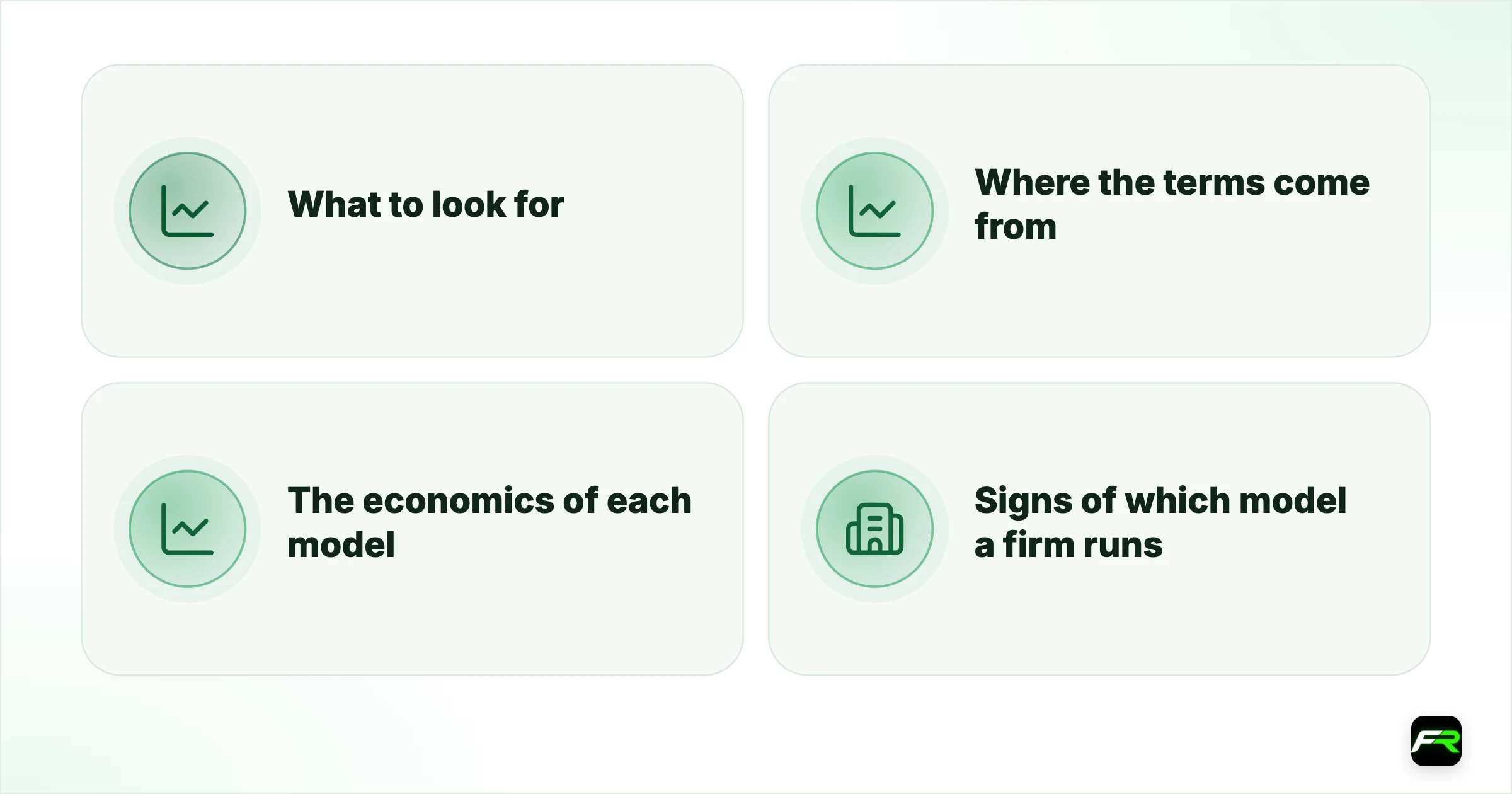
In brokerage, an A-book broker passes client orders to banks or other liquidity providers and earns from spreads and commissions, while a B-book broker keeps the orders in-house and takes the other side, so it gains when clients lose. Many brokers run a mix. Prop firms borrowed the words because their choice is similar: keep traders’ accounts in a simulation and pay out from revenue, or put some traders’ orders into real markets with the firm’s capital.
The economics of each model
| Simulated (B-book style) | Real capital (A-book style) | |
|---|---|---|
| Main income | Challenge fees and resets | A share of real trading profit |
| Main cost | Payouts to funded traders | Trading losses on real capital |
| What the firm wants | Many fees, manageable payouts | Consistently profitable traders |
| What can go wrong | Payouts outgrow fee income | Real losses from traders who were not as good as they looked |
Neither model is risk-free for the firm. A simulated firm is exposed if sales fall; a real-capital firm is exposed to market losses. Most large firms blend the two, keeping most traders simulated and moving a small group to real capital.
Signs of which model a firm runs
- The firm’s own disclosure: established firms state that accounts are simulated, as FTMO and FundedNext do.
- A published route to a live account with criteria, as Topstep has with its Live Funded Account.
- Payout caps per request on simulated stages and none on live ones; Topstep, for example, caps Express Funded payouts per request but not Live Funded ones.
- How the firm talks about payouts: “rewards” or “performance-based rewards” usually signals simulation.
What it means for your strategy
On a simulated account, your results do not affect a real market, so the firm cares less about your fills and more about whether you follow its rules. On a real-capital account, the firm’s own profit depends on your trading, so expect closer attention to slippage, size and behaviour around news. Traders moving from simulated to live stages sometimes find results change for that reason: the market is real, and so are its frictions.
A trader whose simulated account showed tight fills during fast markets moves to a live account and finds a few stop orders now fill several pips worse. Over a month that costs them about 0.3 per cent. Nothing changed in their method; the market stopped being a simulation.
If a firm offers a live stage, read its criteria before you start. Building the record it asks for from day one is easier than reconstructing it later.
The short version
Most retail prop firms run simulated accounts and pay from their revenue; a few move proven traders to real capital. Neither is a scam in itself. Judge the firm on whether it can keep paying, which comes down to its record, its terms and how quickly it pays you.
Related guides
The business model behind a firm shapes its rules, its payouts and what happens if it runs into trouble.
- How prop firms make money: challenge fees, resets and why most firms are fee businesses first.
- Is a funded account real money?: simulated accounts, live stages and where payouts come from.
- Checking a firm pays: evidence to trust, evidence to ignore and a scoring sheet.
- If a firm closes: what you lose, what you can do and how to limit the risk.
Cite this guide
FX Recap, "A-Book vs B-Book Prop Firms, and Why It Affects Your Payout", updated 14 October 2026, https://fxrecap.com/prop-trading/a-book-vs-b-book-prop-firms
Free to quote with a link. Journalists: data and comment in our press room.
Frequently asked
What is a B-book prop firm?
A firm whose funded accounts are simulations, paying traders a share of simulated profit from its own revenue, mostly challenge fees. Most retail forex prop firms work this way; FTMO says its accounts are demo accounts with fictitious funds.
What is an A-book prop firm?
A firm that puts traders' orders into real markets with its own capital and shares the real profit. Few retail firms do this for most traders; some, such as Topstep with its Live Funded Account, move a small share of proven traders to real capital.
Is a B-book prop firm a scam?
Not in itself. It is the industry's standard model and is legal when disclosed. The risk is financial: payouts depend on the firm's revenue, so check its payout record and stability.
How can I tell which model a firm uses?
Read its terms and risk disclosures: established firms say whether accounts are simulated. Look for any published route to a live account and its criteria.
Do B-book prop firms want traders to fail?
Their income depends mostly on fees, so failure does not cost them, but they also need some traders to pass and be paid to keep selling challenges. Their incentive is clear rules and manageable payouts, which is why rules are strict.
Is real-capital prop trading better for traders?
It aligns the firm's interest with yours, but very few traders reach it. Topstep reports that 0.71 per cent of Express Funded traders were called up to a Live Funded Account in 2025.
Can a firm switch me from simulated to live without telling me?
Read the terms: firms describe their stages there. Established firms state which accounts are simulated and how a live stage is reached.
Related reading
The team behind this guide
Researched, checked and approved by five forex specialists
Every guide is written, fact-checked and edited before it goes live, and updated when the facts change. Spotted an error? Tell us.