 IC Markets

 3:09
 2:39
 2:10
 2:18
 3:43
 8:42




































Payout Proof: How to Check a Prop Firm Actually Pays
A prop firm is only as good as its payouts. Here are the checks to make before you buy a challenge, and the ones that matter most.
 WriterAbir KhanWriterWrites the guides · checks every figure against primary sources View profileAbout Abir →

 Market analysisTanbir Habib RiyadForex & Crypto AnalystForex and crypto analyst · technical and fundamental analysis View profileAbout Tanbir →

 Fact-checking & riskJannatul FerdaushFact-Checker & Risk AnalystFact-checks every figure · risk analysis · Applied Statistics, University of Dhaka View profileAbout Jannatul →

 Trading reviewJowel RanaForex TraderForex trader · reviews guides from a trader's view View profileAbout Jowel →

 Final approvalRanjan N. MondolForex TraderForex trader · signs off every guide View profileAbout Ranjan →

Prop firms are mostly unregulated, your funded account is usually simulated, and the payout comes from the firm’s own funds. So the most important question about any firm is simple: does it pay, reliably, under the rules it publishes? Here is how to find out before you pay a fee.
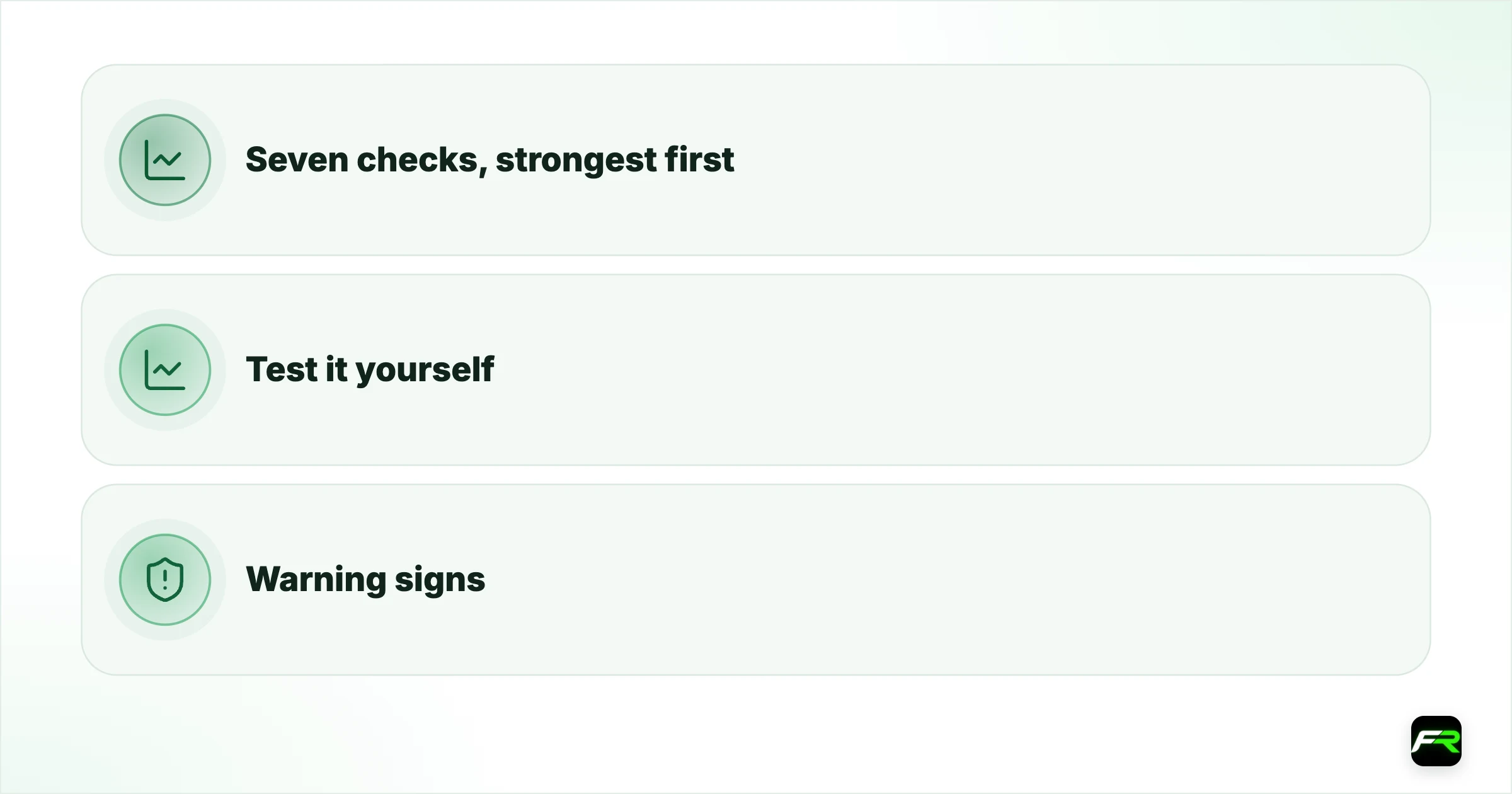
Seven checks, strongest first
- Time in business. Firms that have paid traders through several years and market cycles are the safest bet. FTMO has operated since 2015.
- Published payout totals. Some firms state how much they have paid; FTMO reports more than $650 million in rewards. A figure is a claim, but a firm that publishes one can be held to it.
- Clear payout terms. The split, waiting period, minimum and processing time should be written down. FTMO, for example, publishes a first request on day 14, review in 1 to 2 business days and its payment methods. FundedNext says 99.99 per cent of its rewards are processed within 24 hours.
- Recent trader reports. Read recent reviews from funded traders, looking for payouts received, not passes. A sudden run of “payout denied” or “still waiting” is the strongest warning there is.
- A named company. Find the legal entity in the terms and check it in its country’s company register.
- Stable rules. Firms that rewrite payout rules often, especially just before payout dates, are worth avoiding.
- Payment routes. Several established payout methods are a better sign than crypto only.
Test it yourself
The best proof is your own. Once funded, request a small payout as soon as the rules allow. It tests the review, the identity checks and the payment method with little at stake. If the first small payout is slow or refused without a clear rule, do not build up a large balance there.
Warning signs
- Payout terms that are vague or missing from the site.
- New rules added after you are funded, applied to earlier trades.
- Long or open-ended “review” periods before every payout.
- Very cheap challenges with very large account sizes and a short history.
- Pressure to buy add-ons or new challenges instead of being paid.
Firms have closed with traders’ profits unpaid. See which prop firms have shut down for what that looks like.
Keep your own records: screenshots of your funded balance, every payout request and every reply. They are your evidence if something goes wrong.
Reading payout evidence critically
Firms and their affiliates publish a lot of payout material. Some is strong evidence; some is advertising.
| Evidence | How much it tells you |
|---|---|
| Long operating history with continuous payouts | Strong |
| A published total paid, with a date | Useful, though it is the firm’s own figure |
| Published outcome statistics, such as Topstep’s pass and payout rates | Strong, and rare |
| Dated payout certificates or reports | Useful if they can be checked against named traders |
| Undated screenshots or scrolling payout feeds | Weak |
| Influencer posts with discount codes | Advertising |
Questions to ask support before paying
- Which company pays rewards, and from which country?
- Which payout methods are available to residents of my country?
- How long does a first payout usually take after a request?
- What identity documents will you need, and when?
- Has the payout policy changed in the last year?
The answers matter, and so does how the firm answers. Clear, consistent replies within a day or two are a good sign; vague or evasive ones are not.
Track your own payout record
Once you are funded, keep a simple log of every payout request: the date asked, the amount, the date approved and the date received. Over a few months it shows whether the firm is getting slower, which is one of the most reliable early warnings. Traders who noticed slower payouts early, and took smaller payouts more often, lost the least when firms ran into trouble.
A trader logs five payouts: received in 2, 2, 3, 6 and 11 business days. The trend is clear before any public news. They stop adding risk, request the next payout at the first eligible date, and move new trading to a second firm.
A firm that pays your first small payout quickly is passing your own test. Keep testing it every cycle.
A scoring sheet you can reuse
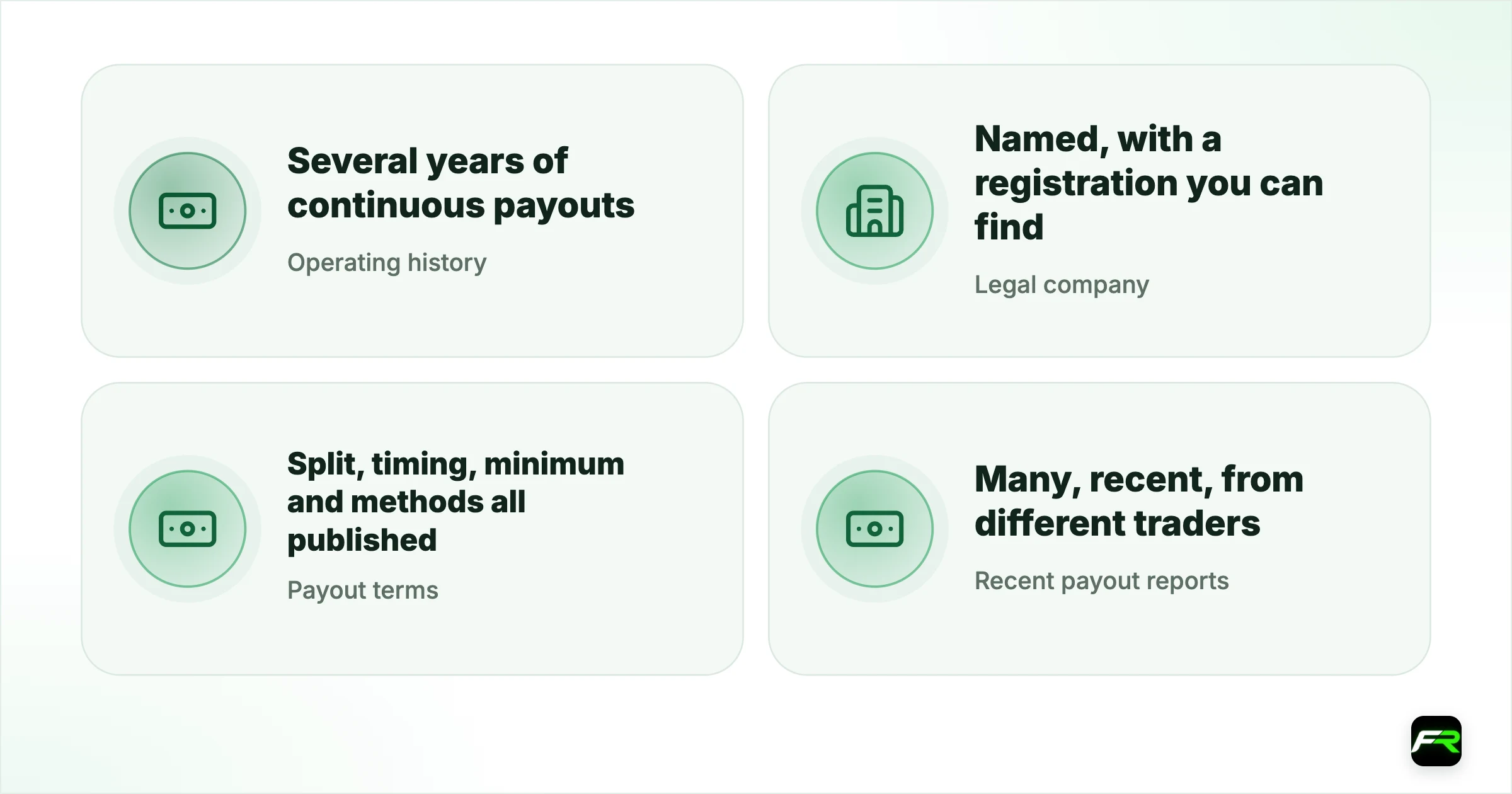
| Check | Score 2 if… | Score 0 if… |
|---|---|---|
| Operating history | Several years of continuous payouts | Under a year, or a recent rebrand |
| Legal company | Named, with a registration you can find | Not named or untraceable |
| Payout terms | Split, timing, minimum and methods all published | Missing or vague |
| Recent payout reports | Many, recent, from different traders | Few, old or only from affiliates |
| Rule stability | No sudden payout rule changes | Recent changes applied to existing accounts |
| Your own test | First small payout paid on time | Delayed without a clear reason |
A firm scoring 10 or more out of 12 is a reasonable candidate. Below 8, the cheapest challenge in the world is not worth the risk. Score again every few months, because firms change.
Pair this with our guides to withdrawal problems and red flags, which cover what to do if the score drops after you are funded.
- Re-score after any change of payment processor or platform.
- Re-score when you see several traders reporting the same payout problem.
- Re-score before buying a larger account at the same firm.
Related guides
Checking a firm’s payouts connects to how payouts work, what goes wrong with them and how to choose a firm in the first place.
- How payouts work: splits, waiting periods, minimums and reviews.
- Withdrawal problems: fair refusals, warning signs and how to write to a firm.
- How to choose a firm: the checklist in order, starting with whether it pays.
- Firms that shut down: the closures so far and the pattern behind them.
Cite this guide
FX Recap, "Payout Proof: How to Check a Prop Firm Actually Pays", updated 14 October 2026, https://fxrecap.com/prop-trading/how-to-check-a-prop-firm-actually-pays
Free to quote with a link. Journalists: data and comment in our press room.
Frequently asked
How do I know if a prop firm really pays?
Check how long it has operated, whether it publishes payout totals and clear payout terms, what recent funded traders report about payouts received, and whether its company can be found in a register. Then test it with a small first payout.
Is FTMO a legit prop firm that pays?
FTMO has operated since 2015 and reports more than $650 million paid in rewards, and it publishes its payout terms. As with any prop firm, your account is simulated and payouts are made under its own terms.
What are the warning signs of a prop firm that will not pay?
Vague payout terms, rules changed after you are funded, open-ended reviews before payouts, very cheap challenges from new firms, and pressure to buy more products instead of being paid.
Should I request a small first payout?
Yes. It tests the firm's process, identity checks and payment method with little at stake before you build up a larger balance.
Are prop firm payout certificates reliable?
They are useful if dated and linked to real, checkable traders, but they are the firm's own marketing. Long operating history and published statistics are stronger evidence.
What should I ask a prop firm before buying?
Which company pays rewards and from where, which payout methods work in your country, how long a first payout takes, what documents are needed, and whether the payout policy has recently changed.
How can I spot a firm slowing its payouts?
Keep a log of every payout request with the dates asked, approved and received. A rising trend over several payouts is an early warning.
Related reading
The team behind this guide
Researched, checked and approved by five forex specialists
Every guide is written, fact-checked and edited before it goes live, and updated when the facts change. Spotted an error? Tell us.