 IC Markets

 3:09
 2:39
 2:10
 2:18
 3:43
 8:42





































Best Prop Firms With No Consistency Rule
If your edge is a few large moves, a consistency rule works against you. These are the account types that do not impose one, and the trade-offs.
 WriterAbir KhanWriterWrites the guides · checks every figure against primary sources View profileAbout Abir →

 Market analysisTanbir Habib RiyadForex & Crypto AnalystForex and crypto analyst · technical and fundamental analysis View profileAbout Tanbir →

 Fact-checking & riskJannatul FerdaushFact-Checker & Risk AnalystFact-checks every figure · risk analysis · Applied Statistics, University of Dhaka View profileAbout Jannatul →

 Trading reviewJowel RanaForex TraderForex trader · reviews guides from a trader's view View profileAbout Jowel →

 Final approvalRanjan N. MondolForex TraderForex trader · signs off every guide View profileAbout Ranjan →

A consistency rule caps how much of your total profit any single day can represent. It is meant to stop a lucky day passing an evaluation or unlocking a payout, and for a steady scalper it barely registers. For a news trader, a breakout trader, or anyone whose month is made by two or three large moves, it is a real constraint that can hold up a payout you have earned. The consistency rule guide explains the mechanics.
"No consistency rule" is a genuine differentiator, and several firms advertise it, mostly on the futures side. As of 2026 the account types commonly cited as having no funded consistency rule include MyFundedFutures on its Pro plan and Take Profit Trader on PRO. On the forex side, FTMO says it has no additional consistency requirements beyond its Trading Objectives, though its 1-Step Challenge has a Best Day Rule. Confirm the current terms on the firm's own site, because this is exactly the kind of rule firms add or remove.
The comparison, for 2026
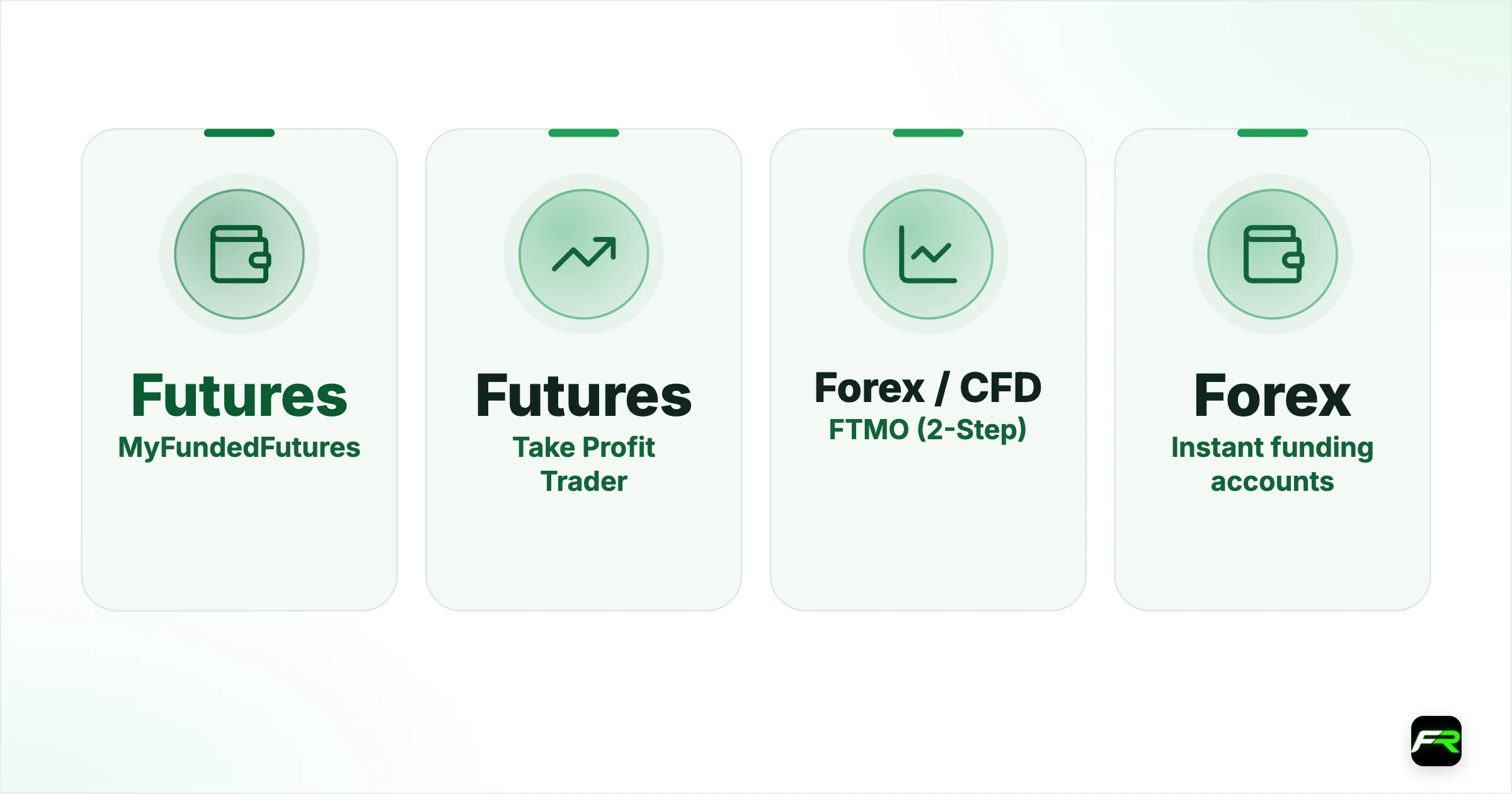
| Firm / plan | Market | Consistency rule | The trade-off to weigh |
|---|---|---|---|
| MyFundedFutures (Pro) | Futures | None on funded | Trailing drawdown; newer firm, shorter record |
| Take Profit Trader (PRO) | Futures | None on funded | Subscription pricing; end-of-day drawdown on some plans |
| FTMO (2-Step) | Forex / CFD | No extra consistency rule | 5% daily and 10% max loss; at least 4 trading days |
| Instant funding accounts (various) | Forex | Usually yes, 15 to 20% | You skip the evaluation but accept the tightest consistency cap |
A firm with no consistency rule often makes up for it elsewhere: a tighter trailing drawdown, an end-of-day drawdown calculation, a shorter operating history, or subscription fees that add up if you take several months to pass. Read the whole rule set, not just the one line you were searching for.
When to actually care about this
- Your strategy relies on a small number of large winners rather than many small ones.
- You trade scheduled news and expect occasional outsized days.
- You have been funded before and had a payout delayed by a consistency check.
If you are a steady intraday trader closing winners at a planned target, a consistency rule is unlikely to bite, and you are better off choosing on payout record and drawdown type. Matching the rule set to how you trade matters more than chasing the absence of any single rule.
Dev made most of his profit on two or three CPI and NFP releases a month. His first firm held a $3,100 payout for five weeks because one day was 61 per cent of the month's profit against a 45 per cent cap. He moved to a futures firm with no funded consistency rule, kept the same approach, and his next payout cleared on the normal schedule. The trade-off he accepted was a tighter trailing drawdown, which he manages by banking partial profit.
Traders search for "no consistency rule" and stop reading there. The firms that drop that rule usually tighten the drawdown instead. Work out which constraint actually fits your trading, because you are choosing which rule to live with, not escaping all of them.
Where consistency rules apply at firms we have checked
| Firm and plan | Consistency rule |
|---|---|
| FTMO 2-Step | No additional consistency requirement beyond its Trading Objectives |
| FTMO 1-Step | 50% Best Day Rule |
| Topstep Trading Combine | Best day under 55% of the profit target |
| Topstep XFA Consistency path | Largest day no more than 40% of net profit |
| FundedNext Futures Flex | 40% in the challenge phase |
| FundedNext Futures Direct | 20% consistency across withdrawals |
Why no-consistency plans suit some traders
Traders whose profits come from a few large days, such as trend followers and news traders where allowed, can be slowed or blocked by consistency caps. A plan without one lets a single strong day count fully towards the target. The trade-off is that such plans often keep other protections, such as minimum trading days or tighter loss limits.
How to check a plan for hidden consistency rules
- Read the evaluation rules and the payout rules separately.
- Search the terms for words like “consistency”, “best day” and “largest day”.
- Check whether a breach fails the account or raises the target.
- Ask support in writing if anything is unclear, and keep the reply.
A trader makes 6 per cent in one day during a 10 per cent challenge. On a plan with a 50 per cent best-day rule, that day is 60 per cent of the target and the trader must earn more before passing. On FTMO’s 2-Step, which has no extra consistency rule, the day simply counts.
Key terms
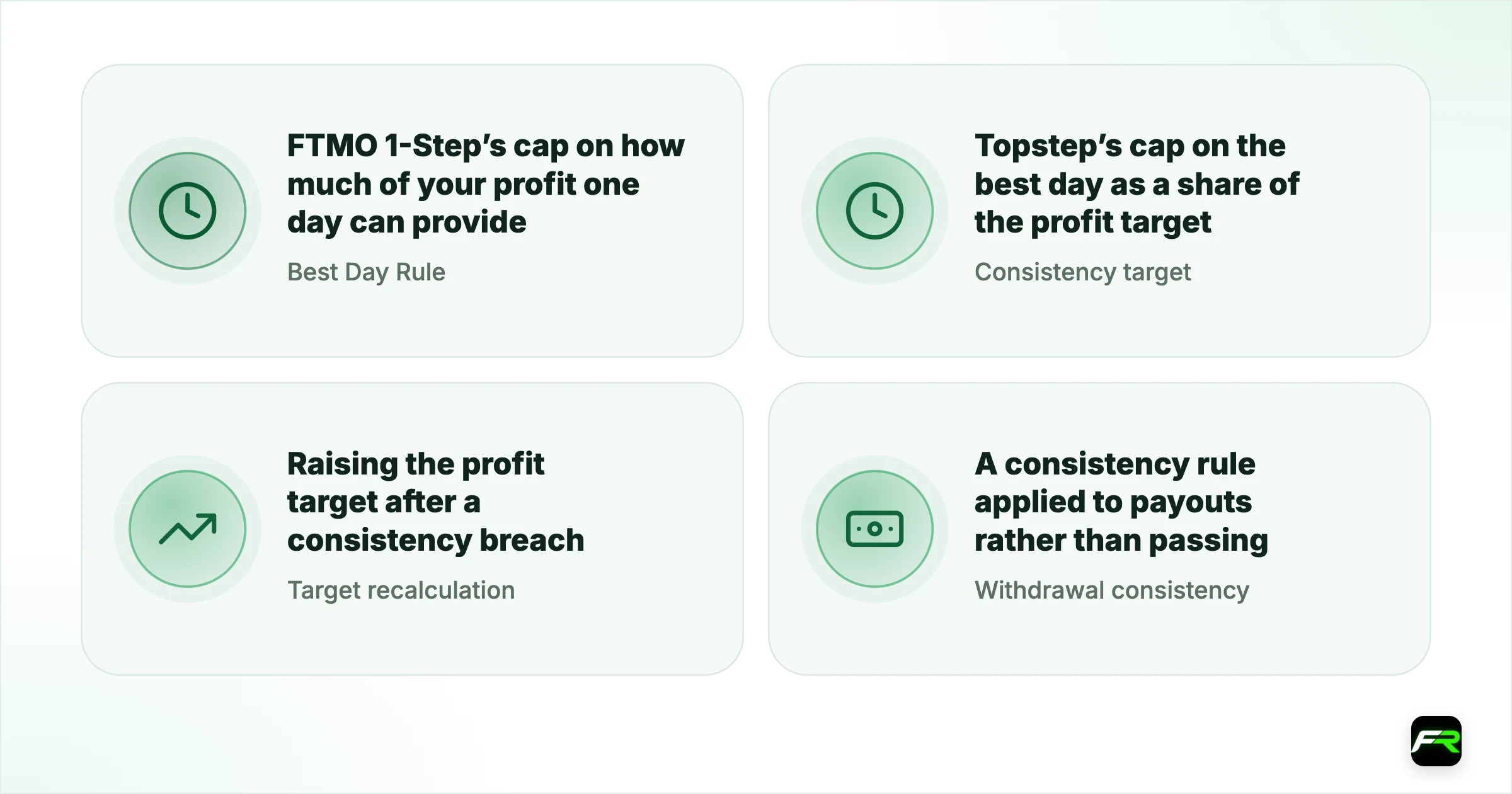
| Term | Meaning |
|---|---|
| Best Day Rule | FTMO 1-Step’s cap on how much of your profit one day can provide |
| Consistency target | Topstep’s cap on the best day as a share of the profit target |
| Target recalculation | Raising the profit target after a consistency breach |
| Withdrawal consistency | A consistency rule applied to payouts rather than passing |
Related guides
For more on consistency and the plans that use it, see these guides.
- The consistency rule: how best-day caps work and when they bite.
- One-step vs two-step: which format suits your losing and winning days.
- FTMO review: rules, payouts and who it suits.
- Topstep review: the futures benchmark, from its own pages.
The short version
If your profits come from a few big days, look for plans without a consistency cap, such as FTMO’s 2-Step, and check the payout rules for hidden ones. If your days are even, a consistency rule costs you little.
Cite this guide
FX Recap, "Best Prop Firms With No Consistency Rule", updated 9 September 2026, https://fxrecap.com/prop-trading/best-prop-firms-no-consistency-rule
Free to quote with a link. Journalists: data and comment in our press room.
Frequently asked
Which prop firms have no consistency rule?
As of October 2026, MyFundedFutures on Pro and Take Profit Trader on PRO say so on their own sites, and FTMO says it has no additional consistency requirements beyond its Trading Objectives on the 2-Step. Terms change often, so confirm on the firm's own site before buying.
What is wrong with a consistency rule?
Nothing, if you trade many small winners. It becomes a problem when your profit comes from a few large moves, because a firm with a payout consistency cap can hold your withdrawal until you trade enough extra days to spread the profit out, which can take weeks.
Do no-consistency-rule firms have a catch?
Usually. They tend to compensate with a tighter or trailing drawdown, an end-of-day drawdown calculation, a shorter track record, or subscription fees that mount up. Read the full rule set rather than choosing on the one rule you searched for.
Should I choose a firm just because it has no consistency rule?
Only if your strategy actually needs it, meaning you rely on a few large winners or trade the news. A steady intraday trader is rarely affected, and is better off choosing on payout history and the type of drawdown the firm uses.
Does FTMO have a consistency rule?
FTMO says its 2-Step has no additional consistency requirement beyond its Trading Objectives. Its 1-Step has a 50 per cent Best Day Rule.
What happens if I break a consistency rule?
It depends on the plan. On some, such as Topstep's Combine and FundedNext Futures Flex, the target rises; on payout rules, a payout may be delayed until the ratio comes back into line.
Related reading
The team behind this guide
Researched, checked and approved by five forex specialists
Every guide is written, fact-checked and edited before it goes live, and updated when the facts change. Spotted an error? Tell us.