 IC Markets

 3:09
 2:39
 2:10
 2:18
 3:43
 8:42




































One-Step vs Two-Step: Which Challenge to Pick
One-step challenges are faster and usually stricter. Two-step challenges take longer and usually give more room. Here is the trade-off with real rules.
 WriterAbir KhanWriterWrites the guides · checks every figure against primary sources View profileAbout Abir →

 Market analysisTanbir Habib RiyadForex & Crypto AnalystForex and crypto analyst · technical and fundamental analysis View profileAbout Tanbir →

 Fact-checking & riskJannatul FerdaushFact-Checker & Risk AnalystFact-checks every figure · risk analysis · Applied Statistics, University of Dhaka View profileAbout Jannatul →

 Trading reviewJowel RanaForex TraderForex trader · reviews guides from a trader's view View profileAbout Jowel →

 Final approvalRanjan N. MondolForex TraderForex trader · signs off every guide View profileAbout Ranjan →

A two-step challenge asks you to hit a profit target twice. A one-step asks once. The obvious conclusion, that one step is easier, is often wrong, because firms compensate with tighter rules.
Side by side at FTMO
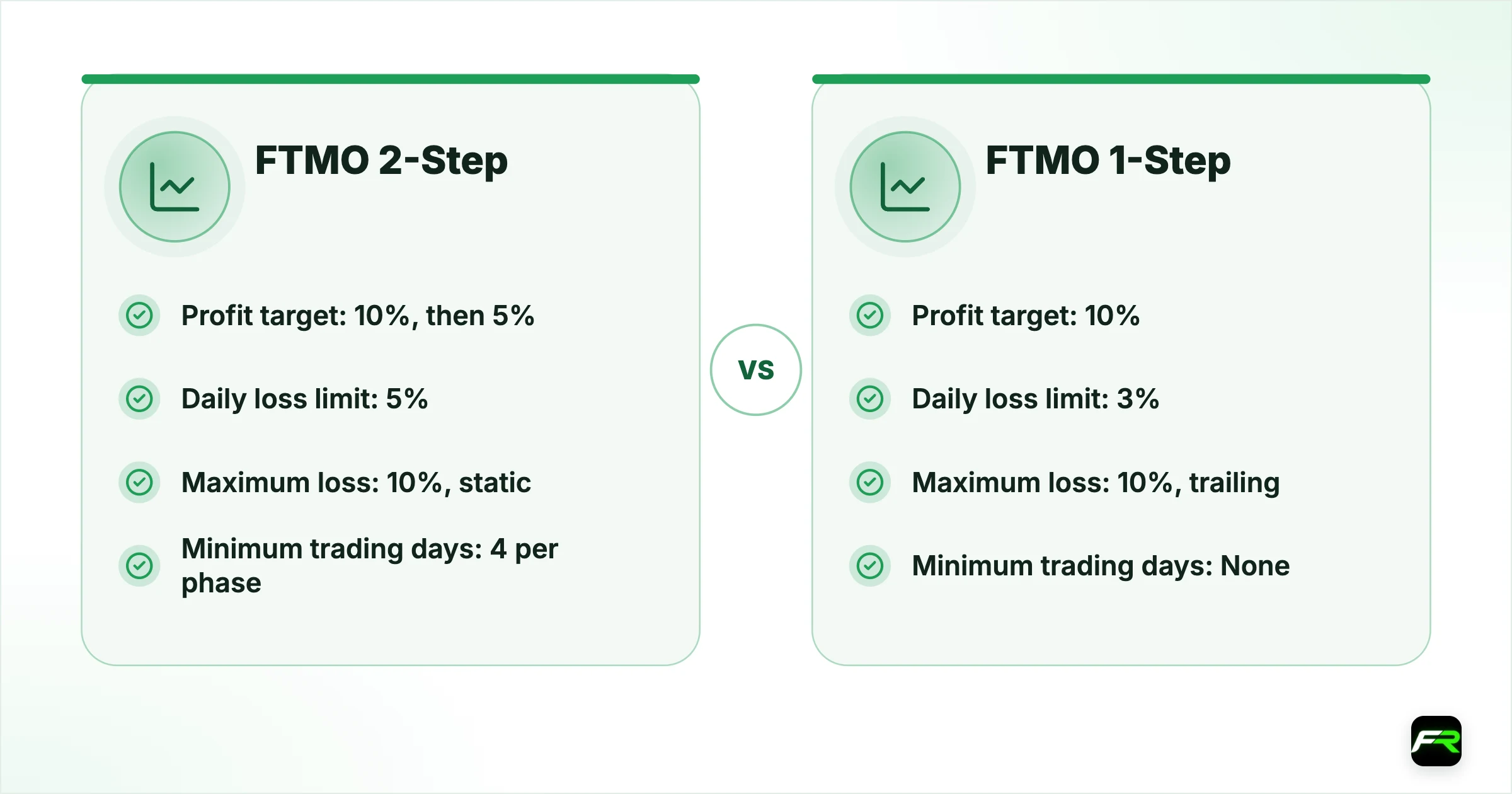
| FTMO 2-Step | FTMO 1-Step | |
|---|---|---|
| Profit target | 10%, then 5% | 10% |
| Daily loss limit | 5% | 3% |
| Maximum loss | 10%, static | 10%, trailing (end of day) |
| Minimum trading days | 4 per phase | None |
| Consistency | None beyond the objectives | 50% Best Day Rule |
| Split | 80%, up to 90% through scaling | 90% |
| $100,000 fee | €540, refunded with first reward | €499, not refunded |
The 1-Step is one phase shorter and pays a higher split from the start. In exchange its daily limit is 3 per cent instead of 5, its floor trails your end-of-day balance, no single day may be more than half your profit, and the fee is gone either way.
Watch this on video
One-Step vs Two-Step Prop Challenges, in 2:34
One-step or two-step prop challenge? The faster one is usually stricter, so let your demo record decide.
At FundedNext
FundedNext’s Stellar 2-Step asks for 8 per cent then 5 per cent and returns the fee with the first reward. Its Stellar 1-Step asks for 10 per cent in a single phase, and FundedNext says you can get your first reward within 7 days. Its Stellar Lite is a two-phase plan with 8 and 4 per cent targets at a lower upfront cost.
Which suits you
| Pick two-step if… | Pick one-step if… |
|---|---|
| Your losing days can reach 3–4% | Your worst days stay well under 3% |
| You let winners run and give some back | You bank profits steadily |
| You want the fee back | Speed matters more than the fee |
| Your profits come from a few big days | Your profits are spread evenly across days |
A trader with occasional 3.5 per cent losing days passes a 2-Step in nine weeks without touching the 5 per cent limit. On a 1-Step, the first of those days would have breached the 3 per cent limit. For this trader the slower format is the only one that works.
Look at your last 50 trading days on demo: your worst day and your best day as a share of total profit decide the format more than anything else.
Three-step and instant: the other formats
One- and two-step evaluations are the most common, but not the only ones. Some firms offer a three-step format with smaller targets in each phase, aimed at traders who prefer slow, steady progress; The5ers, for example, lists a 3-Step Bootcamp. At the other end, instant accounts skip the evaluation entirely, in exchange for stricter drawdown and non-refundable fees. Our guide to instant funding covers those.
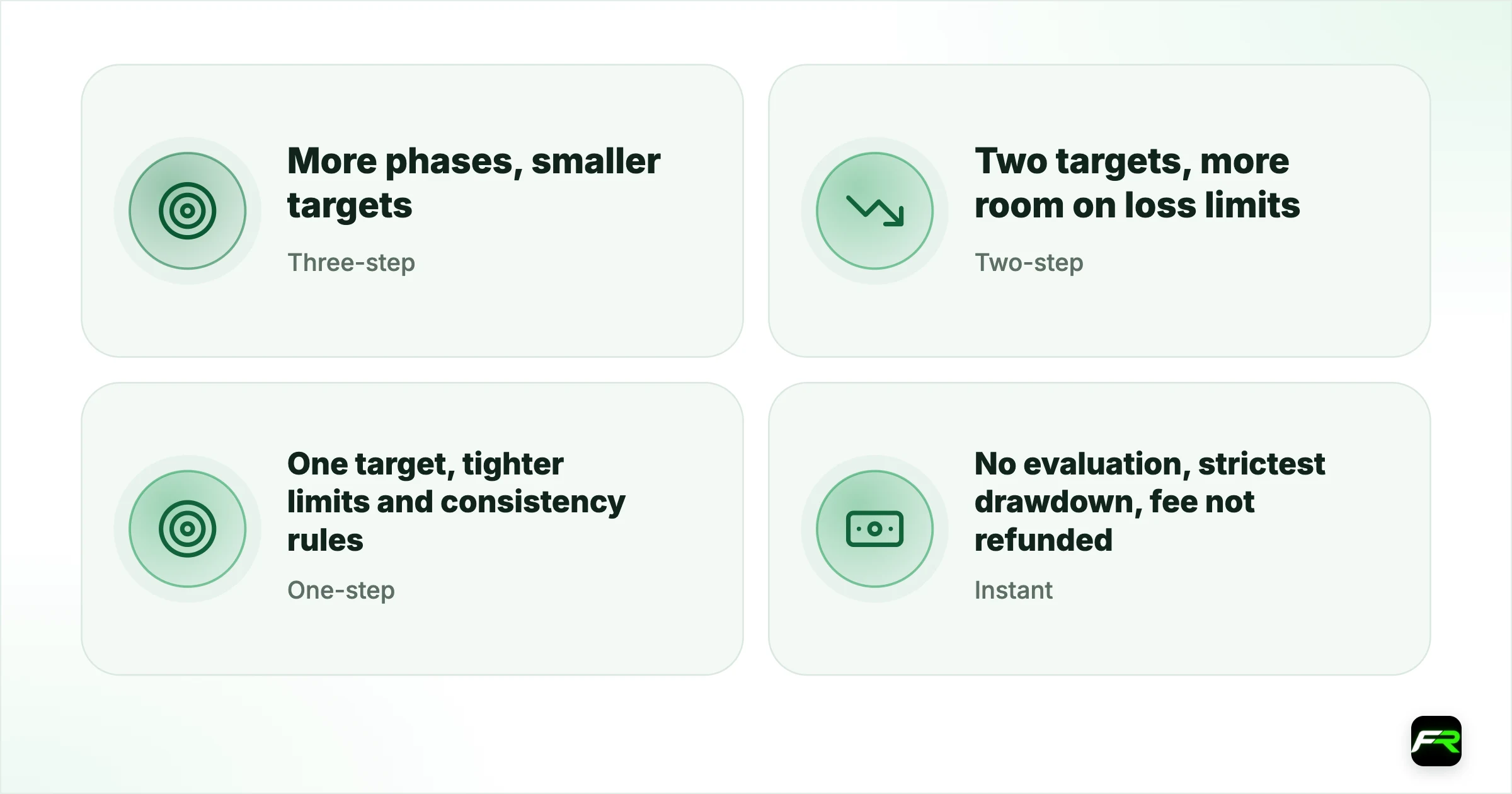
| Format | Typical trade-off | Suits |
|---|---|---|
| Three-step | More phases, smaller targets | Slow, very consistent traders |
| Two-step | Two targets, more room on loss limits | Most traders who need room for normal losing days |
| One-step | One target, tighter limits and consistency rules | Traders with small, evenly spread days |
| Instant | No evaluation, strictest drawdown, fee not refunded | Proven traders who want payouts immediately |
The cost comparison, with real prices
At FTMO on 14 October 2026, a $100,000 2-Step cost €540 and a $100,000 1-Step €499. The 1-Step looks €41 cheaper. But the 2-Step fee is refunded with your first reward and the 1-Step fee is not, so a trader who passes and is paid ends up €540 better off on the 2-Step, and the gap grows with every failed attempt.
| Attempts until paid | 2-Step: paid, minus refund | 1-Step: paid |
|---|---|---|
| 1 | €0 | €499 |
| 2 | €540 | €998 |
| 3 | €1,080 | €1,497 |
The faster format only saves money if it raises your chance of passing enough to cover the lost refund.
Test which format suits you
- Take your last 40 to 60 trading days on demo.
- Find your worst day as a percentage of a $100,000 account. If it often passes 3 per cent, a one-step daily limit will end your account.
- Find your best day as a share of your total profit. If it is often above 50 per cent, a one-step best-day rule will slow you down.
- If both numbers are comfortably inside, a one-step is realistic. Otherwise, pick a two-step.
Over 50 demo days a trader’s worst day was −2.1 per cent and their best day was 31 per cent of the month’s profit. Both fit inside a one-step’s 3 per cent daily limit and 50 per cent best-day rule, so the faster format suits them. A colleague with a −3.8 per cent worst day would fail it on that day alone.
Common misconceptions
- “One step means half the work.” The target in a one-step is often the same 10 per cent as the first phase of a two-step, under tighter limits, so the hardest phase remains.
- “Two-step takes twice as long.” The second phase usually has a smaller target, such as FTMO’s 5 per cent, so it tends to take about half as long as the first.
- “A higher split makes one-step better value.” FTMO’s 1-Step pays 90 per cent from the start against 80 per cent by default on the 2-Step, but the 2-Step can rise to 90 per cent through scaling, and its fee comes back.
- “You can switch formats later.” Usually not on the same account. Pick before you buy.
The format you can pass at your normal size, without changing how you trade, is the right one. If you find yourself planning to trade differently to fit a format’s rules, that is the wrong format.
Whichever you choose, practise its exact limits on a free demo account for two weeks first. If the demo breaches, the real challenge will too.
The short version
Pick two-step if your losing days can approach 3 per cent or your profits come from a few big days; pick one-step only if your days are small and even. Count the refund in the cost, not just the price.
Related guides
The rules that decide which format suits you each have their own guide.
- The daily loss limit: how it is measured, why equity counts and how to stay inside it.
- Maximum drawdown, explained: static and trailing floors side by side.
- The consistency rule: how best-day caps work and when they bite.
- Instant funding: what you gain by skipping the evaluation, and what you give up.
Cite this guide
FX Recap, "One-Step vs Two-Step: Which Challenge to Pick", updated 14 October 2026, https://fxrecap.com/prop-trading/one-step-vs-two-step-which-to-pick
Free to quote with a link. Journalists: data and comment in our press room.
Frequently asked
Is a one-step or two-step prop challenge better?
It depends on how you trade. One-step is faster but usually stricter: FTMO's 1-Step has a 3 per cent daily limit, a trailing maximum loss and a 50 per cent best-day rule, against 5 per cent, a static floor and no consistency rule on the 2-Step.
Is the one-step challenge easier?
Not usually. There is one target instead of two, but tighter loss limits and consistency rules mean a single bad day or one outsized winning day can fail it.
Which FTMO challenge is refundable?
The 2-Step fee is refunded with your first reward. The 1-Step fee is not refunded.
What are FundedNext's one-step and two-step targets?
FundedNext's Stellar 2-Step asks for 8 per cent then 5 per cent, with the fee back on the first reward; its Stellar 1-Step asks for 10 per cent in one phase.
Is a two-step challenge cheaper than a one-step?
Often in the end, if the two-step fee is refunded with the first payout. At FTMO the $100,000 2-Step cost €540 and is refunded with the first reward; the 1-Step cost €499 and is not refunded.
What is a three-step prop challenge?
A format with three phases and smaller targets in each, aimed at slow, steady traders. The5ers, for example, lists a 3-Step Bootcamp.
How do I know if a one-step challenge suits me?
Check your demo record: if your worst day stays well under 3 per cent of the account and no single day makes up more than half your profit, a one-step is realistic.
Related reading
The team behind this guide
Researched, checked and approved by five forex specialists
Every guide is written, fact-checked and edited before it goes live, and updated when the facts change. Spotted an error? Tell us.