 IC Markets

 3:09
 2:39
 2:10
 2:18
 3:43
 8:42




































FTMO vs FundedNext: Which Fits Your Trading
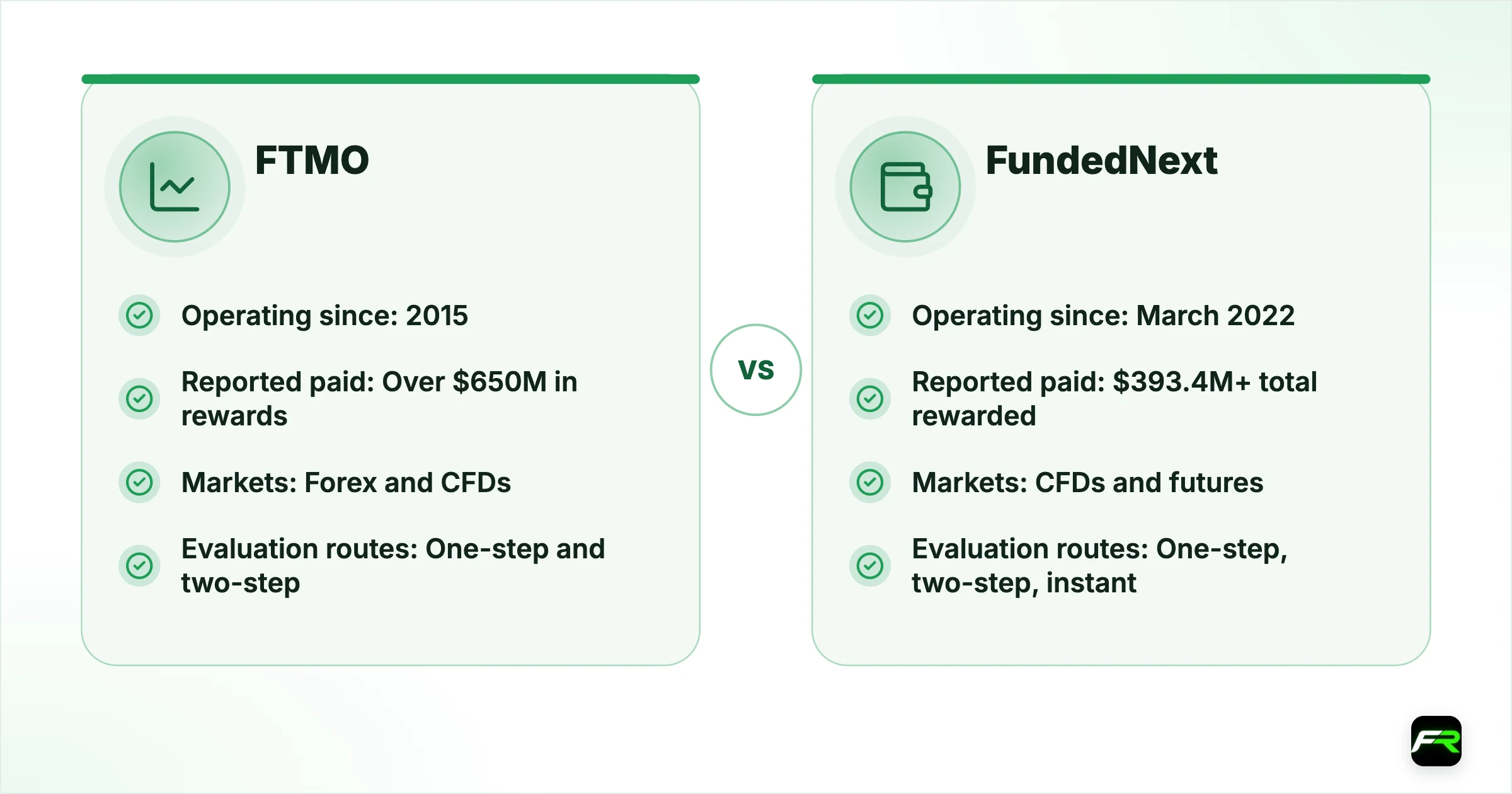
FTMO is the older, pricier firm, operating since 2015. FundedNext is cheaper and offers more routes, including instant funding. The right one depends on what you trade and how much history you need.
 WriterAbir KhanWriterWrites the guides · checks every figure against primary sources View profileAbout Abir →

 Market analysisTanbir Habib RiyadForex & Crypto AnalystForex and crypto analyst · technical and fundamental analysis View profileAbout Tanbir →

 Fact-checking & riskJannatul FerdaushFact-Checker & Risk AnalystFact-checks every figure · risk analysis · Applied Statistics, University of Dhaka View profileAbout Jannatul →

 Trading reviewJowel RanaForex TraderForex trader · reviews guides from a trader's view View profileAbout Jowel →

 Final approvalRanjan N. MondolForex TraderForex trader · signs off every guide View profileAbout Ranjan →

These are the two forex prop firms most first-time challengers weigh against each other. Neither is regulated as a prop firm, both keep you on a simulated account, and both have paid traders reliably. The differences are track record, price, flexibility, and how far the account can scale.
Side by side, for 2026
| FTMO | FundedNext | |
|---|---|---|
| Operating since | 2015 | March 2022 |
| Reported paid | Over $650M in rewards | $393.4M+ total rewarded (its site, October 2026) |
| Markets | Forex and CFDs; a futures product is listed | CFDs and futures |
| Evaluation routes | One-step and two-step | One-step, two-step, instant |
| Reward share | Up to 90% | Up to 95% |
| Reward during evaluation | No | 15% performance reward on some plans |
| Max account size | $200,000 to start; scaling to $2 million | Check the plan |
| Payout speed | See FTMO's site | FundedNext says 99.99% are processed within 24 hours |
| Challenge fee | €540 for a $100k 2-Step (refundable) | Check the plan |
| Consistency rule | No extra rule on 2-Step; Best Day Rule on 1-Step | Varies by model; check the plan |
| Track record | Operating since 2015 | Shorter |
Both support MT4, MT5 and cTrader, both allow news trading, scalping and EAs, and both offer raw-spread accounts.
Where FTMO wins
- Track record. Nine years of paid withdrawals through the collapses that took out other firms. In an unregulated sector, this is the single strongest signal.
- Predictable rules. One standardised path, no funded consistency rule, a fixed overall drawdown anchored to the starting balance.
- Payout reliability. A long history of processing withdrawals in a day or two without disputes.
Where FundedNext wins
- Price and flexibility. Lower entry fees on its smaller plans, plus an instant route FTMO does not offer.
- Reward share. Up to 95 per cent, against up to 90 per cent at FTMO.
- Profit during the evaluation. You keep 15 per cent of what you make in the challenge phase, even if you ultimately fail.
- Evaluation reward. A 15 per cent performance reward on some plans.
- Payout speed. 24-hour processing on its faster models.
FundedNext has a shorter record than FTMO, and this is a sector where firms that looked solid have closed. The mitigation is the same either way: withdraw profit early and do not let a balance build.
For readers in India: both firms are named on the RBI Alert List of entities not authorised to deal in forex under FEMA (FTMO no. 13, FundedNext no. 83; list updated 19 November 2025). See prop trading in India.
How to choose
- Trade futures? Both now list a futures product; compare the rules, or look at a dedicated futures firm.
- Want the safest firm and will pay for it? FTMO.
- Want a cheaper route, instant funding, or a very large account? FundedNext.
- News or breakout trader? FTMO's 2-Step has no extra consistency rule, which is an advantage; check FundedNext's rule on the specific plan.
- Beginner testing the model? FundedNext's lower fee and evaluation profit share lower the cost of finding out whether prop trading suits you.
Marcus passed FundedNext first because the $99 fee and the 15 per cent evaluation share made it a cheap test. Once he had two profitable funded months there, he added an FTMO account for the longer track record and split his size across the two, keeping no more than one payout cycle of profit in either. His reasoning was that two firms with different histories was safer than scaling up with one.
This is not a case where one firm is right. FTMO buys you history and predictability at a higher price. FundedNext buys you flexibility, scaling and a lower entry cost with a shorter record. A trader who is serious about this often ends up with an account at each, sized so that either firm failing is survivable.
Rules side by side
| FTMO 2-Step | FundedNext Stellar 2-Step | |
|---|---|---|
| Targets | 10%, then 5% | 8%, then 5% |
| Daily loss | 5% | 5% |
| Maximum loss | 10%, static | 10%, static |
| Minimum days | 4 per phase | 5 per phase |
| Time limit | None | None |
| $100,000 fee | €540 | $549.99 |
| Fee refund | With first reward | With first reward |
| Default split | 80%, up to 90% with scaling | 80%, up to 90% with scale-up, 95% add-on |
| First payout | From day 14 after first trade | First cycle 21 days, then every 14 |
The plans are close. FundedNext asks for a smaller first target and one more minimum day; FTMO has the longer record and a faster first payout. Prices were read on both firms’ sites on 14 October 2026.
Beyond the 2-Step
- Both offer one-step and instant routes with tighter rules; see our one-step vs two-step guide.
- FundedNext also runs a futures programme; FTMO lists a futures product too.
- FundedNext pays 15 per cent of challenge-phase profit on its 1-Step and 2-Step after the first scale-up.
Two traders with similar records choose differently. One prefers FTMO’s longer track record and day-14 first payout. The other prefers FundedNext’s smaller 8 per cent first target. Both choices are reasonable; neither is about price, which is nearly the same.
Key terms
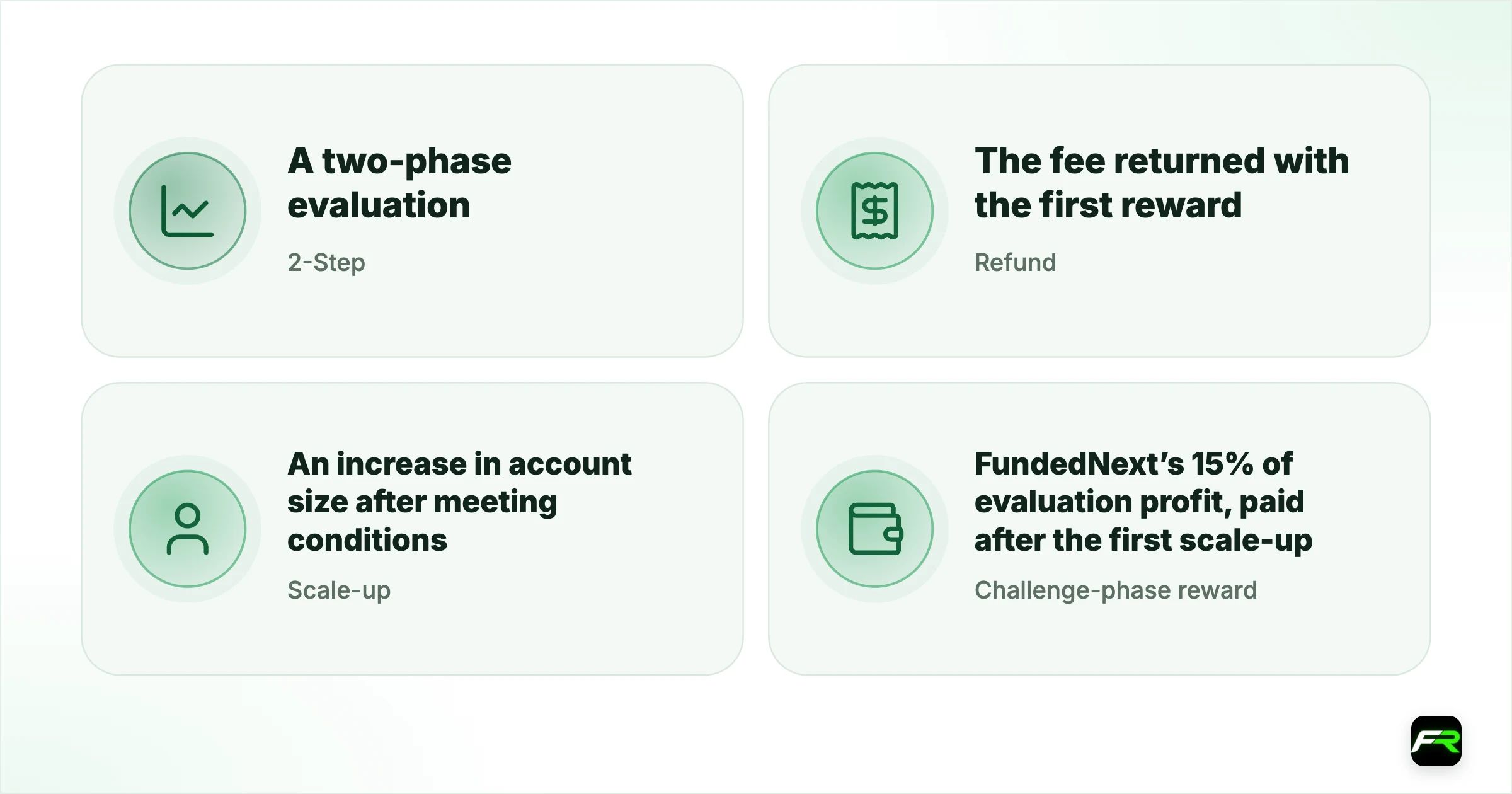
| Term | Meaning |
|---|---|
| 2-Step | A two-phase evaluation |
| Refund | The fee returned with the first reward |
| Scale-up | An increase in account size after meeting conditions |
| Challenge-phase reward | FundedNext’s 15% of evaluation profit, paid after the first scale-up |
Related guides
For each firm in depth, see these guides.
- FTMO review: rules, payouts and who it suits.
- FundedNext review: four CFD routes, futures and rewards.
- Rules compared: forex and futures firms in one table.
- Cheapest challenges: real prices and how to compare them per $1,000.
Cite this guide
FX Recap, "FTMO vs FundedNext: Which Fits Your Trading", updated 9 September 2026, https://fxrecap.com/prop-trading/ftmo-vs-fundednext
Free to quote with a link. Journalists: data and comment in our press room.
Frequently asked
Is FTMO or FundedNext better?
Neither is simply better. FTMO has operated since 2015, reports over $650 million paid in rewards, and charges a higher fee. FundedNext offers one-step, two-step and instant routes, a reward share of up to 95% and a 15% performance reward on some plans, with a shorter record. Choose FTMO for safety, FundedNext for flexibility and cost.
Which is cheaper, FTMO or FundedNext?
Fees change often and both firms run discounts, so compare the two sites for the account size you want. FTMO lists €540 for a $100,000 2-Step Challenge, refundable once you earn rewards; its 1-Step fee is not refunded.
Which pays out faster, FTMO or FundedNext?
FundedNext says 99.99% of its rewards are processed within 24 hours. FTMO describes its reward withdrawals as fast and easy but check its site for current timings.
Can I use both FTMO and FundedNext?
Yes, and some traders do, running an account at each and splitting size so that one firm failing is survivable. Keep records separate, withdraw profit from both on their earliest schedules, and do not concentrate a large balance in either.
Is FTMO or FundedNext easier to pass?
Their 2-Step loss limits are the same: 5 per cent daily and 10 per cent static maximum. FundedNext's first target is 8 per cent against FTMO's 10 per cent, but it requires five minimum days per phase against FTMO's four.
Which pays faster, FTMO or FundedNext?
FTMO allows the first reward request from day 14 after the first trade; FundedNext's 2-Step first reward cycle is 21 days, then every 14 days.
Related reading
The team behind this guide
Researched, checked and approved by five forex specialists
Every guide is written, fact-checked and edited before it goes live, and updated when the facts change. Spotted an error? Tell us.