 IC Markets

 3:09
 2:39
 2:10
 2:18
 3:43
 8:42





































Prop Firm Withdrawal Problems and How Firms Delay Payouts
Most refused payouts trace back to a rule, a document or a timing condition. Here is how to tell a fair refusal from a firm that does not want to pay.
 WriterAbir KhanWriterWrites the guides · checks every figure against primary sources View profileAbout Abir →

 Market analysisTanbir Habib RiyadForex & Crypto AnalystForex and crypto analyst · technical and fundamental analysis View profileAbout Tanbir →

 Fact-checking & riskJannatul FerdaushFact-Checker & Risk AnalystFact-checks every figure · risk analysis · Applied Statistics, University of Dhaka View profileAbout Jannatul →

 Trading reviewJowel RanaForex TraderForex trader · reviews guides from a trader's view View profileAbout Jowel →

 Final approvalRanjan N. MondolForex TraderForex trader · signs off every guide View profileAbout Ranjan →

A delayed or refused payout is the most stressful moment in prop trading. Sometimes the firm is right: a rule was broken or a condition not met. Sometimes the firm is stalling. Knowing the difference, and keeping evidence, puts you in a much stronger position.
The common, fair reasons
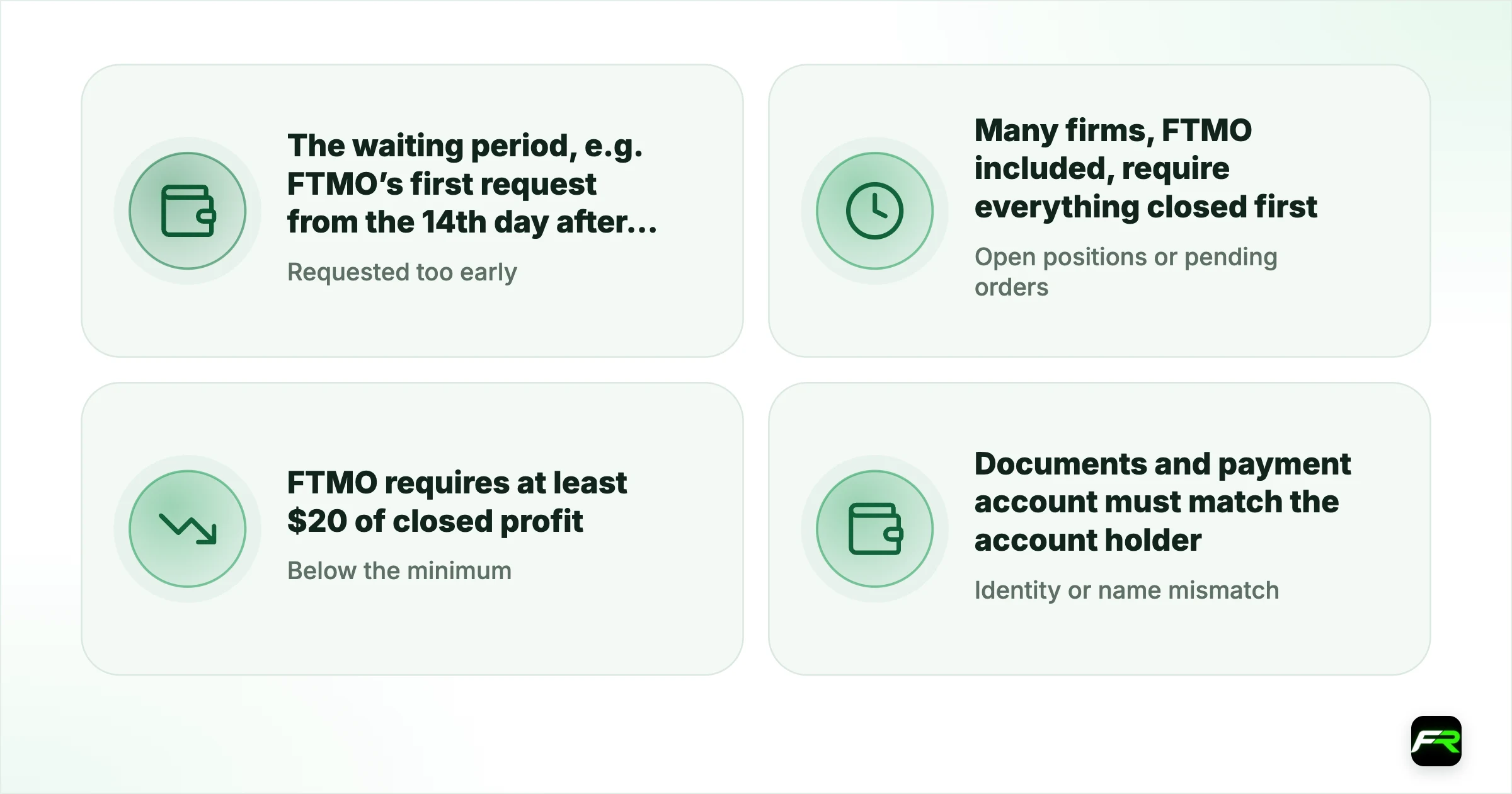
| Reason | What to check |
|---|---|
| Requested too early | The waiting period, e.g. FTMO’s first request from the 14th day after the first funded trade |
| Open positions or pending orders | Many firms, FTMO included, require everything closed first |
| Below the minimum | FTMO requires at least $20 of closed profit ($50 for crypto) |
| Identity or name mismatch | Documents and payment account must match the account holder |
| A rule broken | Consistency caps, news windows, maximum lot sizes, banned strategies |
The warning signs
- A refusal that cites a rule you cannot find in the terms, or one added after your trades.
- A “review” with no end date, repeated every time you ask.
- Vague accusations such as “abnormal trading” with no specific trades named.
- Requests to buy a new challenge or add-on before a payout can be processed.
- Many traders reporting the same problem at the same time.
What to do if your payout is delayed
- Read the payout terms again and confirm every condition was met on the date you asked.
- Ask, in writing, which specific rule or trade is the issue and under which clause.
- Keep screenshots of your account, the request and every reply.
- If a card or payment processor was used for your fee, ask whether a dispute route exists.
- If the firm is unresponsive, file a complaint with the consumer authority in the firm’s country, and post a factual review so other traders can see it.
Do not keep trading a large balance at a firm that is stalling a payout. Request small payouts, and stop adding risk until the first one arrives.
Before you buy, the best protection is choosing a firm with a long payout record and clear terms; see how to check a prop firm actually pays.
Identity checks and payout delays
Know-your-customer (KYC) checks are the most common cause of a first payout taking longer than expected. Firms ask for an identity document, proof of address and sometimes a selfie or video check, and the payout method must be in the same name as the account.
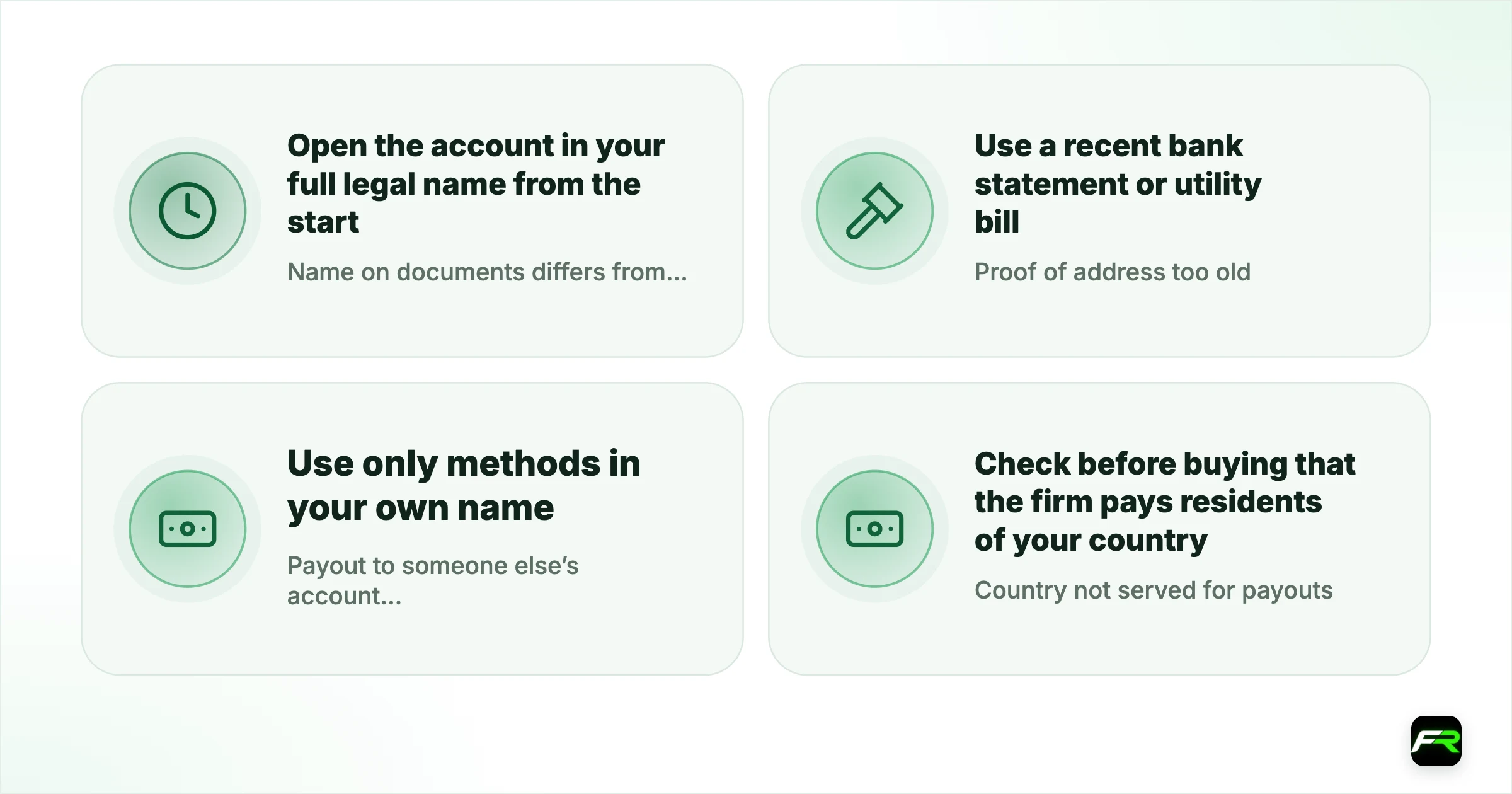
| Problem | How to avoid it |
|---|---|
| Name on documents differs from the account | Open the account in your full legal name from the start |
| Proof of address too old | Use a recent bank statement or utility bill |
| Payout to someone else’s account or wallet | Use only methods in your own name |
| Country not served for payouts | Check before buying that the firm pays residents of your country |
| Checks left until the first payout | Complete verification as soon as the firm allows |
Payout methods and their own delays
Once a firm approves a payout, the payment method adds its own time and fees. Topstep, for example, lists same-day Prop-to-Brokerage if requested by noon Chicago time, 1–3 business days for ACH and Wise, and 5–10 business days for wire, with $30 fees on ACH and wire. FTMO says approved rewards are usually sent within 1–2 business days. A delay inside these published windows is normal; a delay well beyond them, without a reason, is the warning sign.
Consistency and trade reviews
Firms review trading before paying, and a review can find rule breaches that the dashboard did not flag. The most common findings:
- A consistency cap exceeded, such as one day making up too much of the profit.
- Trades opened or closed inside a restricted news window.
- Hedging across accounts, copy trading or account management by someone else.
- Strategies that exploit the simulation, such as price-feed delays.
If a payout is reduced or refused after a review, ask for the specific trades and the clause in writing. A fair firm can name both.
Writing to the firm
- Keep it short and factual: your account number, the payout request date and amount.
- List the payout conditions and show each was met on the date you asked.
- Ask for the specific rule and trades if the firm says a rule was broken.
- Give a reasonable deadline for a reply, such as seven days.
- Keep a copy of everything, including screenshots of the dashboard on the day.
A trader requests a first payout of $1,400 and hears nothing for four business days. Their written query gets a reply: their proof of address was more than three months old. They upload a new bank statement and are paid two days later. The delay was a document, not the firm.
Request payouts on a normal schedule rather than all at once. A run of small, prompt payouts is the best evidence a firm will keep paying.
The short version
Most payout problems are documents, timing or a rule. Complete verification early, pay out to your own accounts, follow the rules exactly and keep records. If a firm cannot name the rule or trade behind a refusal, treat that as a warning and stop adding risk there.
Related guides
Most payout problems trace back to the payout rules, the firm’s record or a rule broken during trading.
- How payouts work: splits, waiting periods, minimums and reviews.
- Checking a firm pays: evidence to trust, evidence to ignore and a scoring sheet.
- The consistency rule: how best-day caps work and when they bite.
- Scams and red flags: warning signs before you pay and after you are funded.
Cite this guide
FX Recap, "Prop Firm Withdrawal Problems and How Firms Delay Payouts", updated 14 October 2026, https://fxrecap.com/prop-trading/prop-firm-withdrawal-problems
Free to quote with a link. Journalists: data and comment in our press room.
Frequently asked
Why was my prop firm payout denied?
Usually because a condition was not met, such as the waiting period, open positions, a minimum amount or a document mismatch, or because the firm says a trading rule was broken. Ask in writing for the specific rule and trades.
How long should a prop firm payout take?
Firms publish their own times. FTMO says it reviews requests within 1 to 2 business days and usually sends payment within 1 to 2 business days after approval; FundedNext says 99.99 per cent of rewards are processed within 24 hours.
What can I do if a prop firm will not pay me?
Ask for the exact rule in writing, keep records, check whether your payment provider offers a dispute route, and complain to the consumer authority in the firm's country if it stops responding.
How do I avoid withdrawal problems?
Choose a firm with a long payout record and clear published terms, follow its rules precisely, keep your documents and payment account in your own name, and take a small first payout early.
Why is my first prop payout taking so long?
Most often because identity checks are incomplete or documents do not match. Complete verification early, use documents in your full legal name, and pay out only to accounts in your own name.
How long should a prop payout take after approval?
It depends on the firm and method. FTMO says approved rewards are usually sent within 1 to 2 business days; Topstep lists 1 to 3 business days for ACH and Wise and 5 to 10 for wire.
Can a prop firm reduce my payout after reviewing trades?
Firms may reduce or refuse a payout if a review finds a rule breach. Ask in writing for the specific trades and clause; a fair firm can name both.
Related reading
The team behind this guide
Researched, checked and approved by five forex specialists
Every guide is written, fact-checked and edited before it goes live, and updated when the facts change. Spotted an error? Tell us.