 IC Markets

 3:09
 2:39
 2:10
 2:18
 3:43
 8:42





































Instant Funding Prop Firms: The Trade-Offs
Instant funding skips the challenge. You pay for that with a higher price, stricter drawdown rules or tighter payout conditions.
 WriterAbir KhanWriterWrites the guides · checks every figure against primary sources View profileAbout Abir →

 Market analysisTanbir Habib RiyadForex & Crypto AnalystForex and crypto analyst · technical and fundamental analysis View profileAbout Tanbir →

 Fact-checking & riskJannatul FerdaushFact-Checker & Risk AnalystFact-checks every figure · risk analysis · Applied Statistics, University of Dhaka View profileAbout Jannatul →

 Trading reviewJowel RanaForex TraderForex trader · reviews guides from a trader's view View profileAbout Jowel →

 Final approvalRanjan N. MondolForex TraderForex trader · signs off every guide View profileAbout Ranjan →

An instant funding account gives you a funded account the day you pay, with no evaluation to pass. That sounds like the best deal in prop trading. In practice the firm has to protect itself from traders it has never seen trade, so the rules are tighter in other places.
Two examples
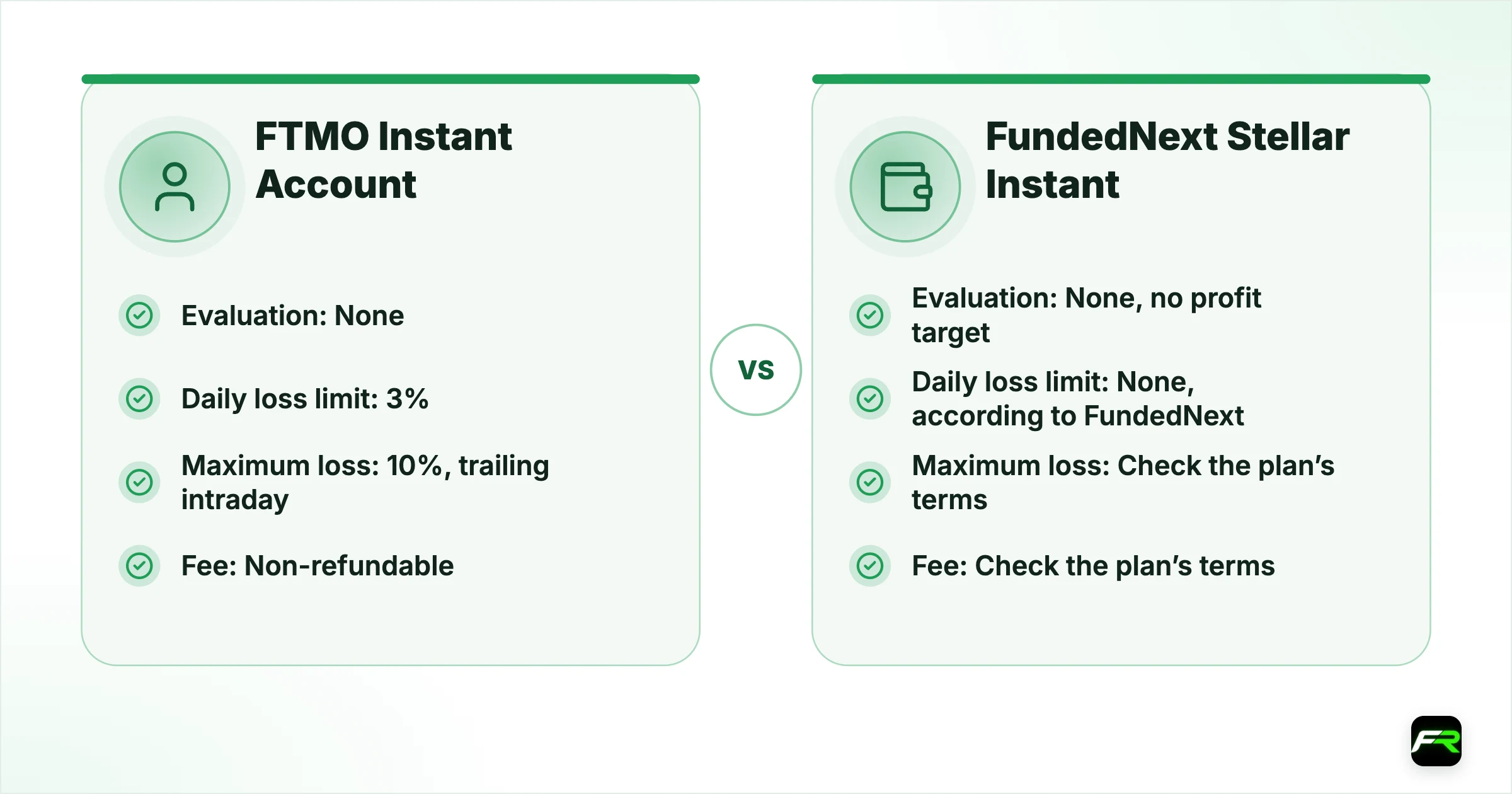
| FTMO Instant Account | FundedNext Stellar Instant | |
|---|---|---|
| Evaluation | None | None, no profit target |
| Daily loss limit | 3% | None, according to FundedNext |
| Maximum loss | 10%, trailing intraday | Check the plan’s terms |
| Fee | Non-refundable | Check the plan’s terms |
| Scaling plan | Not available | Check the plan’s terms |
| News restriction | Applies | Check the plan’s terms |
| Payouts | 90% split | Reward on demand, per FundedNext |
FTMO’s numbers show the typical trade-off. Its Instant Account uses an intraday trailing maximum loss, which follows your highest equity during the day, the strictest form of drawdown. Its 2-Step uses a static 10 per cent floor instead, and refunds the fee.
Watch this on video
Instant Funding Prop Firms: The Trade-Offs, in 3:05
Instant funding skips the challenge, but the trailing floor and the non-refundable fee are the real price.
What you gain
- Payouts from the start, without weeks of evaluation.
- No pressure to hit a profit target.
- A clear, known cost: you pay once.
What you give up
- Drawdown room. Trailing floors, often intraday, leave much less room after a winning trade.
- Your fee. Usually not refundable.
- Growth. At FTMO the Scaling Plan does not apply to the Instant Account.
- Payout conditions. Consistency rules and caps are more common on instant plans.
On a $100,000 account with a 10 per cent intraday trailing floor, a trade that runs to +$4,000 lifts the floor to $94,000 even if it is closed at breakeven. On a static 10 per cent account the floor stays at $90,000. Two or three trades like that and the instant account has a fraction of the room.
Who it suits
Instant funding suits traders with a proven, steady method who take small, controlled profits and rarely let trades run far against or for them. It suits less well traders whose method needs room to breathe, and it is a poor place to learn. For most traders an evaluation with a static drawdown and a refundable fee is the better value.
Read our guide to trailing drawdown before buying any instant account: it is the rule that decides most of them.
The real price of skipping the evaluation
An instant account usually costs more than an evaluation of the same size, and the fee is usually not refunded. Against that, you save the weeks of evaluation and the chance of failing it. The fair comparison is with your realistic cost of passing an evaluation, not with one attempt.
| Evaluation (two-step) | Instant account | |
|---|---|---|
| Upfront cost | Lower; often refunded with first payout | Higher; usually not refunded |
| Time to first payout | Weeks to months | From the first eligible cycle |
| Drawdown room | Usually static | Usually trailing, often intraday |
| Chance of losing the fee | Depends on your pass rate | Depends on surviving the trailing floor |
Surviving a trailing floor
Instant accounts are lost most often to the trailing maximum loss, not the daily limit. Habits that help:
- Take partial profit as trades move in your favour, so equity highs do not run far above your closing balance.
- Avoid holding several winners open at once on an intraday-trailing account; their combined peak sets the floor.
- Know the floor at the start of each session and how far it moved yesterday.
- Bank a payout as soon as you are eligible; on many plans the floor stops trailing once it reaches the starting balance.
Who should never buy instant funding
- Traders who have not yet passed a standard evaluation at any firm.
- Swing traders whose positions need days and wide stops.
- Anyone who would be upset to lose the fee in the first week.
A trader who passes about one evaluation in three could expect to spend three fees before being funded, but get one back with the first payout on a refundable plan. An instant account would fund them immediately but cost more, with no refund, and a trailing floor that their wide-stop swing method breaches often. For this trader, the evaluation is cheaper and more likely to pay.
If you want instant funding, prove you can trade inside a trailing floor first, on demo or a cheap evaluation with the same drawdown type.
Instant funding glossary
| Term | Meaning |
|---|---|
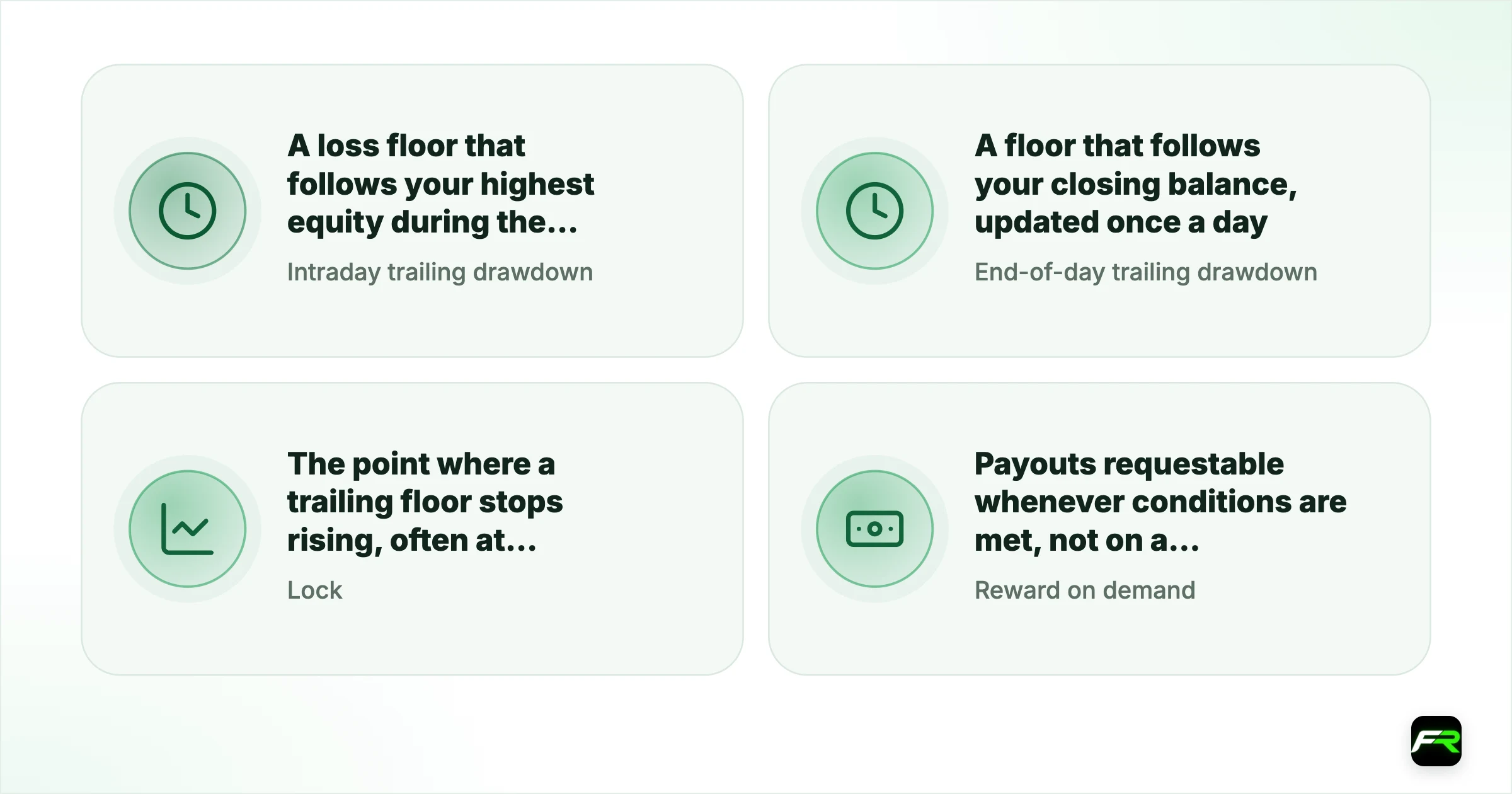
| Intraday trailing drawdown | A loss floor that follows your highest equity during the day, including open trades |
| End-of-day trailing drawdown | A floor that follows your closing balance, updated once a day |
| Lock | The point where a trailing floor stops rising, often at the starting balance |
| Reward on demand | Payouts requestable whenever conditions are met, not on a fixed cycle |
| Consistency rule | A cap on how much of your profit one day can provide |
Most surprises on instant accounts come from the first two rows. Read which one your plan uses before your first trade, and work out where the floor will lock.
- Find the drawdown type and percentage in the plan’s rules.
- Work out the floor at your starting balance and after a few example trades.
- Note where the floor locks, and plan to reach that point with a payout.
Compare these terms with the evaluation plans in our one-step vs two-step guide before deciding which route to buy.
Related guides
Instant accounts are decided by drawdown rules and cost, which these guides cover in detail.
- Trailing drawdown, with numbers: how a trailing floor follows your profit and when it stops.
- Maximum drawdown, explained: static and trailing floors side by side.
- Cheapest challenges: real prices and how to compare them per $1,000.
- The real cost of funding: fees divided by your chance of passing.
Cite this guide
FX Recap, "Instant Funding Prop Firms: The Trade-Offs", updated 14 October 2026, https://fxrecap.com/prop-trading/instant-funding-prop-firms-trade-offs
Free to quote with a link. Journalists: data and comment in our press room.
Frequently asked
What is an instant funding prop firm?
A firm that sells a funded account with no evaluation, so you can trade for payouts from day one. In exchange the rules are usually stricter elsewhere, such as trailing drawdowns or non-refundable fees.
Is instant funding better than a challenge?
Not usually. It saves time, but at FTMO, for example, the Instant Account has a 3 per cent daily limit, an intraday trailing 10 per cent maximum loss, a non-refundable fee and no scaling plan, while the 2-Step has a static floor and a refundable fee.
Does FTMO offer instant funding?
Yes, the FTMO Instant Account, with a 3 per cent daily loss limit, an intraday trailing 10 per cent maximum loss and a 90 per cent split. Its fee is not refundable and the Scaling Plan does not apply.
Do instant funding accounts have a daily loss limit?
It depends on the firm. FTMO's Instant Account has a 3 per cent daily limit; FundedNext says its Stellar Instant has no daily loss limit. Check the maximum loss rule too, which is often trailing.
Why is instant funding more expensive?
The firm takes on traders it has not evaluated, so it charges more, rarely refunds the fee and uses stricter drawdown rules to protect itself.
What usually breaks an instant funding account?
The trailing maximum loss. It rises with your equity or closing balance and does not fall, so giving back profit can breach it even when you are still up overall.
Who is instant funding best for?
Traders with a proven method that takes small, steady profits and rarely gives much back, who want payouts without waiting for an evaluation.
Related reading
The team behind this guide
Researched, checked and approved by five forex specialists
Every guide is written, fact-checked and edited before it goes live, and updated when the facts change. Spotted an error? Tell us.