 IC Markets

 3:09
 2:39
 2:10
 2:18
 3:43
 8:42





































Position Sizing for a Prop Challenge: The Exact Math
Position size is the one setting that decides whether a bad streak ends your challenge. Here is how to work it out from the firm’s own loss limits.
 WriterAbir KhanWriterWrites the guides · checks every figure against primary sources View profileAbout Abir →

 Market analysisTanbir Habib RiyadForex & Crypto AnalystForex and crypto analyst · technical and fundamental analysis View profileAbout Tanbir →

 Fact-checking & riskJannatul FerdaushFact-Checker & Risk AnalystFact-checks every figure · risk analysis · Applied Statistics, University of Dhaka View profileAbout Jannatul →

 Trading reviewJowel RanaForex TraderForex trader · reviews guides from a trader's view View profileAbout Jowel →

 Final approvalRanjan N. MondolForex TraderForex trader · signs off every guide View profileAbout Ranjan →

Most failed challenges are not failed by a bad strategy. They are failed by size: a few normal losses at too large a position, and the daily or maximum loss limit is gone. Sizing from the firm’s limits backwards fixes that.
Step 1: decide risk per trade
Start from the tightest limit. On FTMO’s 2-Step, the daily loss limit is 5 per cent and the maximum loss 10 per cent of the starting account. A common rule is to risk no more than 0.5 to 1 per cent of the account per trade, so that five losing trades in a row still leave you inside the daily limit.
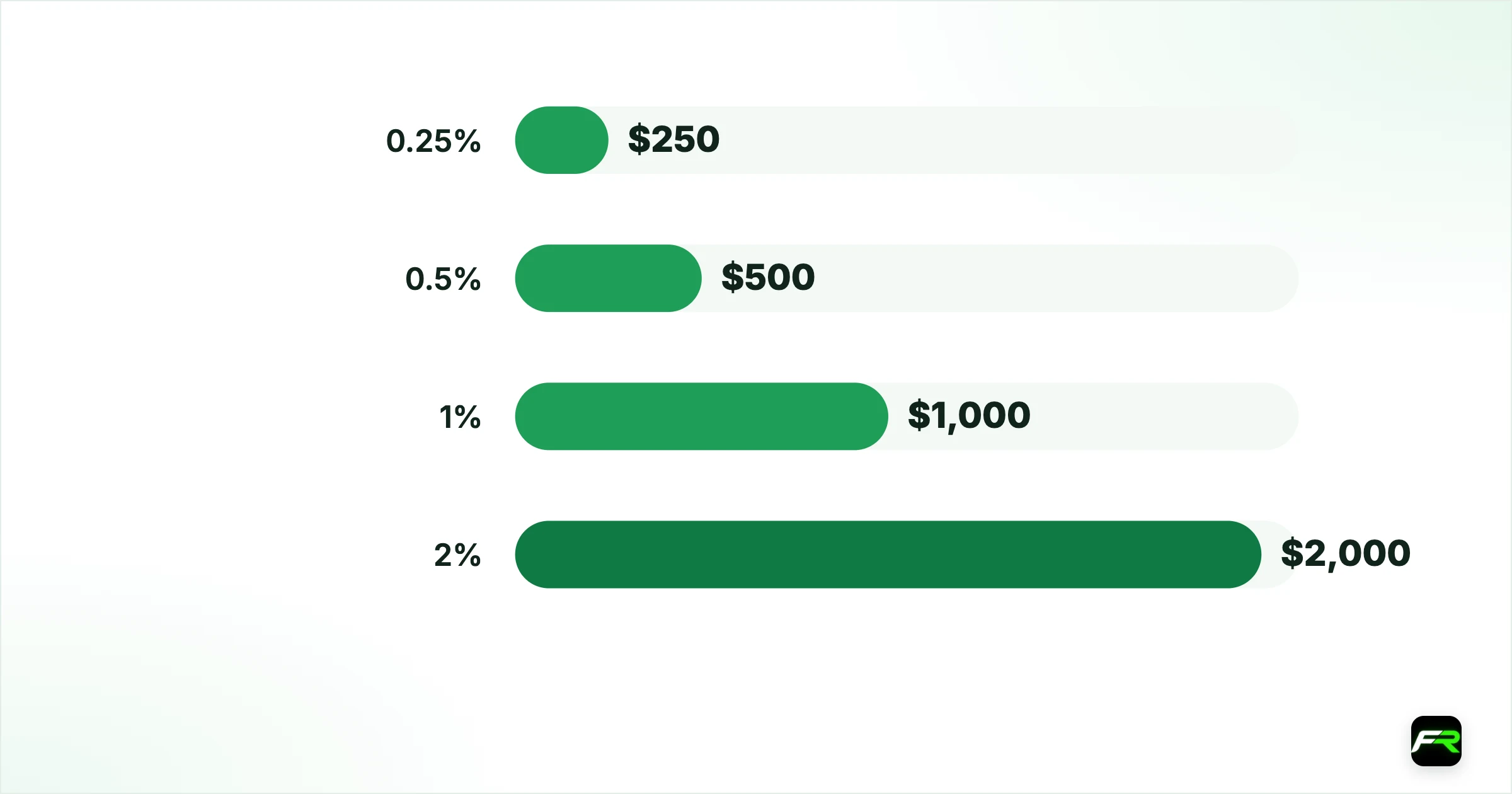
| Risk per trade | On $100,000 | Losses in a row to hit a 5% daily limit | Losses in a row to hit 10% maximum loss |
|---|---|---|---|
| 0.25% | $250 | 20 | 40 |
| 0.5% | $500 | 10 | 20 |
| 1% | $1,000 | 5 | 10 |
| 2% | $2,000 | about 3 | 5 |
At 2 per cent a trade, three ordinary losses in a day end a 2-Step account and a streak of five ends any account. At 0.5 per cent you need ten losses in one day.
Step 2: turn risk into lots
Position size in lots = money at risk ÷ (stop loss in pips × pip value per lot). On EUR/USD and other pairs quoted in US dollars, one standard lot is worth about $10 a pip.
On a $100,000 challenge, risking 0.5 per cent means $500. With a 25-pip stop on EUR/USD: $500 ÷ (25 × $10) = 2 lots. With a 40-pip stop the same risk is $500 ÷ (40 × $10) = 1.25 lots. The risk stays fixed; the lot size moves with the stop.
On pairs not quoted in dollars, such as USD/JPY, the pip value changes with the exchange rate, so recalculate it or use a calculator.
Our prop firm calculator and position size calculator do this arithmetic for you.
Step 3: cap total open risk
Firms measure equity, including open trades. Three trades open at 1 per cent risk each is 3 per cent of exposure if all three hit their stops together, which is easy when the trades are correlated, such as EUR/USD and GBP/USD long. Add up the risk of every open position and keep the total well inside the day’s remaining room.
Step 4: shrink after losses
When you are close to a limit, cut size. If you are 3 per cent down on the day against a 5 per cent limit, a full-size loss takes you to 4 per cent and a second one ends the account. Halving size after a loss, or stopping for the day at your own lower limit, keeps one bad session from ending a challenge.
Doubling size to “win back” a loss is the fastest way to fail. The target can wait; FTMO sets no time limit.
Pip values on common instruments
The lot-size formula needs the value of a pip, or point, per lot. These are approximate and depend on the account currency and price:
| Instrument | Value of 1 pip or point per standard lot | Note |
|---|---|---|
| EUR/USD, GBP/USD, AUD/USD | About $10 | Quote currency is USD |
| USD/JPY | About ¥1,000, which varies in USD with the rate | Recalculate as the rate moves |
| Gold (XAU/USD) | $1 move = $100 per 100-ounce lot | Contract sizes vary by firm; check specifications |
| Indices | Varies by contract | Always check the firm’s contract size |
Because contract sizes differ between firms and instruments, use the firm’s own specifications or a calculator rather than assuming.
Sizing for correlated trades
Two trades in correlated markets are close to one trade at double size. If you go long EUR/USD and GBP/USD at 0.5 per cent each, a broad dollar rally can stop both, costing 1 per cent. Treat strongly correlated positions as one when adding up risk, and cap the total.
Adjusting size as a challenge progresses
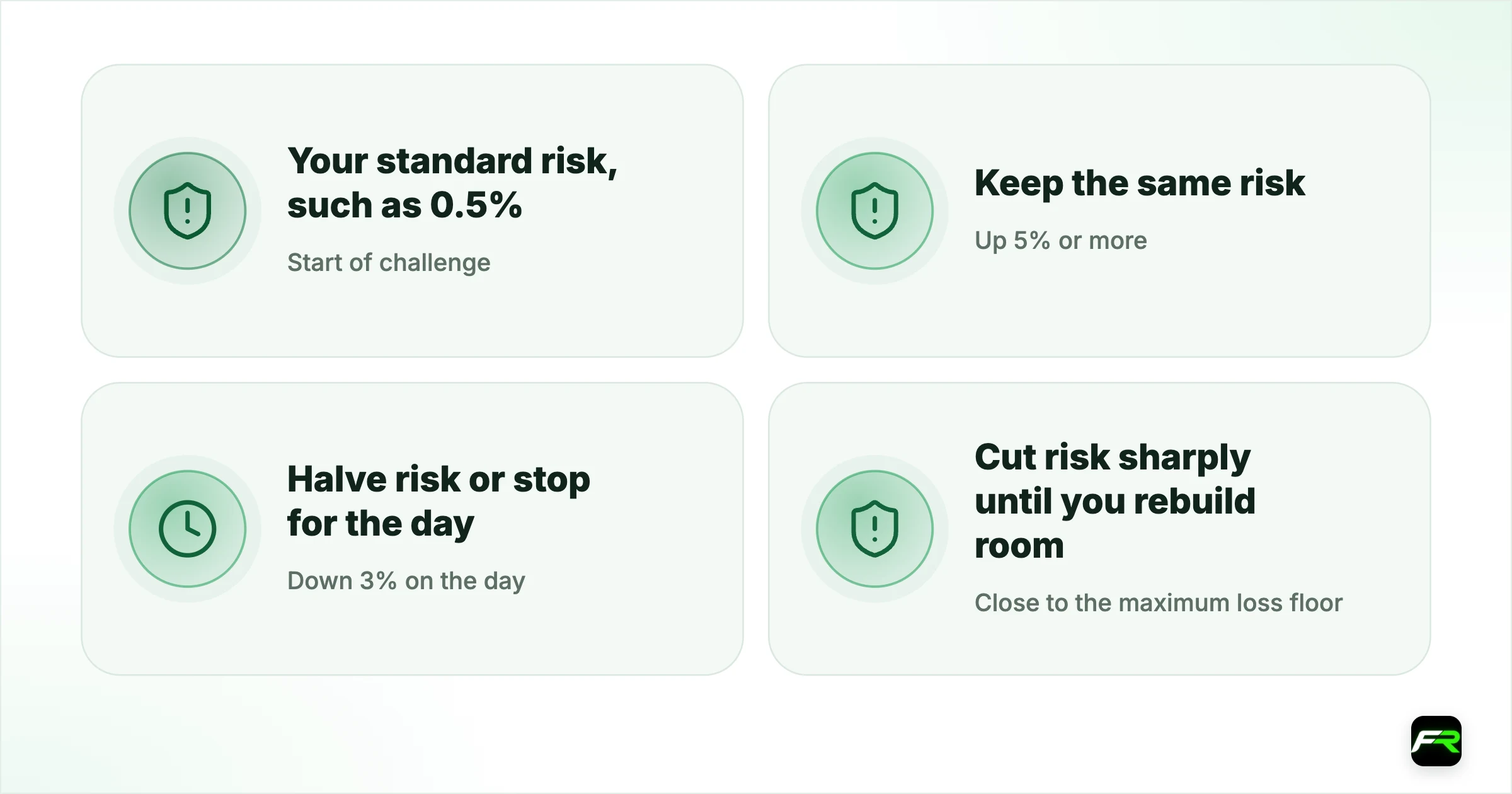
| Situation | Sizing approach |
|---|---|
| Start of challenge | Your standard risk, such as 0.5% |
| Up 5% or more | Keep the same risk; do not press |
| Down 3% on the day | Halve risk or stop for the day |
| Close to the maximum loss floor | Cut risk sharply until you rebuild room |
| Near the target | Same risk; let the plan finish it |
A trader risking $500 on gold with a $5 stop calculates $500 ÷ ($5 × $100 per lot) = 1 lot. If the firm’s gold contract were 10 ounces instead, the same risk would need 10 lots. Checking the contract size first avoids a tenfold sizing error.
Use our gold lot size calculator and prop firm calculator rather than doing contract maths in your head during a session.
Related guides
Sizing connects directly to the loss limits and to how long a challenge takes.
- The daily loss limit: how it is measured, why equity counts and how to stay inside it.
- Maximum drawdown, explained: static and trailing floors side by side.
- How long passing takes: realistic timelines worked out from your own numbers.
- Mistakes that fail an evaluation: trading, technical and rule-reading errors, with fixes.
A sizing checklist for every trade
- Risk amount: account size × risk percentage.
- Stop distance in pips or points, set from the chart, not from the size you want.
- Pip or point value per lot from the firm’s specifications.
- Lots = risk ÷ (stop × value per lot), rounded down.
- Total open risk, including correlated trades, still inside today’s room.
Rounding down, never up, keeps every trade at or below your planned risk.
Key terms
| Term | Meaning |
|---|---|
| Lot | A standard unit of trade size; 1 lot of EUR/USD is 100,000 euros |
| Pip | The usual smallest price step in a currency pair, 0.0001 for most pairs |
| Risk per trade | The amount lost if the stop is hit, as a share of the account |
| Correlation | How closely two markets move together, which adds their risks up |
Cite this guide
FX Recap, "Position Sizing for a Prop Challenge: The Exact Math", updated 14 October 2026, https://fxrecap.com/prop-trading/position-sizing-for-a-prop-challenge
Free to quote with a link. Journalists: data and comment in our press room.
Frequently asked
How much should I risk per trade on a prop challenge?
Commonly 0.5 to 1 per cent of the account. At 0.5 per cent on a $100,000 account you would need ten losing trades in one day to reach a 5 per cent daily loss limit.
How do I calculate lot size for a prop challenge?
Divide the money you are risking by the stop loss in pips times the pip value per lot. Risking $500 with a 25-pip stop on EUR/USD, at about $10 a pip per standard lot, gives 2 lots.
Do open trades count towards the daily loss limit?
At FTMO, yes: equity, including open trades, must stay above the daily limit. Add up the risk of all open positions, especially correlated ones.
Should I trade bigger to pass faster?
No. Larger size makes a run of normal losses fatal. Most firms, including FTMO, set no time limit, so a slower pass at safe size is the better plan.
How much is a pip worth on gold?
It depends on the contract size. On a 100-ounce lot, a $1 move in gold is worth $100. Contract sizes vary by firm, so check the specifications.
Should I reduce size after a losing day?
Yes. Halving risk after a loss or stopping for the day protects the daily and maximum loss limits while you recover.
Related reading
The team behind this guide
Researched, checked and approved by five forex specialists
Every guide is written, fact-checked and edited before it goes live, and updated when the facts change. Spotted an error? Tell us.