 IC Markets

 3:09
 2:39
 2:10
 2:18
 3:43
 8:42





































How Long It Really Takes to Pass a Prop Firm Challenge
Firms quote the fastest possible pass. At a safe position size, most consistent traders need weeks, and that is fine when there is no deadline.
 WriterAbir KhanWriterWrites the guides · checks every figure against primary sources View profileAbout Abir →

 Market analysisTanbir Habib RiyadForex & Crypto AnalystForex and crypto analyst · technical and fundamental analysis View profileAbout Tanbir →

 Fact-checking & riskJannatul FerdaushFact-Checker & Risk AnalystFact-checks every figure · risk analysis · Applied Statistics, University of Dhaka View profileAbout Jannatul →

 Trading reviewJowel RanaForex TraderForex trader · reviews guides from a trader's view View profileAbout Jowel →

 Final approvalRanjan N. MondolForex TraderForex trader · signs off every guide View profileAbout Ranjan →

FTMO says you can reach a funded account in as few as 8 trading days on its 2-Step Challenge and as few as 2 on its 1-Step. Those are the minimums the rules allow, not a guide to what a careful trader should expect.
The rules set the floor, not the pace
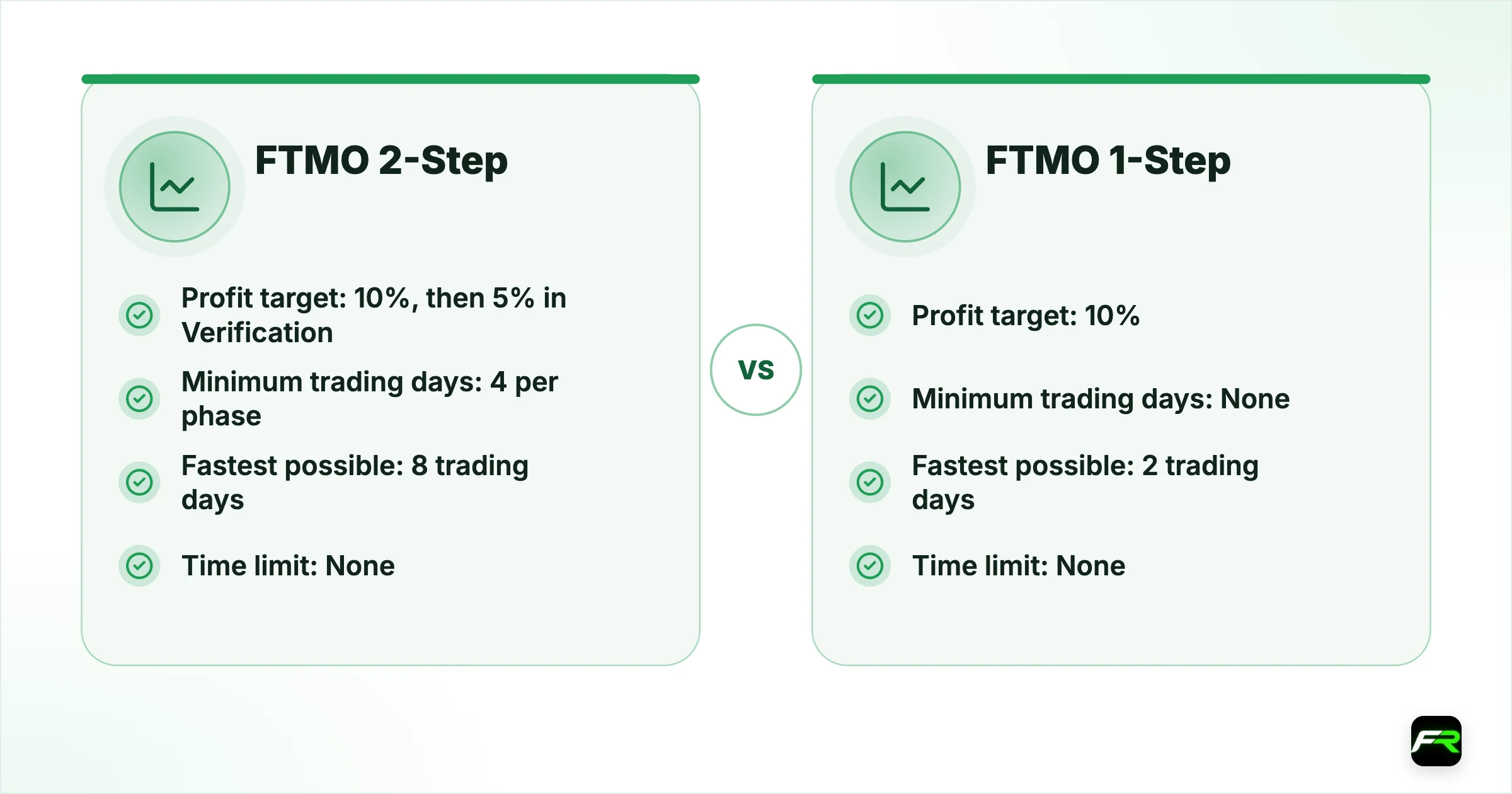
| FTMO 2-Step | FTMO 1-Step | |
|---|---|---|
| Profit target | 10%, then 5% in Verification | 10% |
| Minimum trading days | 4 per phase | None (50% Best Day Rule) |
| Fastest possible | 8 trading days | 2 trading days |
| Time limit | None | None |
Without a time limit, the question is not how fast you can pass, but how long your method takes to make 10 per cent at a size that will not breach the loss limits.
Watch this on video
A Plan to Pass a Two-Step Challenge, in 3:01
Passing a two-step challenge is about small, boring trades and rules you set before you start.
Working it out from your own numbers
Expected gain per trade = (win rate × average win) − (loss rate × average loss), measured in units of your risk. Divide the target by that, and by how many trades you take a day.
A trader risks 0.5 per cent per trade, wins 45 per cent of trades at twice the risk and loses 55 per cent at the full risk. Expected gain per trade is 0.45 × 2 − 0.55 × 1 = 0.35 times the risk, or about 0.175 per cent of the account. A 10 per cent target needs about 57 trades. At two trades a day that is roughly 29 trading days, about six weeks. The 5 per cent Verification needs about half as many trades, so around three more weeks.
Losing streaks stretch that further. The same trader will see runs of five or six losses in a row over 57 trades, which is why safe sizing matters more than speed.
Why fast passes are a warning sign
- Passing in a few days usually means large size, which works until the first bad streak, often on the funded account.
- A method that needs big size to pass will need it to make payouts too, under the same loss limits.
- Firms review trades before paying; a fast pass built on luck tends to show up later as a breached funded account.
If you have hit the target with a few minimum days left, see our guide to minimum trading days for how to finish safely.
Six weeks at half a per cent risk is a good pass. It is also the pace you will need to keep on the funded account, so it is the right one to practise.
What speeds you up and what slows you down
| Speeds you up | Slows you down |
|---|---|
| More good setups per week in your method | Waiting out losing streaks at reduced size |
| A higher win rate or better reward-to-risk | Consistency rules that cap a single good day |
| A smaller second-phase target | Minimum trading days after an early target |
| No time limit, so no rushed trades | Subscription costs that tempt you to hurry |
Notice that “more risk per trade” is not on the left. It speeds up good runs and ends challenges on bad ones, so on average it slows you down.
The effect of losing streaks
A method that wins 45 per cent of the time will often lose five or six trades in a row over a few dozen trades. At 0.5 per cent risk a six-trade losing streak costs 3 per cent, which takes roughly 17 average trades to recover at the expectancy used in our example above. That recovery is where most of the time in a challenge goes. Planning for it, rather than being surprised by it, is what keeps traders from increasing size to catch up.
Timelines by trading style
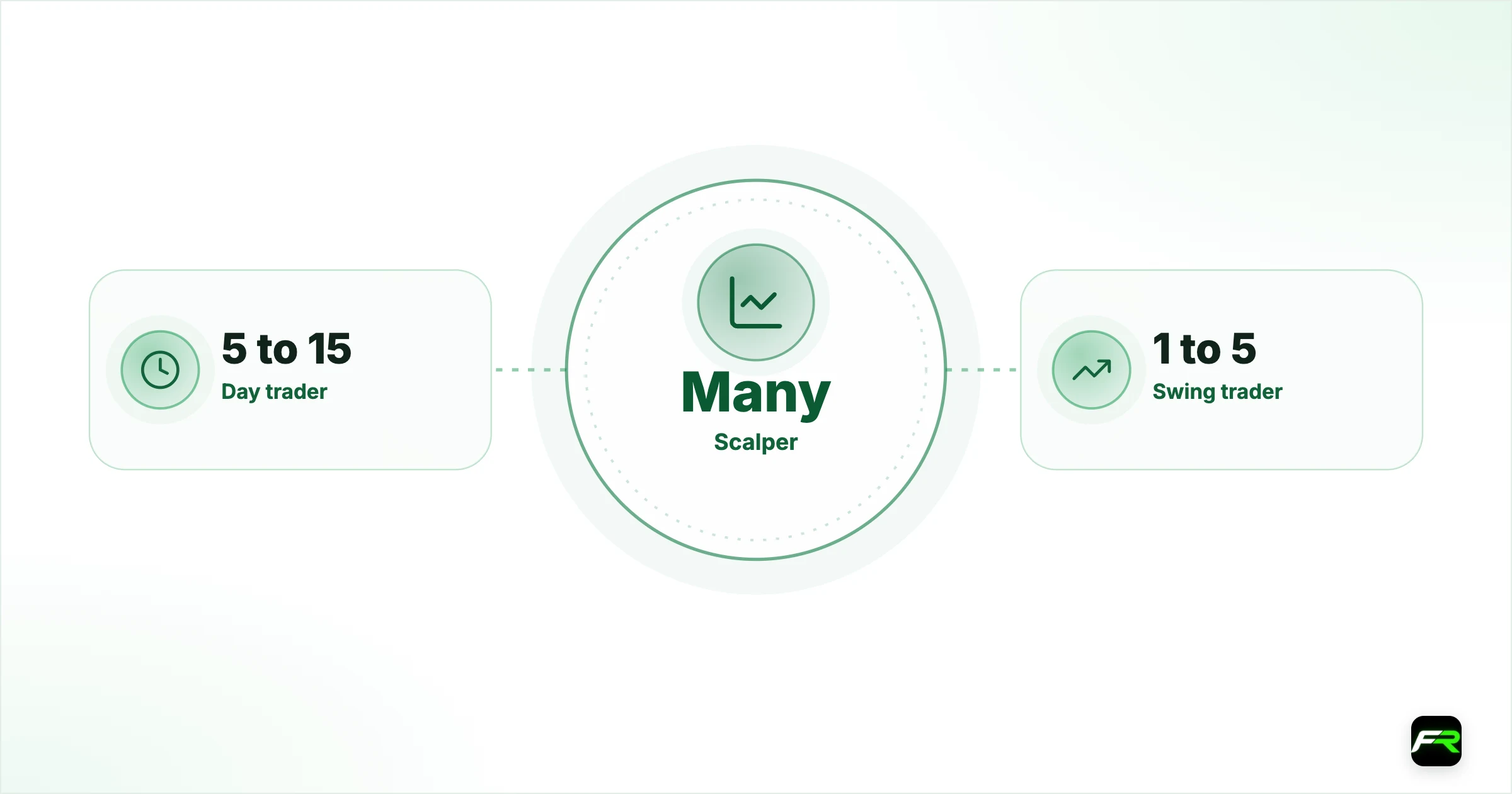
| Style | Trades per week | Typical effect on time |
|---|---|---|
| Scalper | Many | Faster, if costs and consistency rules allow |
| Day trader | 5 to 15 | The base case in most challenge designs |
| Swing trader | 1 to 5 | Slower; may need swing-friendly rules such as FTMO’s Swing account |
A swing trader takes about three trades a week at 0.5 per cent risk with a reward-to-risk of 2.5 and a 40 per cent win rate. Expected gain is 0.4 × 2.5 − 0.6 = 0.4 times the risk, or 0.2 per cent per trade. A 10 per cent target needs about 50 trades, around four months. With no time limit, that is fine; on a monthly subscription, it is expensive.
Estimate your timeline before buying. If it is long, prefer a plan with no time limit and a one-time fee.
Plan the weeks, not the days
Thinking in weeks rather than days takes pressure off. A simple plan for a 10 per cent first phase at 0.5 per cent risk:
| Weeks | Aim | Behaviour |
|---|---|---|
| 1–2 | Settle in, around 2–3% up | Normal size, follow the plan exactly |
| 3–4 | Around 5% up | Same size; review the journal weekly |
| 5–6 | Approach the target | Same size; no larger trades to finish |
| Any week | A losing streak | Halve size after two losses in a day; stop at your daily limit |
The figures are a guide, not a schedule. Some weeks will be flat or negative, and with no time limit at firms such as FTMO, that is fine. What matters is that size never rises to make up time.
- Review results weekly, not after every trade.
- Compare progress with your demo record, not with other traders.
- If a week ends below its start, the next week’s plan is the same, not bigger.
Related guides
Time to pass depends on sizing, minimum days and the plan you choose.
- Position sizing for a challenge: the lot-size formula and safe risk per trade.
- Minimum trading days: what counts as a day and how to finish early targets safely.
- A plan to pass a two-step: from demo practice to the first funded month.
- One-step vs two-step: which format suits your losing and winning days.
Cite this guide
FX Recap, "How Long It Really Takes to Pass a Prop Firm Challenge", updated 14 October 2026, https://fxrecap.com/prop-trading/how-long-to-pass-a-prop-firm-challenge
Free to quote with a link. Journalists: data and comment in our press room.
Frequently asked
How long does it take to pass a prop firm challenge?
The rules allow a fast pass, but at a safe position size most consistent traders take weeks. FTMO's minimum is 8 trading days for the 2-Step and 2 for the 1-Step, with no time limit.
Is there a time limit on the FTMO Challenge?
No. FTMO says there is no maximum time limit on its 2-Step or 1-Step Challenge.
How can I estimate my own time to pass?
Work out your expected gain per trade from your win rate and average win and loss, divide the profit target by it, then divide by the number of trades you take a day.
Is passing quickly a good sign?
Not usually. Very fast passes tend to come from large position sizes, which also make a funded account easy to lose. A steady pace at 0.5 to 1 per cent risk is more likely to lead to payouts.
Do scalpers pass prop challenges faster?
They can, because they take more trades, but costs, consistency rules and restrictions on some short-term strategies can slow them. Check the plan's rules for your style.
How long does it take a swing trader to pass?
Often several months, because swing traders take fewer trades. A plan with no time limit and a one-time fee suits that pace better than a monthly subscription.
Why do losing streaks matter so much?
Recovering a streak takes many average trades, and that recovery is where most of the time goes. Planning for streaks stops traders raising risk to catch up.
Related reading
The team behind this guide
Researched, checked and approved by five forex specialists
Every guide is written, fact-checked and edited before it goes live, and updated when the facts change. Spotted an error? Tell us.