 IC Markets

 3:09
 2:39
 2:10
 2:18
 3:43
 8:42




































Minimum Trading Days: Why the Rule Exists
A minimum trading days rule stops you passing on one lucky day. It is the easiest rule to meet, and the one that tempts traders into forcing trades.
 WriterAbir KhanWriterWrites the guides · checks every figure against primary sources View profileAbout Abir →

 Market analysisTanbir Habib RiyadForex & Crypto AnalystForex and crypto analyst · technical and fundamental analysis View profileAbout Tanbir →

 Fact-checking & riskJannatul FerdaushFact-Checker & Risk AnalystFact-checks every figure · risk analysis · Applied Statistics, University of Dhaka View profileAbout Jannatul →

 Trading reviewJowel RanaForex TraderForex trader · reviews guides from a trader's view View profileAbout Jowel →

 Final approvalRanjan N. MondolForex TraderForex trader · signs off every guide View profileAbout Ranjan →

Many prop challenges require you to trade on a minimum number of days before you can pass, even if you hit the profit target sooner. The aim is simple: a firm wants evidence of a method that works over several sessions, not a single good guess.
How it works at FTMO
FTMO’s 2-Step Challenge requires at least 4 trading days in the Challenge and 4 in the Verification. The days do not need to be consecutive. FTMO counts a trading day as any day from 00:00:00 to 23:59:59 Central European time on which a trade is executed. With the targets met, that makes 8 trading days the fastest route to a funded FTMO Account.
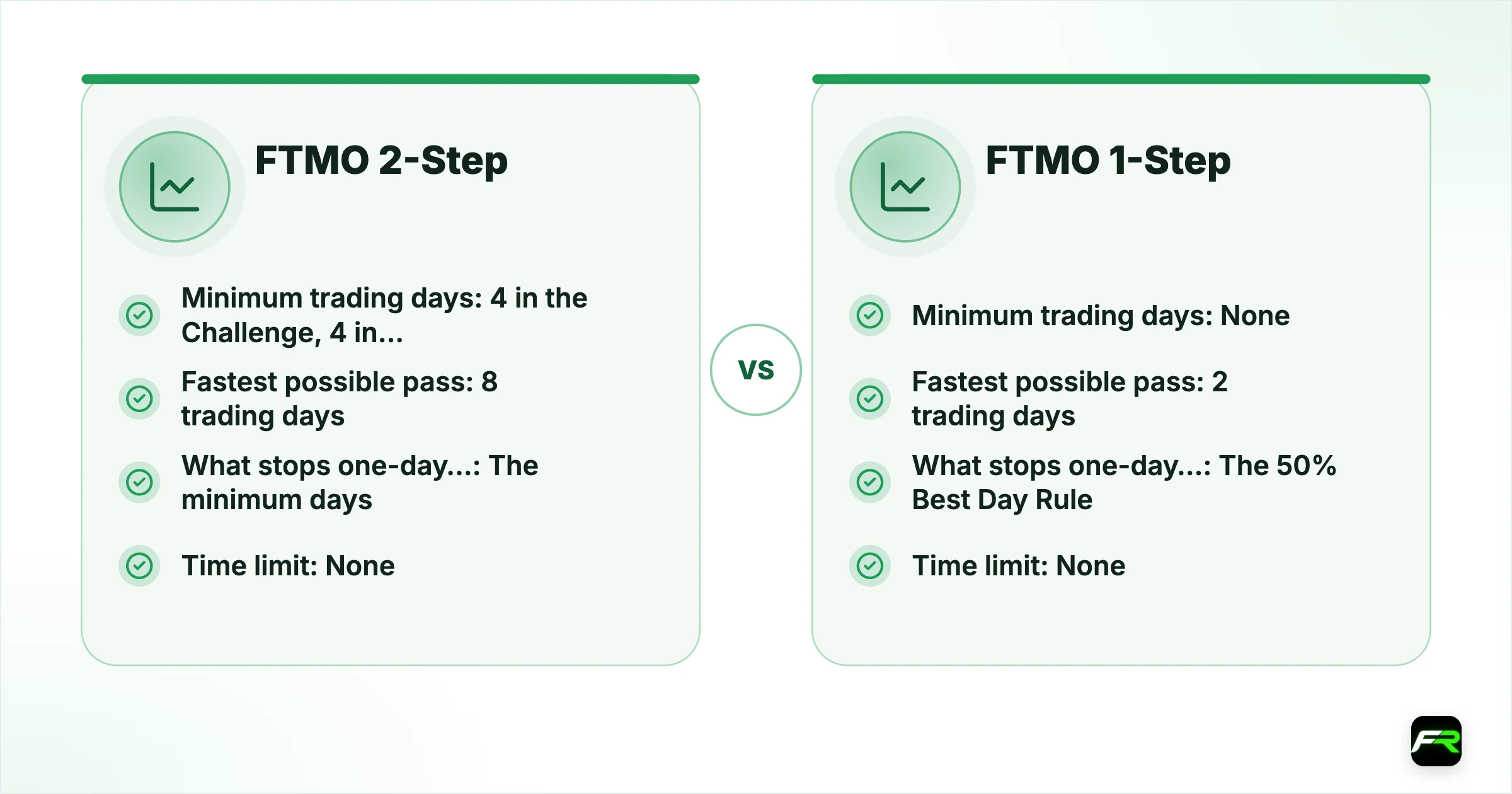
The 1-Step Challenge has no minimum trading days rule. It relies on a Best Day Rule instead: no single day may account for more than 50 per cent of your profit. FTMO notes you could pass in as few as 2 trading days if your profit is split exactly evenly across two days.
| FTMO 2-Step | FTMO 1-Step | |
|---|---|---|
| Minimum trading days | 4 in the Challenge, 4 in the Verification | None |
| Fastest possible pass | 8 trading days | 2 trading days |
| What stops one-day passes | The minimum days | The 50% Best Day Rule |
| Time limit | None | None |
Watch this on video
Minimum Trading Days, Explained, in 3:00
Hit the target on day two and still can't pass? Here's why minimum trading days exist, in under 3 minutes.
The mistake it invites
A trader who reaches the profit target on day two is tempted to open token trades to tick off the remaining days. That is usually allowed, but it is also where accounts are lost: a careless “just to count the day” trade can hit the daily loss limit. If you reach the target early, trade the smallest size the platform allows on the remaining days, with a tight stop.
Since FTMO sets no time limit, there is no reason to rush the remaining days. Wait for setups you would normally take, at minimum size.
Why it is not a burden
Four days is a low bar for a method that is meant to work over months. If a strategy cannot produce trades on four separate days, it will struggle with a funded account’s payout schedule too. Treat the rule as a sanity check, not an obstacle.
What counts as a trading day
Firms define a trading day precisely, and the definition decides how quickly you can meet the rule. FTMO counts any day, midnight to midnight Central European time, on which a trade is executed. FundedNext counts a day when you place at least one trade with a non-zero profit or loss. Read your firm’s wording, because a day with only a pending order that never filled may not count.
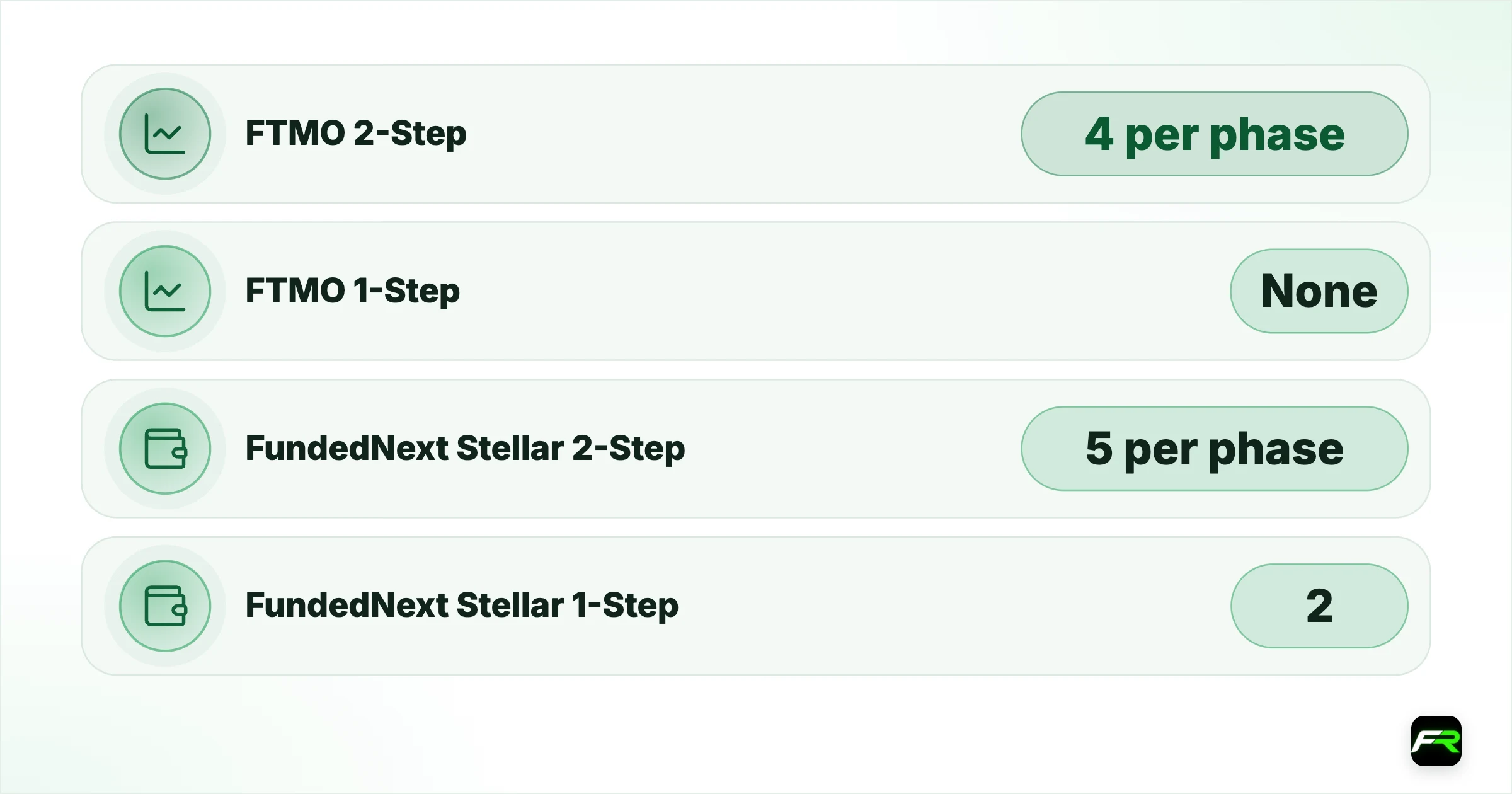
| Firm and plan | Minimum trading days | Notes |
|---|---|---|
| FTMO 2-Step | 4 per phase | Days need not be consecutive |
| FTMO 1-Step | None | 50% Best Day Rule instead |
| FundedNext Stellar 2-Step | 5 per phase | A day counts with a non-zero P&L trade |
| FundedNext Stellar 1-Step | 2 | Single phase |
| Topstep Trading Combine | None | Consistency target instead; as few as two days, Topstep says |
Why firms use either days or consistency
Minimum days and consistency rules solve the same problem in different ways. Both stop a trader from passing on one lucky session. A minimum days rule is simple and easy to meet. A consistency rule is stricter, because it limits how much of your profit a single day may contribute, so several good days are needed, not just several days with a trade. Plans without a minimum days rule usually have a consistency rule, and the reverse.
Planning your days
- Count the days you actually trade in a normal week on demo. If it is fewer than the minimum, expect a longer evaluation.
- Do not schedule trades to tick off days; take setups as they come, at your normal size.
- If you reach the target early, finish the remaining days at the smallest size the platform allows, with tight stops.
- Keep a note of each day counted, in case the dashboard and your records disagree.
A trader hits a 10 per cent target on day three of an FTMO 2-Step Challenge, which needs four trading days. On day four they open one 0.01-lot trade with a 10-pip stop on EUR/USD, a risk of about a dollar, and close it later in the session. The rule is met and the account is never exposed.
Inactivity rules: the opposite problem
Some firms also close accounts that are not traded for too long. FundedNext deactivates a CFD account after 60 consecutive days without a trade. If you plan a break, check the inactivity rule first and place a small trade within the window, or accept that the account may close.
Minimum days protect the firm from luck; inactivity rules protect it from dormant accounts. Know both before you start.
Minimum days on the funded account
Minimum trading days usually apply to the evaluation, not the funded account. Once funded, the equivalent rules are about payouts: FTMO lets you request your first reward from the 14th day after your first trade on the account, and Topstep’s Express Funded payouts need five winning days of $150 or more. These are not the same as minimum days, but they work the same way: a trader cannot be paid from one lucky session.
If you plan your evaluation around the minimum days, plan your funded account around the payout conditions in the same way, so that the first payout arrives on schedule rather than weeks later.
The short version
Minimum trading days are the easiest rule to meet and the one most often met carelessly. Count your normal trading days, finish early-target days at minimum size, and know the inactivity rule as well, so the account never closes for the wrong reason.
Related guides
Minimum days sit alongside the other rules that decide how a challenge is passed.
- The consistency rule: how best-day caps work and when they bite.
- How long passing takes: realistic timelines worked out from your own numbers.
- What a challenge involves: targets, phases and loss limits in a typical evaluation.
- One-step vs two-step: which format suits your losing and winning days.
Cite this guide
FX Recap, "Minimum Trading Days: Why the Rule Exists", updated 14 October 2026, https://fxrecap.com/prop-trading/minimum-trading-days-explained
Free to quote with a link. Journalists: data and comment in our press room.
Frequently asked
What are minimum trading days in a prop challenge?
The fewest days on which you must place a trade before you can pass, even if you reach the profit target sooner. FTMO's 2-Step requires 4 trading days in each phase.
Do the trading days need to be in a row?
Not at FTMO. Its 2-Step trading days do not need to be consecutive, and FTMO counts any day from midnight to midnight Central European time on which a trade is executed.
How fast can you pass FTMO?
FTMO says as few as 8 trading days for the 2-Step, covering both phases, and as few as 2 trading days for the 1-Step if profit is split evenly across two days.
Does FTMO have a time limit?
No. FTMO says there is no maximum time limit on the 2-Step or 1-Step Challenge.
Does a day with only an open position count as a trading day?
Usually a day counts when a trade is executed or closed with a profit or loss, but firms define it differently. FTMO counts a day on which a trade is executed; FundedNext counts a day with a non-zero P&L trade. Check your plan's wording.
Can I hit the profit target before the minimum days?
Yes, but you cannot pass until the minimum days are also met. Finish the remaining days at minimum size with tight stops.
Do all prop firms have minimum trading days?
No. Some plans, such as FTMO's 1-Step and Topstep's Trading Combine, use a consistency rule instead of a minimum number of days.
Related reading
The team behind this guide
Researched, checked and approved by five forex specialists
Every guide is written, fact-checked and edited before it goes live, and updated when the facts change. Spotted an error? Tell us.