 IC Markets

 3:09
 2:39
 2:10
 2:18
 3:43
 8:42




































Prop Firm News Trading Rules: What Is Actually Banned
Most firms do not ban news trading outright. They block trades in a short window around big releases, and the details decide whether your stop loss counts.
 WriterAbir KhanWriterWrites the guides · checks every figure against primary sources View profileAbout Abir →

 Market analysisTanbir Habib RiyadForex & Crypto AnalystForex and crypto analyst · technical and fundamental analysis View profileAbout Tanbir →

 Fact-checking & riskJannatul FerdaushFact-Checker & Risk AnalystFact-checks every figure · risk analysis · Applied Statistics, University of Dhaka View profileAbout Jannatul →

 Trading reviewJowel RanaForex TraderForex trader · reviews guides from a trader's view View profileAbout Jowel →

 Final approvalRanjan N. MondolForex TraderForex trader · signs off every guide View profileAbout Ranjan →

News releases such as US jobs data, inflation figures and central bank decisions move prices fast and can jump straight past a stop. Prop firms take on that risk on every funded account, so many restrict trading around the biggest releases. The restriction is usually narrow, but it catches traders who do not know exactly what it covers.
How FTMO’s rule works
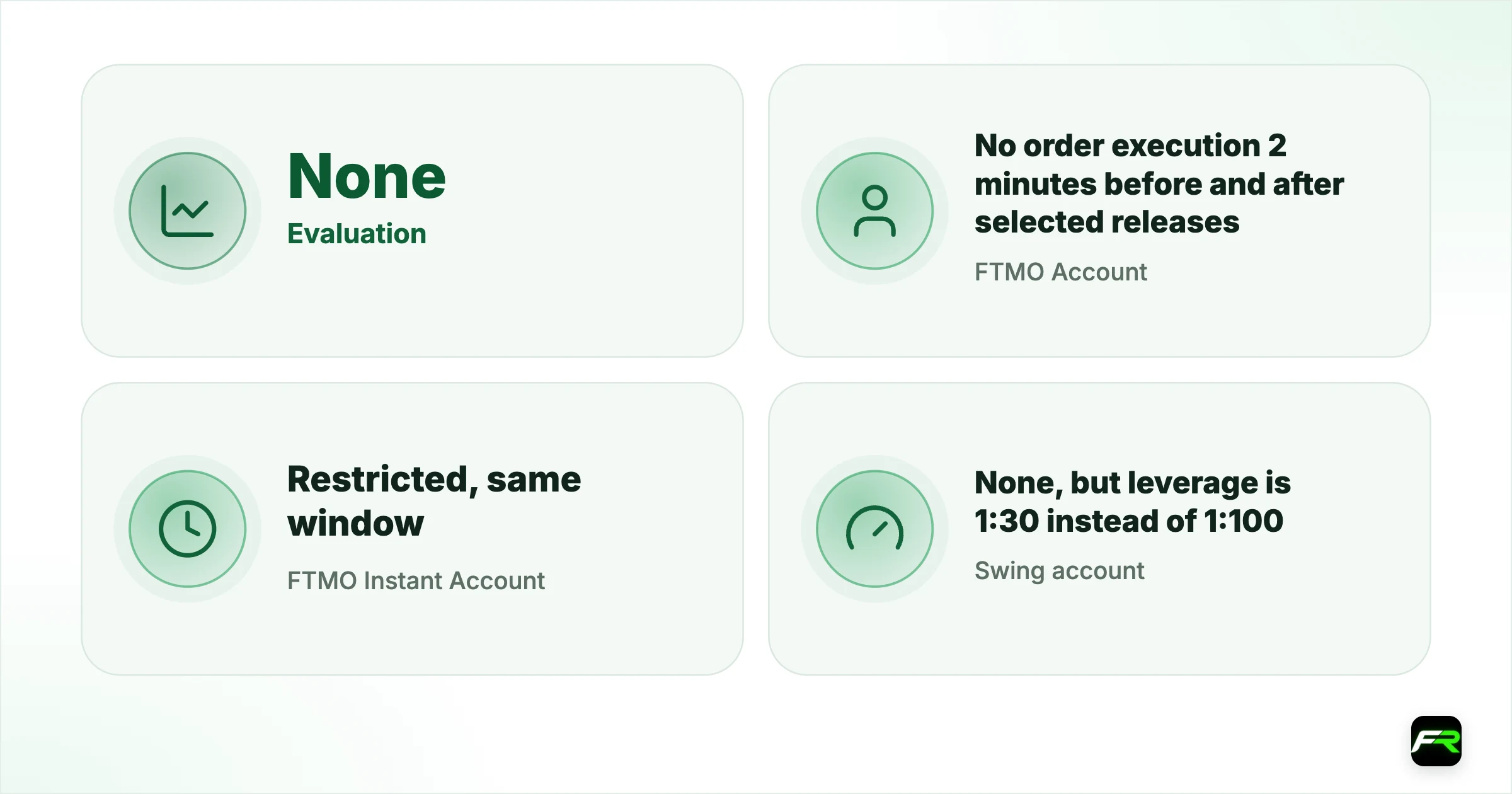
FTMO publishes its rule in full. On a funded FTMO Account it restricts order execution from 2 minutes before to 2 minutes after selected news releases. Three details matter:
- It covers any execution, including your stop loss, take profit and pending orders. A stop that triggers inside the window counts.
- Only the affected instruments are restricted. A US release restricts dollar pairs and related markets; FTMO says trading non-targeted instruments is not restricted.
- Positions opened earlier can stay open if they were opened more than 2 minutes before the release.
| Account | News restriction at FTMO |
|---|---|
| Evaluation (Challenge, Verification) | None |
| FTMO Account (Standard) | No order execution 2 minutes before and after selected releases |
| FTMO Instant Account | Restricted, same window |
| Swing account (2-Step only) | None, but leverage is 1:30 instead of 1:100 |
FTMO marks the affected releases as “Restricted event” on its economic calendar. They include rate decisions and major data from the US, eurozone, UK, Canada, Australia, New Zealand and Switzerland, plus US crude oil inventories. Breaking the rule may end the funded account.
Watch this on video
How to Use an Economic Calendar, in 3:00
Two seconds of data can move a currency. Here's how to read an economic calendar before it catches you out.
The trap: passing with a strategy you cannot keep
Because the evaluation at FTMO has no news restriction, a trader can pass using a news strategy that is not allowed once funded. Plan for the funded rules from day one, or choose a Swing account if news trading is central to your method and you can live with lower leverage.
Other firms
News rules vary more than almost any other rule: some firms have none, some use a wider window, some apply it in the evaluation too, and some ban only certain strategies around news rather than all trading. Read the rule on the exact plan you are buying, and check whether it names your stop loss.
Staying on the right side
- Check the firm’s economic calendar each morning for restricted events on the instruments you trade.
- Close or leave positions alone well before the window; do not place or adjust orders inside it.
- Move stops and targets away from levels that could be hit inside the window, or flatten before it.
- Trade instruments not tied to the release if you want to stay active.
Our economic calendar shows the week’s high-impact releases in your own time zone.
Which releases usually count
Firms publish their own lists, but the releases that tend to be restricted are the scheduled, high-impact ones:
| Type | Examples | Instruments usually affected |
|---|---|---|
| Central bank decisions | Fed, ECB, Bank of England, Bank of Canada, RBA, RBNZ, SNB rate decisions | The currency and related pairs and indices |
| Employment data | US non-farm payrolls | USD pairs, US indices, gold |
| Inflation data | US CPI and similar releases elsewhere | The currency’s pairs |
| Energy inventories | US crude oil inventories | Oil |
FTMO marks restricted events on its economic calendar and restricts only instruments tied to the affected currency or asset. Check your firm’s own list rather than assuming.
Holding through news vs trading news
Two behaviours are often confused. Trading news means opening or closing positions around the release to catch the move. Holding through news means a position opened earlier simply stays open. At FTMO a position opened more than two minutes before a restricted event may stay open, but any execution inside the window, including a stop or target being hit, breaks the rule. So a position held through news must have its stop and target far enough away that neither can trigger inside the window, or it should be closed beforehand.
Slippage and gaps around releases
Even on accounts with no news restriction, releases are where loss limits are most often breached unexpectedly. Prices can jump past a stop, spreads widen, and a daily limit measured on equity can be hit by a single spike. Many experienced prop traders simply stand aside for a few minutes either side of major data, whatever the rules allow.
A trader holds a EUR/USD long from the morning on a funded Standard account, with a stop 15 pips below. US inflation data comes out, the pair drops 25 pips in the first minute, and the stop fills one minute after the release. The position was opened hours earlier, but the stop executed inside the restricted window, which breaks the rule.
Set a calendar alert ten minutes before each restricted event for the instruments you trade, and decide then whether to close or widen.
Related guides
News rules interact with loss limits and account types; these guides cover both.
- The daily loss limit: how it is measured, why equity counts and how to stay inside it.
- EA and automation rules: what firms allow, what they ban and how to run an EA safely.
- Forex vs futures prop: instruments, sizing, costs and drawdown types compared.
- FTMO review: rules, payouts and who it suits.
A news-day routine
- Morning: list the day’s restricted releases for your instruments.
- Before each release: decide to close, hold with distant stops, or switch to an unaffected instrument.
- During the window: place, modify or close nothing on affected instruments.
- After: wait for spreads to settle before new trades.
The routine takes a minute and removes the most common way funded accounts are lost on news days.
Key terms
| Term | Meaning |
|---|---|
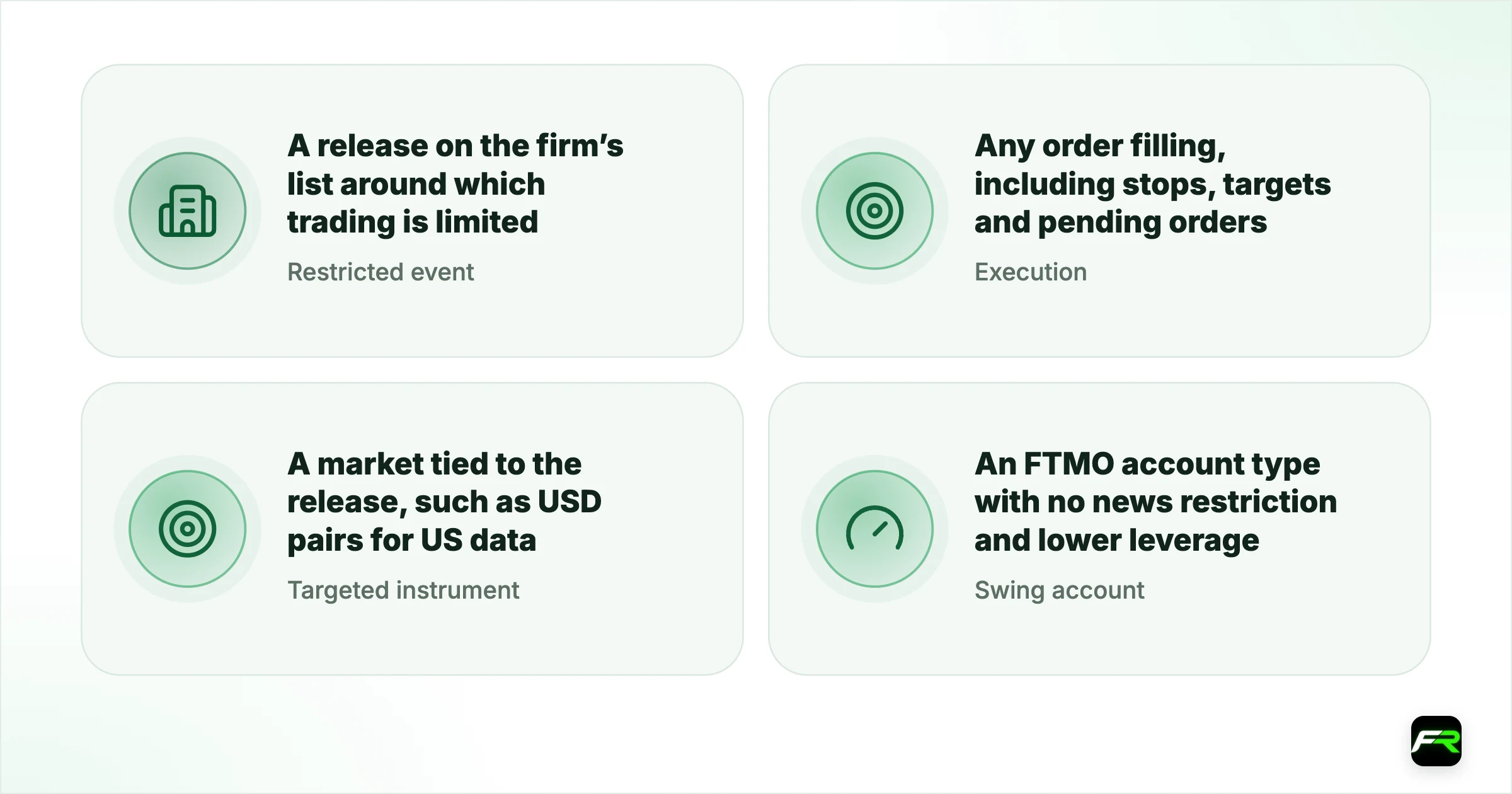
| Restricted event | A release on the firm’s list around which trading is limited |
| Execution | Any order filling, including stops, targets and pending orders |
| Targeted instrument | A market tied to the release, such as USD pairs for US data |
| Swing account | An FTMO account type with no news restriction and lower leverage |
Cite this guide
FX Recap, "Prop Firm News Trading Rules: What Is Actually Banned", updated 14 October 2026, https://fxrecap.com/prop-trading/prop-firm-news-trading-rules
Free to quote with a link. Journalists: data and comment in our press room.
Frequently asked
Can you trade news with a prop firm?
Often during the evaluation, less often on the funded account. FTMO, for example, has no news restriction in the Challenge or Verification but restricts order execution 2 minutes before and after selected releases on a funded Standard account.
Does a stop loss count as trading during news?
At FTMO, yes. The restriction covers any order execution, including stop losses, take profits and pending orders, so a stop that triggers inside the window breaks the rule.
Which news is restricted?
Firms name their own list. FTMO restricts selected releases from the US, eurozone, UK, Canada, Australia, New Zealand and Switzerland, plus US crude oil inventories, and marks them as restricted on its calendar. Only instruments tied to the release are affected.
Is there a prop account with no news restriction?
At FTMO, the Swing account type on the 2-Step Challenge has no news restriction and allows holding over weekends, but its leverage is 1:30 instead of 1:100.
Can I hold a position through news at FTMO?
On a Standard funded account, a position opened more than two minutes before a restricted event can stay open, but no order may execute in the two minutes either side, including your stop or target.
Which news events do prop firms restrict?
Usually scheduled high-impact releases such as central bank decisions, US payrolls and inflation data, and crude oil inventories. Each firm publishes its own list.
Related reading
The team behind this guide
Researched, checked and approved by five forex specialists
Every guide is written, fact-checked and edited before it goes live, and updated when the facts change. Spotted an error? Tell us.