 IC Markets

 3:09
 2:39
 2:10
 2:18
 3:43
 8:42





































Prop Firm Reset and Add-On Fees, Explained
Resets, extensions and paid add-ons can double what a challenge costs. Here is what each one buys, and when it is worth paying for.
 WriterAbir KhanWriterWrites the guides · checks every figure against primary sources View profileAbout Abir →

 Market analysisTanbir Habib RiyadForex & Crypto AnalystForex and crypto analyst · technical and fundamental analysis View profileAbout Tanbir →

 Fact-checking & riskJannatul FerdaushFact-Checker & Risk AnalystFact-checks every figure · risk analysis · Applied Statistics, University of Dhaka View profileAbout Jannatul →

 Trading reviewJowel RanaForex TraderForex trader · reviews guides from a trader's view View profileAbout Jowel →

 Final approvalRanjan N. MondolForex TraderForex trader · signs off every guide View profileAbout Ranjan →

The challenge fee is rarely the whole bill. Firms sell resets after a failure, and add-ons at checkout that change the rules in your favour. Each one makes sense on its own; together they can cost more than the challenge.
Resets
A reset restarts a failed challenge, usually at a discount to a new one. It saves a little money, but it also makes it very easy to buy attempt after attempt without stopping to work out why the last one failed. Treat a reset as a new challenge, and buy it only after the review in our what to do after failing guide.
Some firms make resets less necessary. FTMO sets no time limit on its challenges, so there is no reset for running out of time, and it offers free trials to practise its rules before paying.
Common add-ons
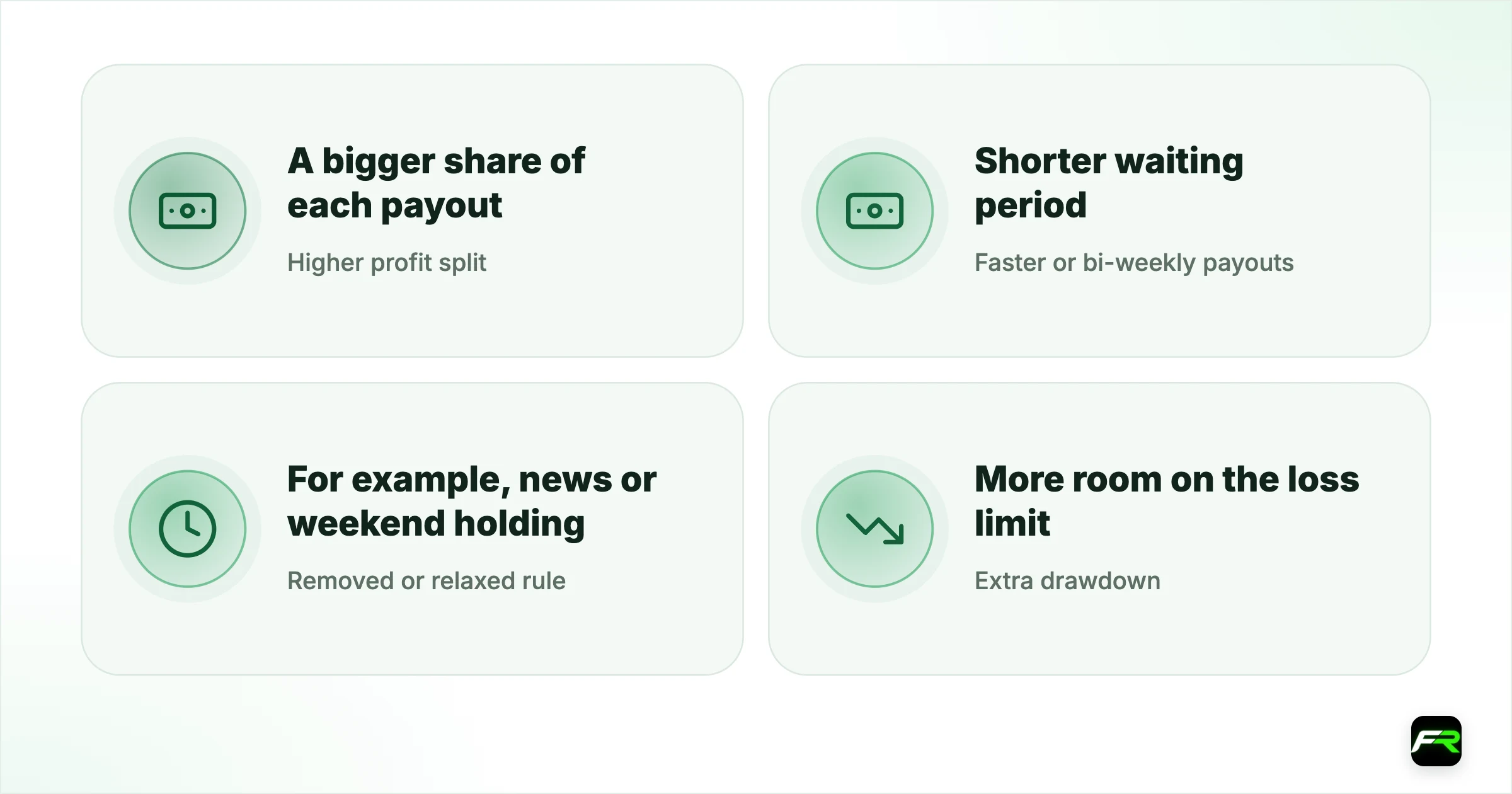
| Add-on | What it buys | When it is worth it |
|---|---|---|
| Higher profit split | A bigger share of each payout | Only if you expect several payouts |
| Faster or bi-weekly payouts | Shorter waiting period | Rarely; the first payout is the one that matters |
| Removed or relaxed rule | For example, news or weekend holding | If your method genuinely needs it |
| Extra drawdown | More room on the loss limit | If your normal losing days sit close to the limit |
| Refundable fee | Fee back with the first payout | Usually worth it if you expect to pass |
How to decide
- Add up the full price: fee, add-ons and a realistic number of resets.
- Compare that with a plan whose standard rules already suit you, such as a firm whose base plan allows the trading you do.
- Pay for add-ons that change whether you pass or get paid, not ones that only change how much you are paid.
- Skip add-ons on your first attempt at a new firm; buy them once you know the rules fit.
A swing trader holds over weekends. At one firm the base plan bans it and a weekend add-on costs 20 per cent extra. At FTMO the Swing account type on the 2-Step allows holding and news trading, at lower leverage (1:30 instead of 1:100), without an add-on. Choosing the plan whose standard rules fit is cheaper than buying the fix.
Discount codes and “last chance” reset offers are timed for the moment after a failure. Decide on resets the next day, not in the same hour.
A worked total-cost comparison
Add-ons and resets are easiest to judge as a total over the attempts you expect to need.
Plan A costs $300 with no add-ons. Plan B costs $300 plus a $60 add-on for extra drawdown and a $45 add-on for a higher split, so $405. A trader who expects two attempts pays $600 on Plan A or $810 on Plan B. Plan B is only worth it if the extra drawdown lifts their pass rate enough to save an attempt, which their demo record should show before they pay.
Monthly subscriptions and resets
Some futures firms charge a monthly subscription for the evaluation instead of a one-time fee. Topstep’s Trading Combine works this way. On a subscription, time is cost: every month you spend trying adds a fee, and resets are a separate charge. On a one-time plan with no time limit, such as FTMO’s, waiting for good setups costs nothing extra. Factor this into your choice if you expect to take months to pass.
Questions to ask before buying any add-on
- Does it change whether I pass or get paid, or only how much I am paid?
- Would a different base plan give me the same thing without paying extra?
- Is the add-on refunded with the challenge fee, or never?
- Does it apply only to this account, or carry over to resets and the funded stage?
Discount codes and timing
Firms run frequent promotions, and codes are widely shared by affiliates. A discount on the fee is genuine value; a discount that is only available on a bundle with add-ons may not be. Compare the final price against the base plan on the firm’s own site, and do not buy because a timer is running.
- Check the price on the firm’s own checkout, not an affiliate’s screenshot.
- Read whether the discount also applies to resets.
- Ignore codes bundled with outside “pass” services, which most firms ban.
Buying add-ons to make a challenge feel safer is a sign the plan does not suit you. Choose a plan whose standard rules fit your trading instead.
How firms design their add-ons
Add-ons are priced so that most buyers pay more than they gain. That is not a trick; it is how optional extras work. An add-on is worth buying only if you know, from your own demo record, that it changes your outcome:
- Extra drawdown helps if your normal losing days come close to the standard limit.
- A removed news restriction helps only if your method trades news.
- A higher split helps only once you are being paid regularly.
- A refundable fee helps if you expect to pass and be paid.
If you cannot point to the trades the add-on would have saved, do not buy it. Use the money for a smaller account instead, or for a second attempt if you need one.
For the wider cost picture, including pass rates, see the real cost of getting funded.
Related guides
Resets and add-ons are one part of the total cost of prop trading, alongside fees and pass rates.
- The real cost of funding: fees divided by your chance of passing.
- Cheapest challenges: real prices and how to compare them per $1,000.
- After failing a challenge: finding the cause and deciding whether to retry.
- One-step vs two-step: which format suits your losing and winning days.
Cite this guide
FX Recap, "Prop Firm Reset and Add-On Fees, Explained", updated 14 October 2026, https://fxrecap.com/prop-trading/prop-firm-reset-and-add-on-fees
Free to quote with a link. Journalists: data and comment in our press room.
Frequently asked
What is a prop firm reset?
A paid restart of a failed challenge, usually cheaper than buying a new one. It is only worth buying once you know why the last attempt failed and have fixed it.
Are prop firm add-ons worth it?
Some are. Add-ons that change whether you pass or get paid, such as extra room on a loss limit your normal trading approaches, can be worth it. Higher splits and faster payouts matter only once you are being paid regularly.
Does FTMO charge for resets?
FTMO sets no time limit on its challenges, so you cannot fail by running out of time, and it offers free trials. A failed challenge still means buying a new one.
How do I keep the total cost down?
Choose a plan whose standard rules already fit your trading, start with a smaller account, prefer refundable fees, and set a budget for attempts before you begin.
Are prop firm resets cheaper than a new challenge?
Usually yes, but they are still a new attempt. Buy one only after reviewing why the last attempt failed and testing the fix.
Is a monthly subscription evaluation worse than a one-time fee?
It depends how long you take to pass. A subscription, such as Topstep's Combine, adds a fee every month; a one-time fee with no time limit, such as FTMO's, does not.
Should I use a discount code for a prop challenge?
Codes can save money, but check the final price on the firm's own checkout and ignore bundles with add-ons or outside services you do not need.
Related reading
The team behind this guide
Researched, checked and approved by five forex specialists
Every guide is written, fact-checked and edited before it goes live, and updated when the facts change. Spotted an error? Tell us.