 IC Markets

 3:09
 2:39
 2:10
 2:18
 3:43
 8:42





































Are Prop Firms Getting Regulated? The 2026 Picture
As of October 2026 we know of no regulator with rules written specifically for retail prop firms. What regulators have done instead is warn, investigate and sue.
 WriterAbir KhanWriterWrites the guides · checks every figure against primary sources View profileAbout Abir →

 Market analysisTanbir Habib RiyadForex & Crypto AnalystForex and crypto analyst · technical and fundamental analysis View profileAbout Tanbir →

 Fact-checking & riskJannatul FerdaushFact-Checker & Risk AnalystFact-checks every figure · risk analysis · Applied Statistics, University of Dhaka View profileAbout Jannatul →

 Trading reviewJowel RanaForex TraderForex trader · reviews guides from a trader's view View profileAbout Jowel →

 Final approvalRanjan N. MondolForex TraderForex trader · signs off every guide View profileAbout Ranjan →

Retail prop firms sit in a gap. They sell evaluations and pay rewards on mostly simulated accounts, so they do not fit neatly into the rules for brokers, fund managers or investment advisers. As of October 2026, we are not aware of any major regulator with a licence or rulebook written specifically for them. That does not mean they are ignored.
What regulators have actually done
| Regulator | Action | When |
|---|---|---|
| CFTC (US) | Sued My Forex Funds; the case was later recommended for dismissal as a sanction against the CFTC | 2023 to 2025 |
| Ontario Securities Commission (Canada) | Parallel proceeding against the same firm, with asset freeze directions | 2023 to 2024 |
| CFTC (US) | Lists “the opportunity to trade with a proprietary trading firm’s money and share the profits” among common features of forex fraud schemes | Current guidance |
| FCA (UK) | Warning that a firm called “Funded Trader” (funded-trader.net) is not authorised and may be targeting people in the UK | 12 August 2025 |
The pattern is clear: regulators act against particular firms, through fraud law, unauthorised-business warnings and asset freezes, rather than through a licensing regime for the sector. Our guide to the My Forex Funds case shows how disruptive that can be, whatever the outcome.
Why it is hard to regulate
- The trading is simulated, so there may be no client money in a market to protect.
- Firms operate across borders, from one country to customers in many others.
- The product looks partly like an education service, partly like a game and partly like a financial service.
- Futures firms route funded traders to exchanges that are regulated, while the evaluation itself is not.
What “regulated prop firm” usually means today
When a prop firm says it is regulated, it usually means a sister company in its group holds a broker licence. That protects clients of the broker, not necessarily your challenge or payout. See regulated prop firms for how to check which company your contract is with.
What could change
- More warnings against individual firms, especially those targeting a country’s residents without a local licence.
- Rules on marketing to retail customers, as already exist for CFDs in many countries.
- Requirements around identity checks, payment processing and disclosure of simulated trading.
- Some firms moving inside licensed broker groups to get ahead of rules.
Until rules arrive, the protection is your own diligence: a long payout record, clear terms, a named company, and payouts taken early. See how to check a firm pays.
Check your own country’s regulator. Some regulators publish warnings naming unauthorised firms; a firm on such a list is one to avoid.
Who could regulate prop firms
Depending on the country, several kinds of authority have a claim on parts of the prop model:
| Authority | Possible angle |
|---|---|
| Securities and derivatives regulators (CFTC, FCA, ASIC, SEC Nigeria and others) | Whether challenges amount to offering leveraged trading or investment services |
| Central banks and exchange control | Payments abroad for trading, as in the RBI and SBP rules |
| Consumer protection agencies | Marketing, fees, refunds and unfair terms |
| Tax authorities | How payouts and fees are treated |
This spread is one reason no single rulebook has appeared: the model touches several regulators’ areas without fitting squarely into any one.
Country positions we have checked
- India: the RBI’s Alert List names FTMO, Smart Prop Trader and FundedNext among entities not authorised to deal in forex under FEMA. See prop trading in India.
- Pakistan: the State Bank’s 2022 circular says remittances to offshore forex, margin and CFD platforms are not allowed. See prop trading in Pakistan.
- Nigeria: the SEC said in 2018 that online retail forex trading is unregulated, and has proposed rules for online forex and CFD brokers. See prop trading in Nigeria.
- United States: the CFTC case against My Forex Funds, recommended for dismissal as a sanction against the CFTC. See the case explained.
What firms are doing in the meantime
Without a rulebook, the better firms have moved to practices that make them easier to defend: stating clearly that accounts are simulated, naming their legal entities, verifying identity early, publishing rules in full, and in some cases operating inside licensed broker groups. FundedNext’s site, for example, says it is not a broker, dealer, exchange or investment adviser and that participants do not trade real assets.
When reading a firm’s legal pages, look for three statements: that trading is simulated, which company you contract with, and which countries it does not serve. Their absence is itself a signal.
Related guides
For the cases behind this picture and how to protect yourself, see these guides.
- The My Forex Funds case: the court record, step by step.
- Regulated prop firms: what “regulated” usually means and how to check it.
- Firms that shut down: the closures so far and the pattern behind them.
- Scams and red flags: warning signs before you pay and after you are funded.
How to stay informed
- Check your own regulator’s warnings and news page every few months.
- Read the legal pages of the firm you use when they change; firms often update terms as rules shift.
- Watch for changes in which countries a firm serves, which often follow regulatory pressure.
- Follow official sources, not social media summaries, for any enforcement news.
We update our country guides and this page when regulators publish new positions, citing their own documents.
Key terms
| Term | Meaning |
|---|---|
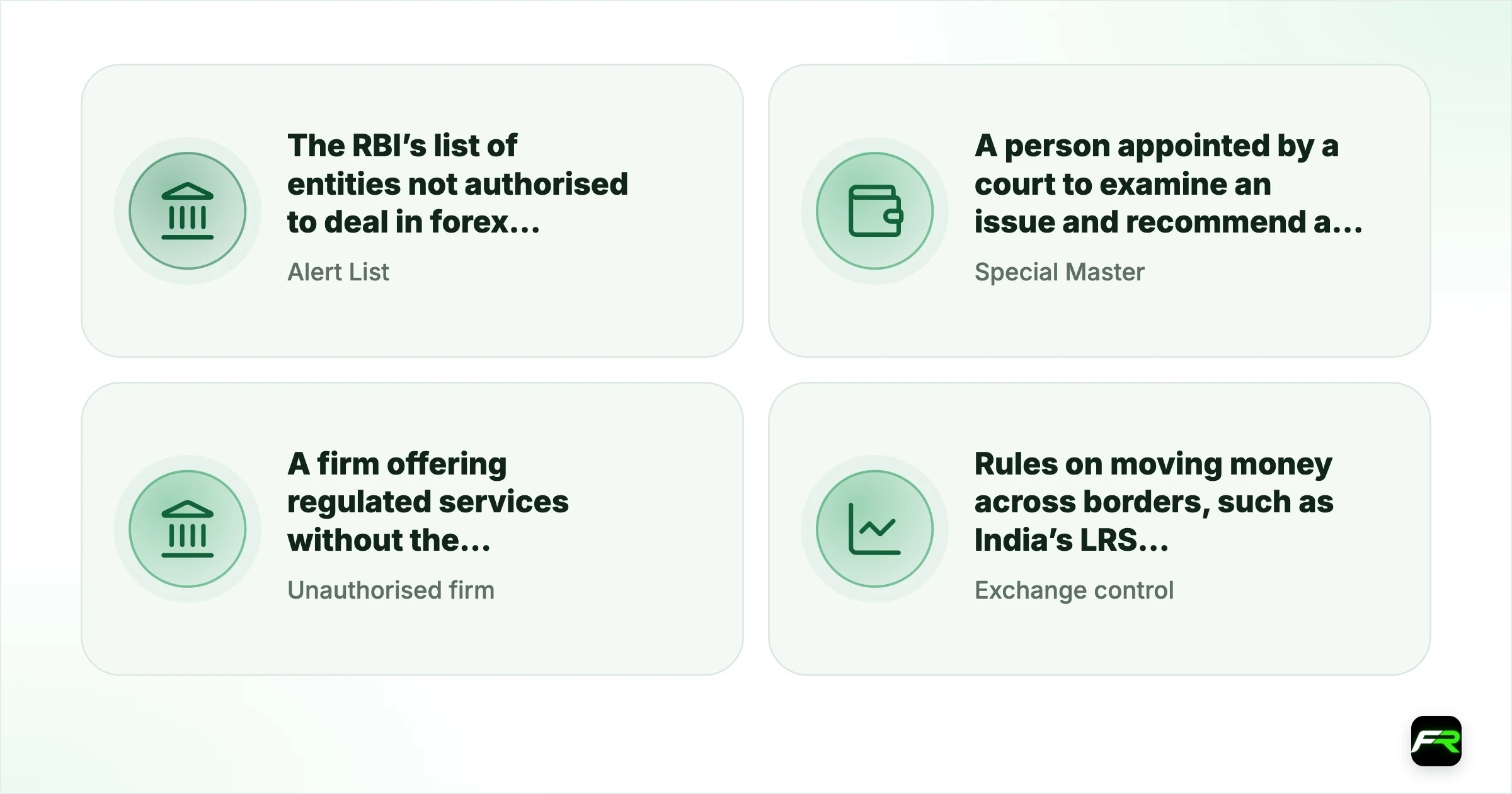
| Alert List | The RBI’s list of entities not authorised to deal in forex under FEMA or run forex trading platforms |
| Special Master | A person appointed by a court to examine an issue and recommend a decision, as in the My Forex Funds case |
| Unauthorised firm | A firm offering regulated services without the regulator’s permission, as the FCA warns |
| Exchange control | Rules on moving money across borders, such as India’s LRS or Pakistan’s FERA |
Cite this guide
FX Recap, "Are Prop Firms Getting Regulated? The 2026 Picture", updated 14 October 2026, https://fxrecap.com/prop-trading/are-prop-firms-getting-regulated
Free to quote with a link. Journalists: data and comment in our press room.
Frequently asked
Are prop firms regulated?
Mostly not as prop firms. As of October 2026 we know of no major regulator with a licence written specifically for retail prop firms. Some belong to groups whose broker arm is regulated, which protects the broker's clients rather than your challenge.
Have regulators taken action against prop firms?
Yes, against particular firms. The US CFTC sued My Forex Funds in 2023, Ontario's securities regulator ran a parallel proceeding, and the UK FCA has warned about at least one unauthorised firm calling itself Funded Trader.
Does the CFTC warn about prop firms?
Its forex fraud guidance lists the opportunity to trade with a proprietary trading firm's money and share the profits among common features of forex fraud schemes. That does not mean every prop firm is a fraud, but it is a reason for care.
How can I protect myself without regulation?
Choose firms with a long, dated payout record, clear published terms and a named legal entity, check your regulator's warning list, and take payouts early.
Will prop firms be regulated soon?
We cannot predict timing. So far regulators have acted against particular firms and payment routes rather than creating a licence for the sector, and several different kinds of authority have a possible role.
Which countries restrict prop trading?
Of those we have checked, India's RBI names several prop firms on its Alert List and Pakistan's State Bank says remittances to offshore forex and CFD platforms are not allowed. Check your own country's regulator.
Related reading
The team behind this guide
Researched, checked and approved by five forex specialists
Every guide is written, fact-checked and edited before it goes live, and updated when the facts change. Spotted an error? Tell us.