 IC Markets

 3:09
 2:39
 2:10
 2:18
 3:43
 8:42





































The My Forex Funds Case and What It Changed
The biggest regulatory action against a prop firm so far ended with the regulator sanctioned. What happened, step by step, from the court records, and what it means for traders.
 WriterAbir KhanWriterWrites the guides · checks every figure against primary sources View profileAbout Abir →

 Market analysisTanbir Habib RiyadForex & Crypto AnalystForex and crypto analyst · technical and fundamental analysis View profileAbout Tanbir →

 Fact-checking & riskJannatul FerdaushFact-Checker & Risk AnalystFact-checks every figure · risk analysis · Applied Statistics, University of Dhaka View profileAbout Jannatul →

 Trading reviewJowel RanaForex TraderForex trader · reviews guides from a trader's view View profileAbout Jowel →

 Final approvalRanjan N. MondolForex TraderForex trader · signs off every guide View profileAbout Ranjan →

My Forex Funds was one of the largest retail prop firms when the US Commodity Futures Trading Commission (CFTC) sued it in 2023. The case froze the business, and two years later a court-appointed Special Master recommended that it be thrown out because of how the CFTC had conducted it. Both halves matter to anyone buying a challenge today.
The timeline, from the court record
| When | What happened |
|---|---|
| August 2023 | The CFTC sued Murtuza Kazmi and Traders Global Group Inc., which traded as My Forex Funds, in federal court in New Jersey. The court issued a statutory restraining order freezing the defendants’ assets and appointing a temporary receiver. The CFTC said more than 135,000 customers had signed up since November 2021, paying at least $310 million in fees. |
| Same period | The Ontario Securities Commission brought a parallel proceeding in Canada, with its own freeze directions. |
| 14 November 2023 | The New Jersey court granted the CFTC’s preliminary injunction only in part and reduced the asset freeze. It gave “no weight” to a $31,550,000 transfer the CFTC had described as going to an “unidentified Kazmi account”. |
| 30 April 2025 | Special Master Jose L. Linares, a retired federal judge, recommended that the complaint be dismissed with prejudice as a sanction, and that the defendants be awarded their legal fees for the sanctions motion. His report was filed on 13 May 2025. |
| 14 July 2025 | The court docket shows the case as terminated. |
What the Special Master found
The report centred on that $31.5 million entry. The Special Master found that the CFTC knew the entry in a sworn declaration was wrong and, rather than correct it openly, “took deliberate steps down a path of obfuscation and avoidance”. He called the conduct “willful and undertaken in bad faith” and said it likely affected the court’s decision to freeze the firm’s assets.
We have read the Special Master’s report, which the CFTC published on its own site, and the court’s 2023 opinion. We have not seen the text of the final order closing the case, so we describe the outcome as the docket records it.
What it means for traders
- Regulatory action is a risk in itself. The firm’s assets were frozen and a temporary receiver appointed in 2023, long before any court decided whether the allegations were right.
- The legal status of the prop model is unsettled. The case ended on the regulator’s conduct, not on a ruling about whether retail prop trading needs a licence.
- Diversify and withdraw. A large balance waiting at one firm is exposed to anything that freezes that firm, whoever is right.
What changed afterwards
The case pushed the better firms towards practices that make them harder to attack: identity checks at sign-up, published rules, dated payout records, named legal entities and separation of client money. Their absence is now a warning sign; see prop firm red flags and prop firms that have shut down.
This page summarises court documents for traders. It is not legal advice, and it makes no finding about the conduct of anyone involved beyond what the documents record.
Why the case matters beyond one firm
- It was the largest public enforcement action against a retail prop firm so far.
- It showed that a regulator can freeze a prop firm’s business quickly through an asset freeze and receivership.
- It ended on the regulator’s conduct, so it did not settle the legal status of the model.
- It changed industry practice, with more firms verifying identity early and publishing rules in full.
The Canadian side
The court records also show a parallel proceeding by the Ontario Securities Commission, with freeze directions on assets in Canada and receivership proceedings before an Ontario court. In January 2024 the New Jersey court said it had no objection to an overlapping freeze agreed by the parties, and asked to be told if the Ontario court rejected it. Traders with exposure to a firm in more than one country should expect any legal process to be split across jurisdictions in the same way.
Reading court documents yourself
- Start with the regulator’s press release, then the complaint, which states the allegations.
- Look for opinions and orders, which state what the court decided.
- Distinguish allegations from findings: a complaint alleges, a court decides.
- Check the docket for the case’s status and closing date.
We used this approach for this page: the CFTC’s press release and complaint, the court’s November 2023 opinion and January 2024 letter order on govinfo.gov, and the Special Master’s report published by the CFTC.
Allegations in a complaint are not findings. In this case the court never ruled on whether the CFTC’s allegations were true; it was the CFTC’s conduct that led to the recommendation to dismiss.
Key terms
| Term | Meaning |
|---|---|
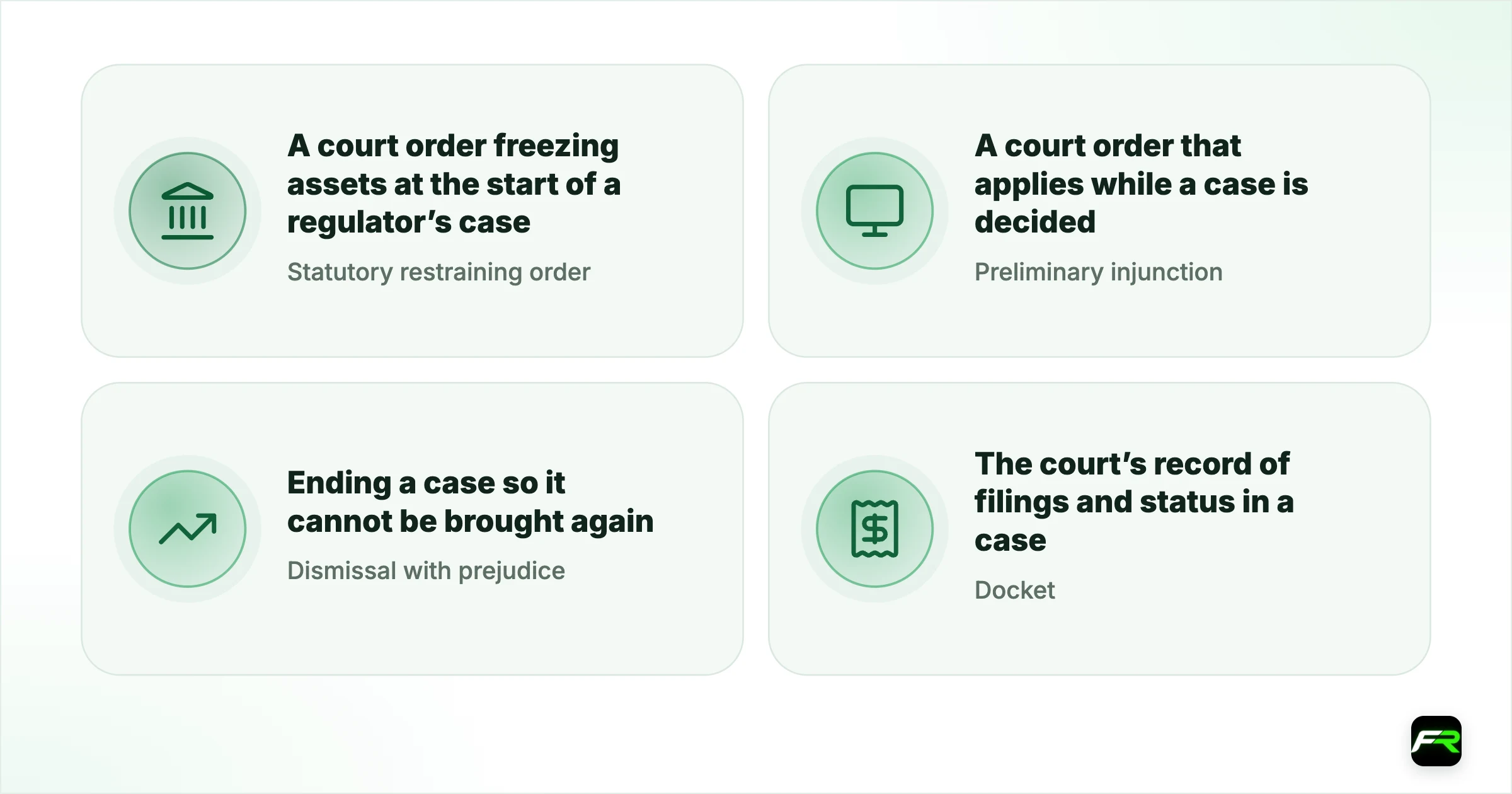
| Statutory restraining order | A court order freezing assets at the start of a regulator’s case |
| Preliminary injunction | A court order that applies while a case is decided |
| Dismissal with prejudice | Ending a case so it cannot be brought again |
| Docket | The court’s record of filings and status in a case |
Related guides
For the wider picture, see these guides.
- Prop firm regulation: what regulators have actually done so far.
- Firms that shut down: the closures so far and the pattern behind them.
- If a firm closes: what you lose, what you can do and how to limit the risk.
- Regulated prop firms: what “regulated” usually means and how to check it.
The short version
The CFTC froze My Forex Funds in 2023 on fraud allegations; in 2025 a Special Master recommended dismissing the case because of the CFTC’s own conduct, and the docket shows it closed. The lessons for traders are about exposure: regulatory action can freeze a firm whoever is right, so keep balances small and payouts regular.
Cite this guide
FX Recap, "The My Forex Funds Case and What It Changed", updated 14 October 2026, https://fxrecap.com/prop-trading/the-my-forex-funds-case-explained
Free to quote with a link. Journalists: data and comment in our press room.
Frequently asked
What happened to My Forex Funds?
The US CFTC sued it in federal court in New Jersey in August 2023, and the court froze its assets. In April 2025 a court-appointed Special Master recommended dismissing the case with prejudice as a sanction for the CFTC's conduct, and the docket shows the case terminated in July 2025.
Why was the CFTC case against My Forex Funds dismissed?
The Special Master found that the CFTC knew a $31.5 million entry in a sworn declaration was wrong and did not correct it openly, calling its conduct willful and in bad faith, and recommended dismissal with prejudice as a sanction.
How many traders did My Forex Funds have?
The CFTC said more than 135,000 customers had signed up since November 2021, paying at least $310 million in fees.
Does the outcome mean prop firms are legal?
Not directly. The case ended on the regulator's conduct, not on a ruling about whether retail prop firms need a licence, so the legal position remains unsettled.
Was My Forex Funds found guilty of fraud?
No court ruled on the CFTC's fraud allegations. A Special Master recommended dismissing the case with prejudice because of the CFTC's conduct, and the docket shows the case closed in July 2025.
Was there a Canadian case against My Forex Funds?
Yes. Court records show a parallel Ontario Securities Commission proceeding, with freeze directions and receivership proceedings in Ontario.
Related reading
The team behind this guide
Researched, checked and approved by five forex specialists
Every guide is written, fact-checked and edited before it goes live, and updated when the facts change. Spotted an error? Tell us.