 IC Markets

 3:09
 2:39
 2:10
 2:18
 3:43
 8:42





































Best Prop Firms for Indian Traders
Prop trading is popular in India, and its legal position is untested. The choice comes down to payment rails, the market you trade, and the firm's payout record, not a ranking.
 WriterAbir KhanWriterWrites the guides · checks every figure against primary sources View profileAbout Abir →

 Market analysisTanbir Habib RiyadForex & Crypto AnalystForex and crypto analyst · technical and fundamental analysis View profileAbout Tanbir →

 Fact-checking & riskJannatul FerdaushFact-Checker & Risk AnalystFact-checks every figure · risk analysis · Applied Statistics, University of Dhaka View profileAbout Jannatul →

 Trading reviewJowel RanaForex TraderForex trader · reviews guides from a trader's view View profileAbout Jowel →

 Final approvalRanjan N. MondolForex TraderForex trader · signs off every guide View profileAbout Ranjan →

Prop firms have become a popular way for Indians to try leveraged trading. The firms are based abroad and run simulated evaluations, and no Indian regulator has issued rules on them yet, so their legal position has not been tested. The RBI does not allow remittances under the Liberalised Remittance Scheme for margin trading abroad, and whether a challenge fee counts has not been ruled on. Payouts are taxable in India; ask a tax adviser how to report them.
There is no single best firm. What actually separates them for an Indian trader is how you pay in and get paid, whether the firm is forex or futures first, and how long it has been paying traders.
The RBI Alert List of entities not authorised to deal in forex under FEMA or to operate forex trading platforms (updated 19 November 2025) names FTMO (no. 13), Smart Prop Trader (no. 82) and FundedNext (no. 83). The RBI says an entity that does not appear on the list should not be assumed to be authorised either. Check the current Alert List before paying any firm.
What matters from India
- Payment in. Most firms take cards and crypto. USDT and USDC are widely accepted and usually clear faster than a card from an Indian bank. A few offer UPI on some products.
- Payout out. Crypto payout is the common route. Confirm the firm pays to an Indian resident and to your chosen wallet or account before you buy.
- Forex or futures. Forex and CFD firms suit MT4 and MT5 traders. Futures firms trade CME products through a different platform and are a separate decision.
- Track record. In an unregulated sector, years of paid withdrawals is the strongest signal you can get.
The names Indian traders use most
This is a factual comparison for 2026, not a ranking. Terms change often, so treat the figures as a starting point and confirm the current rules on the firm's own site.
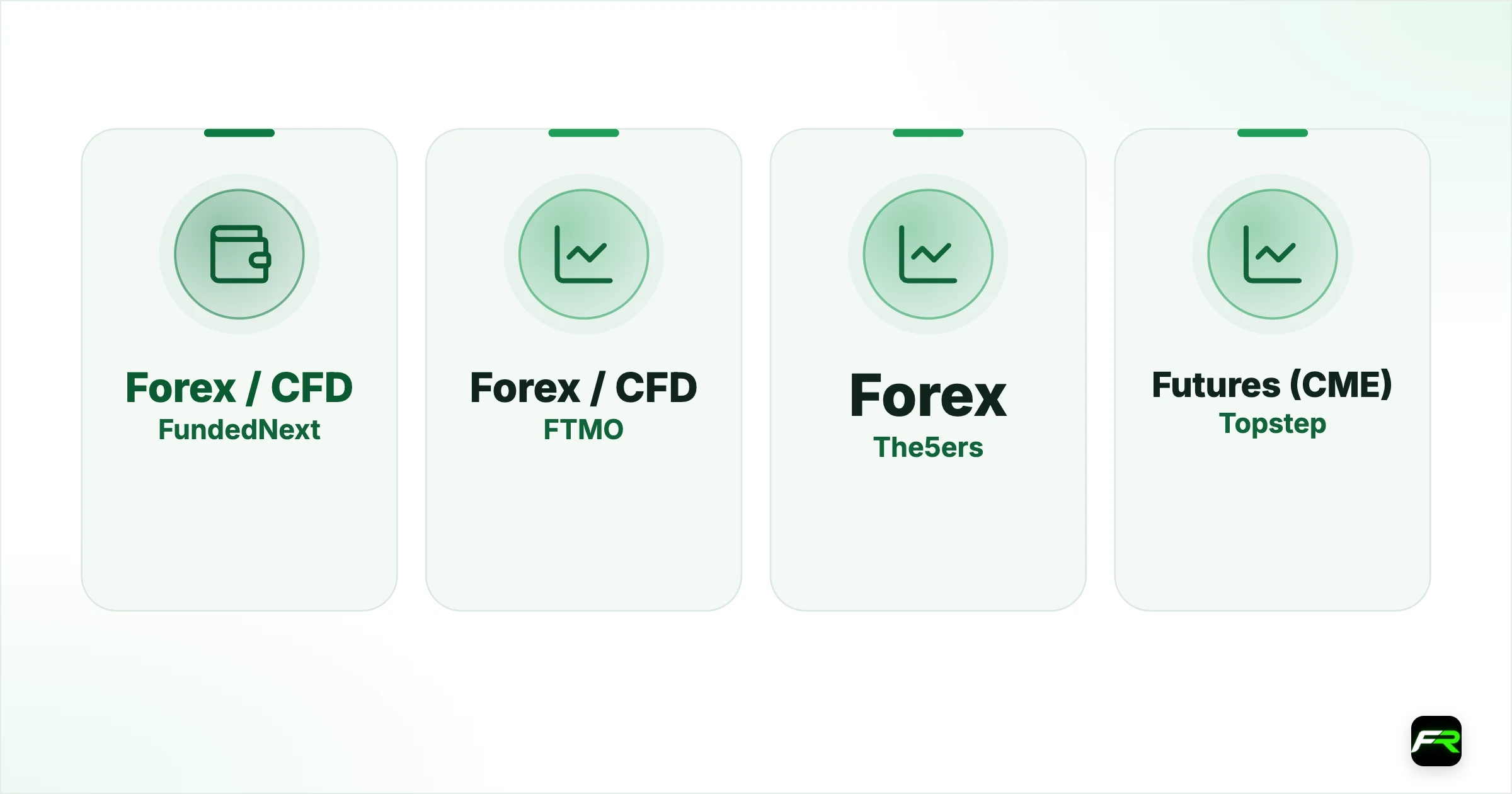
| Firm | Market | Since | Track record | Notes for India |
|---|---|---|---|---|
| FundedNext | Forex / CFD | 2022 | $393.4M+ total rewarded, per its site (October 2026) | Named on the RBI Alert List (no. 83); profit share during the evaluation |
| FTMO | Forex / CFD | 2015 | Over $650M paid in rewards | Named on the RBI Alert List (no. 13); one-step, two-step and instant accounts |
| The5ers | Forex | 2016 | Long payout history | Suits slower, consistency-driven traders; scaling up to $4 million |
| Topstep | Futures (CME) | 2012 | Longest record in futures | Over $1.5B paid out, per its site; check current pricing and rules |
| MyFundedFutures | Futures | Not stated on its site | $250M+ paid to traders, per its site | One-time payment, end-of-day or intraday drawdown by plan |
Ignore the affiliate "top 10 prop firms in India" lists that rank by commission. The order changes with the payout the site earns, not with which firm is safer. Use them only to collect names to check yourself.
Rohan trades forex on MT5 and had shortlisted two well-known firms. Before paying, he checked the RBI Alert List and found both named on it, read the RBI's LRS rules, which exclude remittances for trading in foreign exchange abroad, and decided to keep practising on a free demo account until he had taken advice on his position. The check cost nothing; skipping it could have cost him the fee and more.
The RBI's Liberalised Remittance Scheme allows resident individuals up to USD 250,000 a financial year for permitted purposes, and it excludes remittances for trading in foreign exchange abroad and for margins or margin calls to overseas exchanges or counterparties. Read prop trading in India before you pay any firm.
What the official sources say for India
- The RBI Alert List (updated 19 November 2025) names FTMO (entry 13), Smart Prop Trader (82) and FundedNext (83).
- The RBI says an entity not on the list should not be assumed to be authorised.
- The RBI’s LRS FAQ excludes remittances for trading in foreign exchange abroad and for margins or margin calls to overseas exchanges or counterparties.
- Indian residents can trade currency derivatives on Indian exchanges through SEBI-registered brokers.
These are the facts that matter most for an Indian reader, more than any firm’s rules or price. Our India guide explains them in detail.
A safer route for Indian traders
- Practise prop-style limits on a free demo account: 5 per cent daily and 10 per cent maximum loss.
- Build a three-month record inside those limits.
- Trade listed currency derivatives through a SEBI-registered broker if you want real-money experience.
- Take qualified advice before any payment to an offshore firm.
A trader in Hyderabad spends three months on a demo account under prop-style limits and ends with a 4 per cent gain and a worst day of −1.9 per cent. The record is the same skill a prop firm tests, built without any payment abroad.
Key terms
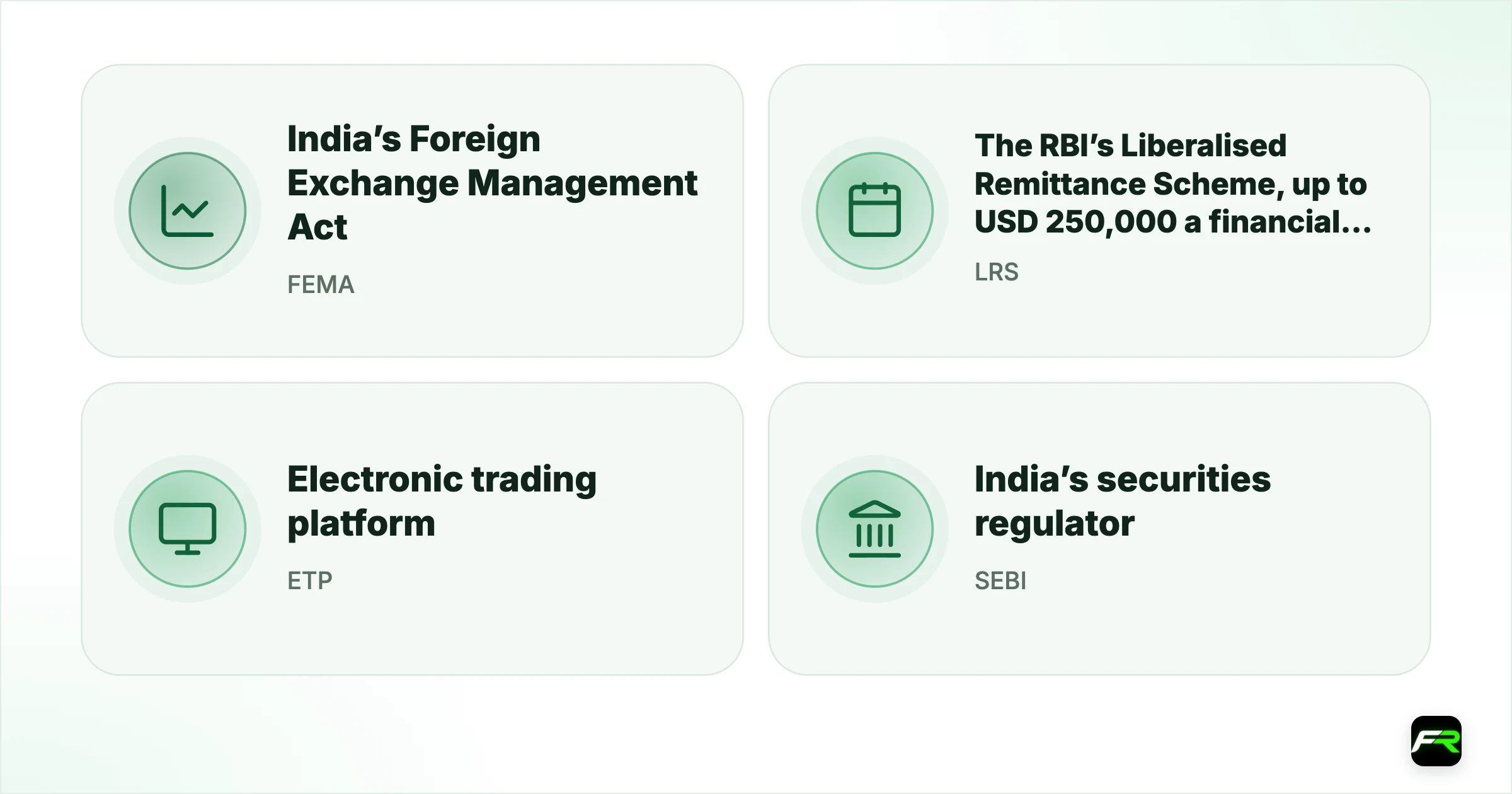
| Term | Meaning |
|---|---|
| FEMA | India’s Foreign Exchange Management Act |
| LRS | The RBI’s Liberalised Remittance Scheme, up to USD 250,000 a financial year |
| ETP | Electronic trading platform |
| SEBI | India’s securities regulator |
Related guides
For Indian readers, these guides give the wider context.
- Prop trading in India: the RBI Alert List and LRS rules.
- Prop firm regulation: what regulators have actually done so far.
- Is prop trading worth it?: an honest cost-benefit, with a self-test before you pay.
- How payouts are taxed: general principles and country starting points.
Cite this guide
FX Recap, "Best Prop Firms for Indian Traders", updated 9 September 2026, https://fxrecap.com/prop-trading/best-prop-firms-in-india
Free to quote with a link. Journalists: data and comment in our press room.
Frequently asked
Is prop trading legal in India?
It has not been tested. The firms operate from abroad and run simulated evaluations, and no Indian regulator has issued rules on them. The RBI does not allow Liberalised Remittance Scheme payments for margin trading abroad, and whether a challenge fee falls under that has not been ruled on. If you go ahead, keep payments small and your records complete.
Which prop firm is best for Indian traders?
There is no single best. For forex, FTMO has the longest payout record and FundedNext the lower entry fee. For futures, Topstep has the longest record and MyFundedFutures offers faster payout routes. Choose on payment rails, the market you trade, and payout history, not on an affiliate ranking.
How do Indian traders get paid by prop firms?
Crypto, usually USDT or USDC, is the common payout route and tends to be faster than a bank transfer. Some firms support local rails on certain products. Before buying a challenge, confirm the firm pays to an Indian resident and to your chosen wallet, because payout method problems are only discovered at withdrawal.
Do I pay tax on prop firm payouts in India?
Yes, payouts are taxable income in India. How they are classified and reported depends on your circumstances, so check with a tax adviser. Keep records of every fee paid and every payout received from the first challenge.
Which prop firms are on the RBI Alert List?
The list updated on 19 November 2025 names FTMO at entry 13, Smart Prop Trader at 82 and FundedNext at 83, among other entities.
What is a safer route for Indian traders interested in prop trading?
Practise prop-style limits on a free demo account, trade listed currency derivatives through a SEBI-registered broker for real-money experience, and take advice before paying any offshore firm.
Related reading
The team behind this guide
Researched, checked and approved by five forex specialists
Every guide is written, fact-checked and edited before it goes live, and updated when the facts change. Spotted an error? Tell us.